

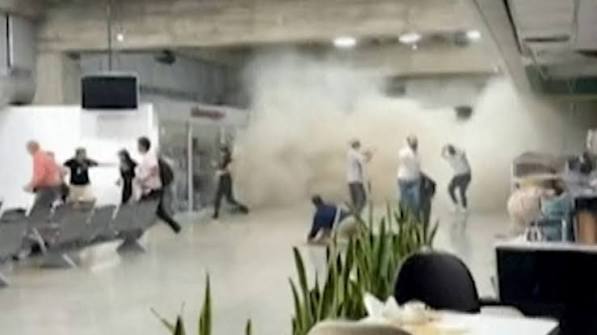

A powerful 7.4-magnitude earthquake struck western Colombia on Monday, August 10, 2026, sending passengers and airport staff scrambling as violent shaking swept through the terminal at Pereira Airport.
The earthquake was felt across large parts of Colombia, with reports of structural damage, collapsed buildings and casualties in several affected areas. Authorities began emergency inspections and rescue operations as communities assessed the extent of the destruction.
Pereira Airport Shaken by Violent Tremors
One of the most dramatic scenes unfolded at Pereira’s Matecaña International Airport, where passengers and airport workers were caught inside the terminal when the earthquake struck.
Video from inside the airport showed people rushing for safety as the building shook. The powerful movement caused panic among passengers and staff, with debris reportedly falling inside parts of the terminal.
The airport was temporarily affected as authorities carried out safety inspections following the earthquake. Pereira was among several airports in the region that faced operational disruptions after the quake.
Airports are particularly sensitive to earthquake damage because authorities must inspect terminals, runways, control facilities and other infrastructure before normal flight operations can safely resume.
Where Did the Earthquake Strike?
The earthquake struck western Colombia, with the epicentre reported near San José del Palmar in the Chocó department.
Colombia’s geological authorities have placed the earthquake at approximately magnitude 7.4. The quake was powerful enough to be felt across numerous departments and reportedly reached all 32 departmental capitals.
The depth of the earthquake also influenced how widely the shaking was experienced.
Tremors were reported far beyond the immediate epicentral area, including in major Colombian cities and parts of neighbouring countries.
Buildings Damaged Across Western Colombia
Pereira was among the areas reporting significant damage, while other cities including Cali, Manizales and Buenaventura were also affected.
Reports indicated that buildings collapsed in several locations, leaving people trapped and prompting emergency teams to begin search-and-rescue operations.
In Cali, more than two dozen structures were reported to have collapsed, with rescue teams working to reach people believed to be trapped beneath rubble. Emergency personnel were mobilised from other major cities to support the response.
Pereira reportedly suffered some of the highest casualties from the earthquake, while deaths and injuries were also reported in other affected cities. Because rescue operations were still underway, casualty and damage figures could change as authorities continue assessing affected areas.
Emergency Teams Begin Rescue Operations
The earthquake triggered a major emergency response across western Colombia.
Rescue workers, firefighters and other emergency personnel were deployed to damaged areas to search collapsed structures and assist residents.
Authorities also began inspecting critical infrastructure, including airports and buildings, to determine whether they remained safe for public use.
The response is particularly challenging in areas where buildings have collapsed or roads and other infrastructure have been damaged.
Emergency officials are also monitoring for possible aftershocks, which can cause additional damage to structures already weakened by a major earthquake.
Earthquake Felt Beyond Colombia
The powerful tremor was not limited to Colombia.
Shaking was also reported in neighbouring countries, including Ecuador and Panama, highlighting the strength and wide reach of the earthquake.
Despite the earthquake’s connection to the Pacific region, authorities did not issue a tsunami threat following the event.
Why the Pereira Airport Footage Is Drawing Attention
Videos from inside Pereira Airport quickly attracted attention online because they captured the intensity of the earthquake from the perspective of passengers and airport workers.
The footage shows people reacting almost immediately as the terminal begins shaking violently.
Airports are designed to remain operational during many emergency situations, but a major earthquake can create significant risks from falling ceilings, glass, equipment, lighting systems and other non-structural elements even when the main building remains standing.
That is why airports in earthquake-affected areas are normally closed or restricted until engineers and aviation authorities complete safety inspections.
Authorities Assess the Damage
With rescue operations continuing, Colombian authorities are expected to provide updated information on casualties, damaged buildings and infrastructure disruptions.
The immediate priorities include locating trapped people, treating the injured, securing damaged structures and restoring essential services.
Authorities are also expected to inspect roads, bridges, hospitals, airports and other critical infrastructure in affected regions.
The earthquake serves as another reminder of Colombia’s exposure to seismic activity and the importance of earthquake-resistant construction and emergency preparedness.
What Happens Next?
The focus now shifts from the initial shock to rescue and recovery.
Emergency teams will continue searching damaged buildings while engineers assess whether structures can safely be occupied.
Airports such as Pereira and Manizales will also need to complete inspections before full operations can safely resume.
For residents in affected areas, authorities are urging caution around damaged buildings and warning that aftershocks could occur.
The full scale of the damage may only become clear in the coming hours and days as emergency teams reach more communities.
Key Facts
- Magnitude: 7.4
- Date: August 10, 2026
- Country: Colombia
- Epicentre: Near San José del Palmar, Chocó
- Major affected areas: Pereira, Cali, Manizales, Buenaventura and other parts of western Colombia
- Pereira Airport: Operations affected while safety inspections were carried out
- Response: Search-and-rescue operations underway
- Tsunami threat: None reported
- Aftershocks: Authorities remain alert for further seismic activity
This is a developing story. Casualty figures, damage assessments and airport operating conditions may change as Colombian authorities release additional information.
