

Data centers rarely attract the same attention as smartphones or artificial intelligence applications.
Yet they are the infrastructure behind many of the digital services people use every day.
When someone makes a digital payment, stores files in the cloud, uses an online business platform or interacts with an AI service, large computing facilities somewhere in the network are helping process and store that information.
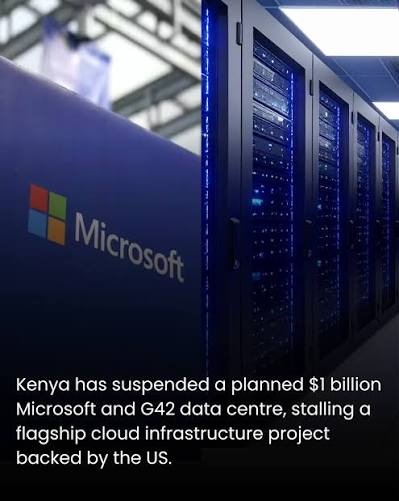
That makes the proposed Microsoft data center project in Kenya more significant than simply adding another technology facility to the country.
It raises questions about Kenya’s electricity supply, internet infrastructure, cloud computing market, employment opportunities and ambitions to become a regional technology hub.
Why Microsoft Data Center Investment Matters
A modern data center provides the computing infrastructure required to run digital services at scale.
For Kenya, additional local capacity could support areas such as:
- Cloud computing
- Artificial intelligence
- Enterprise software
- Data storage
- Digital financial services
- Government technology services
- Online platforms
- Cybersecurity infrastructure
The significance is particularly clear as organizations increasingly move their operations online.
Businesses need computing resources that are reliable, secure and available around the clock.
A stronger local data center ecosystem can make it easier for technology companies and enterprises to deploy digital services closer to their customers.
Kenya Is Competing for Data Center Investment
Kenya already has an established technology ecosystem and a relatively strong position in East Africa’s digital economy.
Nairobi is home to technology companies, startups, financial institutions, telecommunications operators and cloud-service users.
That creates demand for infrastructure.
But attracting major data center projects isn’t simply about having technology companies in the country.
Operators also consider several practical factors:
Electricity
Internet connectivity
Land and construction costs
Political and regulatory stability
Data protection requirements
Availability of skilled workers
Access to international network connections
A country that can provide these conditions consistently has a better chance of attracting large-scale digital infrastructure investment.
The Electricity Question
One of the biggest challenges associated with large data centers is power.
A data center cannot operate like an ordinary office building.
Servers need to run continuously.
Cooling systems also consume electricity.
Security systems, networking equipment and backup infrastructure require additional power.
That means operators need more than simply access to the national grid.
They need reliable electricity with sufficient capacity and backup arrangements.
This makes energy infrastructure an important part of Kenya’s data center ambitions.
Kenya’s Renewable Energy Advantage
Kenya has an important advantage when competing for technology infrastructure investment: its electricity system has a significant renewable-energy component.
Geothermal energy is particularly important, while hydro, wind and solar also contribute to the country’s electricity supply.
This creates an opportunity for Kenya to position digital infrastructure around relatively low-carbon electricity.
For technology companies increasingly focused on sustainability, access to renewable energy can be an important consideration when deciding where to locate large computing facilities.
However, renewable generation alone does not solve the data center power challenge.
The country also needs:
- Reliable transmission
- Sufficient generation capacity
- Grid stability
- Backup systems
- Efficient cooling
- Predictable electricity costs
The combination of generation and reliability is what ultimately matters to a data center operator.
Why Data Centers Need So Much Infrastructure
A data center is more than a building filled with servers.
A large facility can include:
Computing equipment
Servers perform the calculations required by applications, websites, databases and AI systems.
Storage
Large amounts of digital information need to be stored securely and made available when required.
Networking
Data centers need high-capacity connections to telecommunications networks and international internet infrastructure.
Cooling
Computing equipment generates substantial heat, requiring carefully designed cooling systems.
Backup power
Because digital services may need to operate continuously, facilities require backup systems in case the main electricity supply fails.
Physical security
Data centers also require controlled access and other security measures to protect equipment and information.
This explains why building one is a major infrastructure project rather than simply a real-estate development.
How the Project Could Support AI in Kenya
Artificial intelligence is increasing demand for computing infrastructure.
Training and deploying advanced AI models can require significant computing resources, particularly GPUs and other specialised processors.
As African businesses begin using AI for customer service, data analysis, automation and other applications, demand for computing capacity is expected to grow.
Local infrastructure could potentially reduce the need for organizations to rely entirely on computing resources located outside the region.
That could be useful for companies that need:
- Lower network latency
- Local data processing
- Enterprise cloud services
- AI computing
- Secure data storage
- Reliable access to digital infrastructure
The opportunity is therefore bigger than Microsoft’s own services.
A larger data center ecosystem can provide infrastructure that supports an entire technology market.
What It Could Mean for Kenyan Startups
Startups are another potential beneficiary.
A technology startup does not normally want to build its own data center.
It needs to focus on developing its product.
Cloud infrastructure allows a small company to rent computing resources instead of buying and maintaining large amounts of hardware.
That can lower the barrier to launching and scaling digital services.
For Kenyan startups, improved access to local or regional infrastructure could support applications in areas such as:
- Fintech
- E-commerce
- Health technology
- Education technology
- Artificial intelligence
- Logistics
- Agriculture technology
- Enterprise software
The impact would therefore extend beyond Microsoft itself.
Could the Project Create Jobs?
Large data center developments can create employment during both construction and operation.
Construction can require:
- Electrical engineers
- Construction workers
- Project managers
- Equipment specialists
- Security personnel
- Technicians
Once operational, a facility can require specialists in:
- Data center operations
- Networking
- Cybersecurity
- Electrical systems
- Mechanical systems
- Cloud infrastructure
- Facilities management
However, there is an important distinction.
A highly automated data center does not necessarily employ thousands of people permanently.
The larger long-term opportunity may come indirectly through the businesses and digital services that use the infrastructure.
That includes startups, cloud customers, technology companies and enterprises.
Local Data Infrastructure Could Improve Latency
Another potential benefit is network performance.
When data has to travel long distances to an overseas computing facility, there can be additional network latency.
Local infrastructure can bring computing resources closer to users.
Lower latency can be particularly useful for applications that require rapid communication between users and servers.
Examples include:
- Financial applications
- Cloud software
- Online collaboration
- Real-time services
- Gaming
- AI applications
- Enterprise platforms
The exact performance benefit depends on network architecture and where the relevant application is hosted, but local infrastructure can strengthen Kenya’s overall digital ecosystem.
Data Centers and Data Sovereignty
There is also a growing discussion around data sovereignty.
Organizations increasingly want greater clarity about where their information is stored, how it is processed and which legal frameworks apply to it.
Local data infrastructure can provide organizations with more options when deciding where sensitive information is hosted.
That does not automatically mean that every piece of data must be stored inside Kenya.
Rather, having local infrastructure gives businesses and institutions more choices.
For sectors such as financial services, government and healthcare, those choices can become increasingly important as digital services expand.
The Challenge: Data Centers Are Expensive to Operate
There is another side to the story.
Large data centers require substantial investment.
They also have continuing operating costs.
Power is one of the most important.
Cooling is another.
Network connectivity, security, maintenance and hardware replacement all add to the cost of operating the facility.
That means Kenya needs to make sure that new data center investment is supported by an infrastructure environment that is commercially sustainable.
Attracting a facility is one challenge.
Creating the conditions for it to operate efficiently for decades is another.
Kenya Needs More Than Data Centers
A data center alone cannot create a digital economy.
It needs to operate alongside other infrastructure.
Think of the technology ecosystem as a chain:
Electricity → Data center → Networks → Cloud services → Businesses → Consumers
If one part is weak, the benefits of the others can be reduced.
For example, a country can build large amounts of computing capacity, but businesses may struggle to use it if connectivity is expensive or unreliable.
Similarly, cheap electricity is less useful if the network infrastructure connecting data centers to customers is inadequate.
This is why major data center investments should be viewed as part of a broader digital-infrastructure strategy.
What Microsoft Investment Could Mean for Kenya’s Technology Ambitions
Kenya has spent years developing its reputation as one of East Africa’s technology centers.
The country has a large mobile-money ecosystem, an active startup community and growing demand for cloud and digital services.
Additional data center capacity could strengthen that position.
It could help Kenya compete for businesses that require reliable computing infrastructure and give technology companies another reason to consider the country when expanding into East Africa.
The bigger question is whether Kenya can build an ecosystem around that infrastructure.
That means developing:
- Skilled technology workers
- Reliable electricity
- Strong telecommunications networks
- Cybersecurity capabilities
- Clear digital regulations
- Competitive cloud services
- Local technology companies
Infrastructure creates the opportunity.
The wider ecosystem determines how much value the country captures from it.
What Kenyan Businesses Should Watch
For Kenyan businesses, the most important question isn’t simply whether Microsoft builds a data center.
It is what becomes possible because of increased computing infrastructure.
Businesses should watch for changes in:
Cloud availability
More infrastructure can support the growth of cloud-based services.
AI adoption
Greater computing availability could make advanced AI services more accessible to businesses.
Data hosting
Companies may have additional options for where their systems and information are hosted.
Digital service performance
Applications hosted closer to users may benefit from improved network performance.
Technology investment
A stronger infrastructure ecosystem could attract additional technology companies and service providers.
The Bigger Picture
The proposed Microsoft data center project is part of a much larger global trend.
The world is building more computing infrastructure because digital services are becoming more computationally demanding.
Artificial intelligence is accelerating that demand.
Cloud computing continues to expand.
Streaming, financial technology, enterprise software and online services all require computing resources.
Africa is increasingly becoming part of this infrastructure race.
For Kenya, the opportunity is not simply to host servers.
It is to build an environment where those servers support businesses, innovation, jobs and new digital services.
What Happens Next?
The success of major data center investment depends on more than announcements.
Projects have to move through planning, investment, construction, infrastructure development and eventual operation.
Kenya will therefore need to continue addressing the practical requirements of large-scale digital infrastructure.
That includes ensuring adequate electricity capacity, reliable telecommunications networks, appropriate regulation and a workforce capable of supporting increasingly sophisticated technology facilities.
If those pieces come together, projects such as the proposed Microsoft investment could help strengthen Kenya’s position in Africa’s growing digital economy.
But the ultimate measure of success will not be the size of the building.
It will be what Kenyan businesses, startups, developers and consumers are able to build on top of the infrastructure.
That is where the real economic value of a data center lies.
