
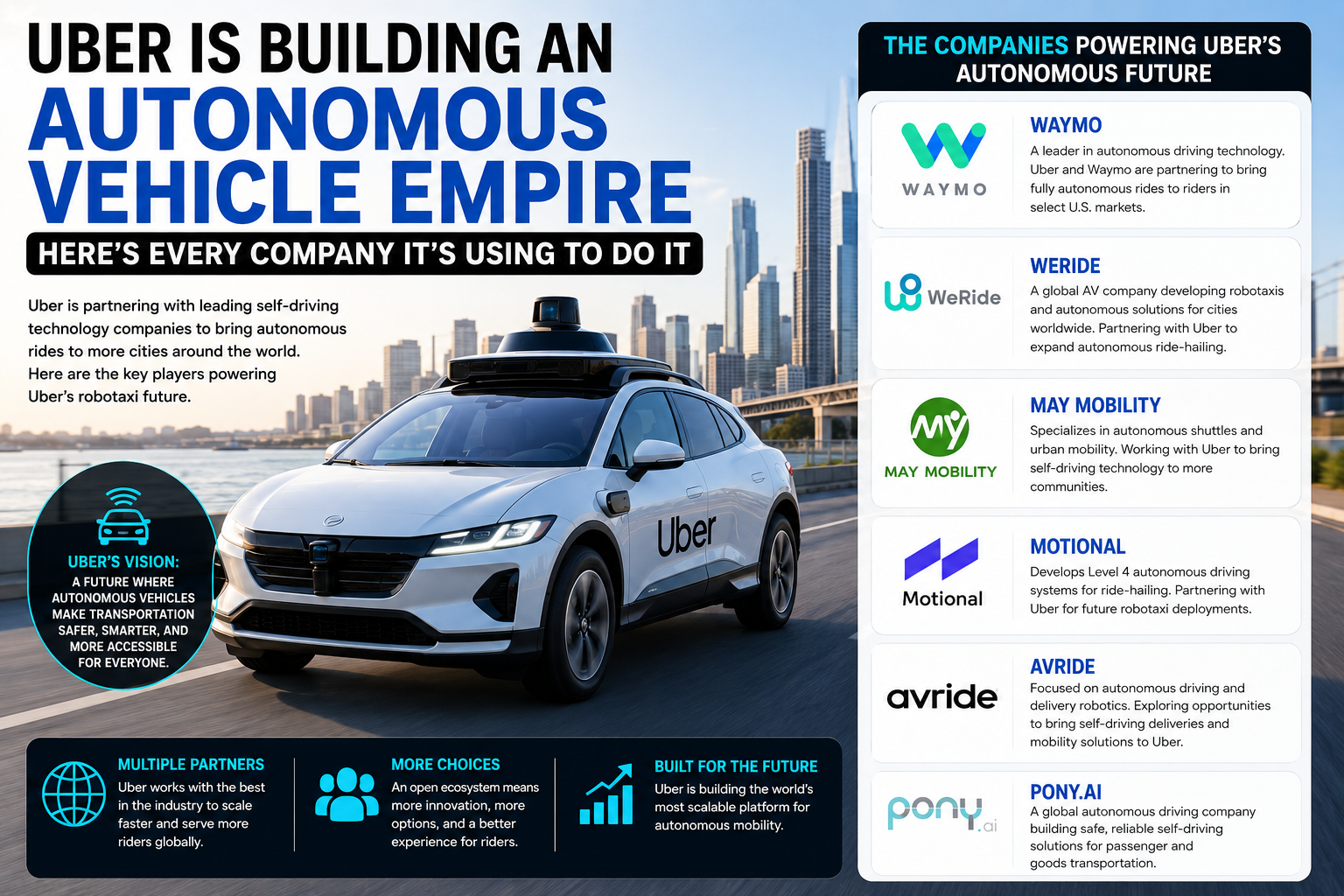

Uber is preparing for a major transformation in transportation: a future where some rides on its platform are completed by autonomous vehicles rather than human drivers.
But Uber is taking a different route from companies trying to build an entire self-driving system themselves.
Instead of developing one autonomous-driving technology and controlling every part of the vehicle, Uber is building a broad ecosystem of partnerships with autonomous-vehicle developers, automakers, artificial-intelligence companies and technology suppliers.
The strategy could allow Uber to become the marketplace and operating platform for autonomous mobility, while different technology partners provide the vehicles and self-driving systems.
In 2026, that strategy has expanded considerably, with partnerships involving companies such as Waymo, WeRide, Pony.ai, Avride, May Mobility, Wayve and Rivian, among others.
But why is Uber pursuing this model, and what does it mean for the future of ride-hailing?
Uber Is No Longer Betting on One Self-Driving Technology
Uber previously attempted to develop its own autonomous-driving technology.
However, the company sold its Advanced Technologies Group to Aurora in 2020, effectively moving away from developing a complete self-driving system internally.
Its current strategy is fundamentally different.
Rather than trying to become another Waymo or Tesla, Uber can concentrate on what it already does well: connecting passengers with transportation providers.
That includes:
- Ride booking
- Route management
- Payments
- Customer support
- Driver and vehicle operations
- Demand forecasting
- Pricing
- Global market access
The autonomous-vehicle partner, meanwhile, can focus on the difficult technology required to make a vehicle drive itself safely.
This division of responsibilities could allow both sides to concentrate on their strongest capabilities.
How Uber’s Partnership Model Works
Think of an autonomous Uber journey as a combination of several technologies and businesses.
The autonomous-vehicle company provides the self-driving technology.
An automaker may provide the vehicle platform.
Uber provides the customer-facing marketplace and transportation network.
The result is a system in which customers can potentially request an autonomous ride through an app they already know.
This is important because building a self-driving vehicle is only one part of the robotaxi business.
A commercially successful service also needs:
- Customers
- Vehicle availability
- Fleet management
- Payments
- Routing
- Customer support
- Charging or vehicle servicing
- Insurance
- Regulatory compliance
- Maintenance
- Safety procedures
Uber already has experience operating many of these parts of a mobility marketplace.
Why Uber Wants Multiple Autonomous Partners
One of the most interesting parts of Uber’s strategy is that it isn’t relying on a single autonomous-vehicle company.
The company has built relationships with multiple technology and automotive partners.
That gives Uber several potential advantages.
1. Reduced Dependence on One Technology
Autonomous driving remains a rapidly developing industry.
Different companies use different combinations of artificial intelligence, cameras, radar, LiDAR, mapping and other technologies.
By working with multiple providers, Uber doesn’t have to predict which company will ultimately dominate the industry.
2. Faster International Expansion
Autonomous-driving regulations, road conditions and consumer expectations differ from country to country.
A technology that works well in one market may require additional testing or adaptation elsewhere.
Multiple partners could allow Uber to select technologies that are appropriate for particular markets.
3. More Vehicle Options
Different autonomous services may require different types of vehicles.
Some deployments may use traditional passenger cars, while others could eventually use purpose-built autonomous vehicles or electric robotaxis.
Uber’s partnership model gives it flexibility to work with different vehicle manufacturers and autonomous systems.
4. Greater Scalability
Uber’s existing platform already connects millions of riders with transportation services.
If autonomous fleets become commercially viable, those vehicles can potentially be integrated into the same marketplace rather than requiring customers to download an entirely new application.
That could give Uber a significant distribution advantage.
Waymo: One of Uber’s Most Important Relationships
Waymo is one of the best-known companies in autonomous driving and has accumulated extensive experience developing and operating driverless vehicles.
Uber has worked with Waymo to make autonomous rides available through the Uber platform in selected markets.
The relationship illustrates the basic idea behind Uber’s strategy: Waymo focuses on autonomous-driving technology while Uber provides access to its ride-hailing marketplace.
However, autonomous partnerships should not be interpreted as universal availability.
A partnership does not mean that driverless Uber rides are automatically available in every city where both companies operate.
Deployments depend on factors such as local regulations, safety validation, vehicle availability and operational readiness.
WeRide Expands Uber’s Autonomous Network
WeRide is another important autonomous-driving partner.
The companies have worked together on robotaxi deployments, including a driverless robotaxi service in Madrid in 2026.
The Madrid deployment demonstrates why Uber’s platform approach could be important for international expansion.
Instead of developing an entirely new ride-hailing network for each autonomous vehicle provider, Uber can potentially connect customers to different autonomous fleets through its existing platform.
Pony.ai and the European Opportunity
Pony.ai has also partnered with Uber to deploy robotaxis through Uber’s platform.
In 2026, the two companies announced plans to expand their European robotaxi operations significantly.
The partnership is particularly important because Europe presents a different regulatory and transportation environment from the United States and China.
For Uber, working with autonomous-driving companies that already understand particular markets can potentially reduce some of the barriers associated with international expansion.
May Mobility and Other Autonomous Partners
Uber’s autonomous strategy extends beyond large robotaxi companies.
May Mobility, for example, has worked with Uber on autonomous transportation services using vehicles such as Toyota Sienna-based autonomous shuttles.
Other partnerships across the wider Uber ecosystem include companies such as Avride, Momenta, Wayve and additional autonomous-vehicle and technology providers.
The significance of this approach is not simply the number of partnerships.
It is the creation of a network in which different autonomous technologies can potentially connect to the same mobility platform.
Uber Is Also Investing in Vehicles
Uber’s strategy is becoming broader than simply connecting existing robotaxis to its app.
In March 2026, Uber announced a major partnership with Rivian that could eventually support the deployment of up to 50,000 fully autonomous robotaxis.
Uber also committed to invest up to $1.25 billion in Rivian through 2031, subject to specified milestones and regulatory conditions.
This suggests that Uber wants more control over the wider autonomous-vehicle ecosystem without necessarily becoming the company that develops the complete self-driving system.
Uber’s New Autonomous Solutions Strategy
Uber’s autonomous ambitions have also expanded beyond simply listing robotaxis inside its existing application.
In 2026, the company introduced Uber Autonomous Solutions, a business focused on helping autonomous-vehicle companies with elements needed to commercialise their services.
The strategy can include areas such as:
- Vehicle deployment
- Fleet operations
- Mapping and data
- Charging
- Maintenance
- Customer experience
- Autonomous fleet management
This is a significant development because it means Uber is attempting to become infrastructure for autonomous mobility rather than merely a ride-hailing application.
Uber Is Collecting Real-World Driving Data
Uber has also begun using manually driven, sensor-equipped vehicles to collect real-world driving data for its autonomous partners.
The company’s AV Lab initiative is designed to generate useful driving data that can help autonomous-vehicle developers train and improve their systems.
In June 2026, Uber said it planned to put hundreds of data-collection vehicles on the road as part of this effort.
This is important because autonomous driving depends on enormous amounts of real-world information.
Vehicles need to understand how humans behave around:
- Pedestrians
- Motorcycles
- Buses
- Cyclists
- Emergency vehicles
- Road construction
- Unusual traffic situations
- Poor weather
- Unexpected obstacles
The more representative the data, the more useful it can be for developing and validating autonomous systems.
The Business Case for Uber
Why is Uber investing so heavily in autonomous mobility?
One reason is economics.
A conventional ride requires a human driver.
That means a portion of the fare ultimately goes toward compensating the driver.
A fully autonomous vehicle could potentially remove that human driving cost from each trip.
However, that does not mean robotaxi rides will automatically become cheap.
Autonomous fleets still have major costs, including:
- Vehicle financing
- Sensors and computing hardware
- Software
- Insurance
- Charging
- Maintenance
- Remote assistance
- Fleet operations
- Regulatory compliance
The economics of autonomous transportation therefore remain a major question for the industry.
What Happens to Uber Drivers?
This is one of the biggest social questions surrounding autonomous ride-hailing.
Uber’s strategy does not mean human drivers are disappearing immediately.
Autonomous vehicles are still being introduced gradually, and many markets require extensive testing and regulatory approval before fully driverless operations are permitted.
In the short and medium term, Uber is likely to operate a mixed ecosystem containing both human-driven vehicles and autonomous vehicles.
The long-term impact on drivers will depend on how quickly autonomous technology becomes reliable, affordable and legally deployable at scale.
Regulation Remains a Major Barrier
Technology alone cannot determine when robotaxis become widespread.
Governments must establish rules governing:
- Vehicle safety
- Testing
- Insurance
- Liability
- Data collection
- Cybersecurity
- Passenger safety
- Emergency response
- Driverless operation
London provides a useful example.
Although companies including Uber and Wayve are preparing autonomous services, regulatory and technical requirements have delayed the rollout of fully driverless robotaxis in the city.
That demonstrates an important reality: having the technology is not the same as being allowed to operate commercially.
What Could Uber’s Strategy Mean for Africa?
Africa could eventually become an important market for autonomous mobility, but adoption is unlikely to happen at the same pace as in highly controlled pilot environments.
Cities such as Nairobi present unique challenges.
Autonomous vehicles would need to deal with:
- Heavy traffic
- Motorcycles and boda bodas
- Pedestrians
- Informal parking
- Road construction
- Variable road quality
- Rapidly changing traffic patterns
- Limited dedicated autonomous-vehicle infrastructure
These conditions make African cities difficult—but potentially valuable—testing environments for autonomous technology.
For Uber, the existing presence of its ride-hailing platform across African markets could eventually provide a foundation for introducing autonomous services if the technology and regulations become suitable.
However, that should be viewed as a future possibility, not an indication that fully driverless Uber services are currently available in Kenya.
Could Robotaxis Become Cheaper?
Potentially, but there is no guarantee.
If autonomous vehicles achieve high utilisation rates and operating costs fall, companies could eventually reduce the cost of each journey.
That could make ride-hailing more accessible and potentially create new transportation options.
But the opposite is also possible during the early stages.
Limited vehicle supply, expensive technology, insurance and regulatory requirements could make early robotaxi services relatively expensive.
Pricing will ultimately depend on the economics of each market.
The Biggest Challenge: Safety
The success of autonomous transportation will ultimately depend on public confidence.
A robotaxi must be capable of handling thousands of ordinary driving situations and rare but potentially dangerous events.
That requires more than impressive demonstrations.
Autonomous systems need extensive testing, validation and monitoring.
Waymo, for example, continues to emphasise that there is no simple AI shortcut to achieving safe autonomous driving, highlighting the importance of extensive testing and a safety-focused development process.
For Uber, maintaining passenger trust will be just as important as expanding the number of autonomous vehicles on its platform.
Uber’s Competitive Advantage May Be Its Network
Uber does not necessarily need to build the world’s best autonomous-driving system to benefit from autonomous vehicles.
Its competitive advantage could instead come from its enormous transportation marketplace.
If several autonomous companies develop successful robotaxis, Uber could potentially connect those vehicles with customers through the same platform.
That creates an interesting business model:
Autonomous companies build the technology.
Automakers build the vehicles.
Uber connects the vehicles to passengers.
If that model works at scale, Uber could become one of the most important distribution platforms in autonomous transportation.
What the Future Could Look Like
The future of ride-hailing may not involve a complete transition from human drivers to autonomous vehicles overnight.
Instead, cities could gradually develop mixed transportation networks.
A passenger might open the Uber app and see:
- A conventional Uber driven by a human
- An autonomous vehicle
- An electric vehicle
- A premium ride
- A shared ride
The choice could depend on price, availability, location and trip requirements.
This gradual transition could allow autonomous vehicles to expand without requiring existing transportation systems to disappear immediately.
Final Thoughts
Uber’s autonomous-vehicle strategy represents a significant change in how the company approaches the future of transportation.
Rather than attempting to develop a single self-driving system itself, Uber is building a broad network of partnerships with autonomous technology companies and automakers.
The approach gives Uber access to different technologies while allowing the company to concentrate on its strengths: customers, mobility infrastructure, payments, fleet operations and marketplace technology.
The strategy is not without risks. Regulation, safety, vehicle costs, public trust and the economics of autonomous fleets could determine how quickly robotaxis become commercially viable.
For consumers, however, the direction is clear: autonomous vehicles are moving from technology demonstrations toward integration with mainstream transportation platforms.
If Uber successfully turns its partnership network into a reliable global autonomous-mobility marketplace, the company could play a central role in determining how people move around cities in the next decade.
