
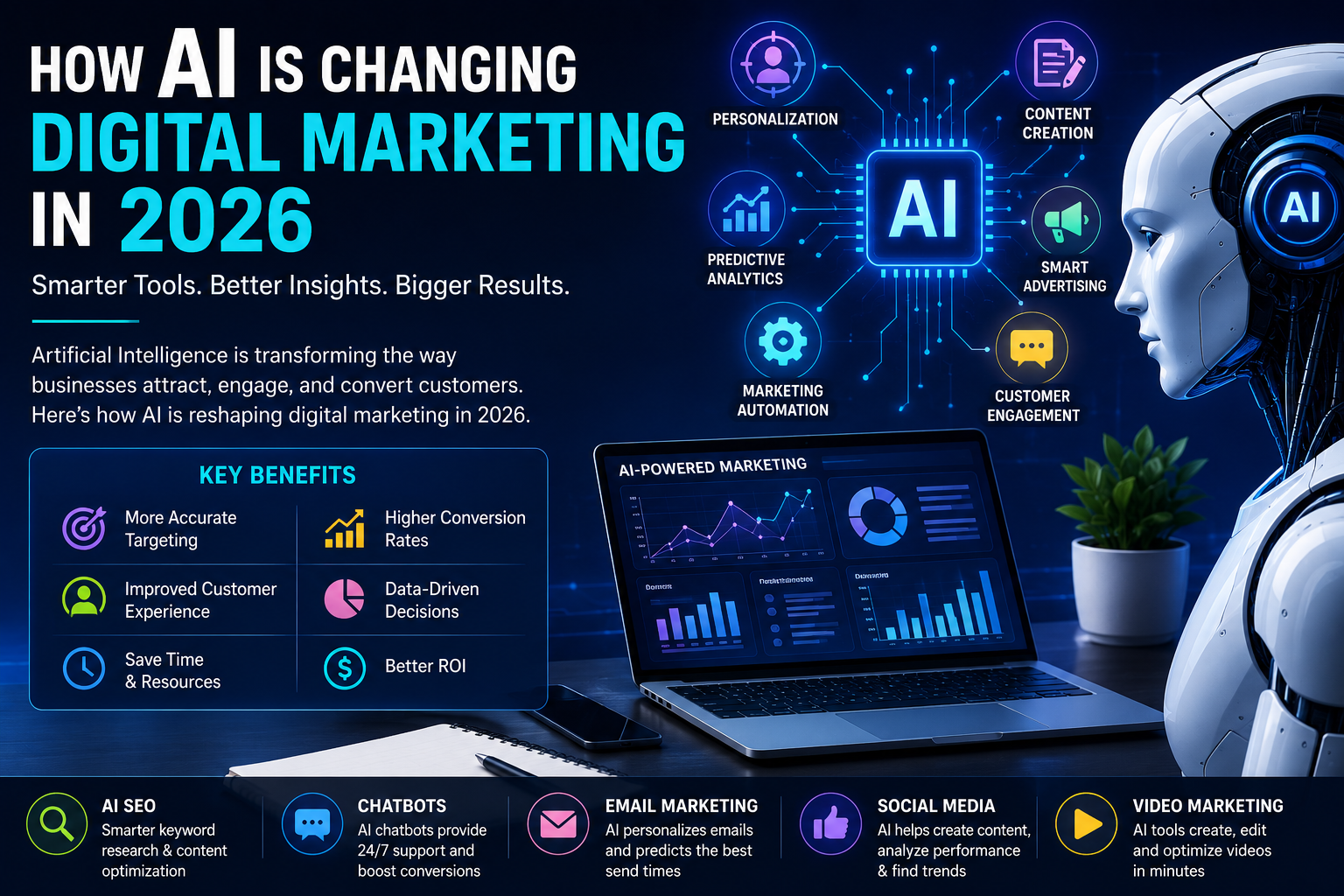

AI(Artificial intelligence) has evolved from a productivity tool into a strategic component of modern digital marketing. In 2026, organizations are using AI not only to automate routine tasks but also to improve customer insights, personalize experiences, optimize campaigns, and make faster data-driven decisions.
The growing adoption of AI has changed how businesses approach search engine optimization (SEO), content marketing, advertising, customer support, email campaigns, and social media management. At the same time, it has introduced new challenges around transparency, data privacy, and maintaining authentic human communication.
This article examines the key ways AI is reshaping digital marketing in 2026 and what businesses should consider as they integrate AI into their marketing strategies.
The Evolution of AI in Marketing
Digital marketing has always relied on data to understand audiences and measure campaign performance. Traditionally, marketers analyzed this information manually or through basic analytics platforms.
AI has expanded these capabilities by enabling systems to process large datasets, identify patterns, predict customer behavior, and generate actionable recommendations in real time.
Modern AI systems can now:
- Analyze millions of customer interactions
- Predict purchasing behavior
- Generate marketing content
- Optimize advertising budgets
- Personalize customer experiences
- Automate repetitive workflows
This allows marketing teams to focus more on strategy, creativity, and relationship-building.
Personalized Customer Experiences at Scale
One of AI’s most significant contributions to digital marketing is personalization.
Consumers increasingly expect brands to understand their preferences and provide relevant recommendations. AI makes this possible by analyzing browsing history, purchase patterns, search behavior, and engagement across multiple channels.
Businesses now use AI to:
- Recommend products based on previous purchases
- Customize website content for different visitors
- Personalize email campaigns
- Display targeted advertisements
- Tailor promotions according to customer interests
For example, two users visiting the same online store may see different homepage banners, featured products, and offers depending on their browsing behavior.
This level of personalization improves customer satisfaction while increasing conversion rates.
AI-Powered Content Creation
Creating quality content consistently remains one of the biggest challenges for marketers.
AI-powered writing assistants have become valuable tools for producing:
- Blog articles
- Product descriptions
- Social media captions
- Email newsletters
- Marketing copy
- Video scripts
- Press releases
Instead of replacing human writers, AI accelerates research, drafting, editing, and idea generation.
Successful businesses combine AI-generated drafts with human expertise to ensure accuracy, originality, and brand consistency.
Search Engine Optimization Is Becoming Smarter
SEO continues to evolve as search engines improve their understanding of user intent.
AI helps marketers:
- Discover keyword opportunities
- Analyze competitor strategies
- Identify technical SEO issues
- Optimize internal linking
- Generate metadata
- Improve content structure
- Monitor ranking changes
Rather than focusing only on keywords, marketers now prioritize answering users’ questions clearly, demonstrating expertise, and delivering genuinely useful content.
This shift aligns with search engines’ increasing emphasis on quality and user satisfaction.
Smarter Digital Advertising
Paid advertising has become increasingly automated through AI.
Advertising platforms use machine learning to determine:
- Who should see an advertisement
- When ads should appear
- Which creatives perform best
- How budgets should be allocated
- Which audiences are most likely to convert
Instead of manually adjusting campaigns daily, marketers can use AI-driven recommendations while focusing on campaign objectives, messaging, and creative direction.
Predictive Analytics Improves Decision-Making
Predictive analytics uses historical and real-time data to forecast future customer behavior.
Marketing teams use these insights to:
- Estimate customer lifetime value
- Predict churn
- Forecast demand
- Identify high-value audiences
- Improve inventory planning
- Schedule campaigns more effectively
Rather than reacting to customer actions, businesses can anticipate them and respond proactively.
AI Chatbots Are Redefining Customer Service
Customer support has shifted significantly with AI-powered chatbots.
Modern AI assistants can:
- Answer common questions
- Guide users through purchases
- Schedule appointments
- Track orders
- Recommend products
- Resolve basic technical issues
Unlike earlier chatbots, today’s AI systems understand natural language and maintain more conversational interactions.
Human agents remain essential for complex issues, but AI enables businesses to provide faster support around the clock.
Social Media Management Is More Efficient
Managing multiple social media platforms can be time-consuming.
AI assists marketers by:
- Suggesting post ideas
- Creating captions
- Scheduling content
- Analyzing engagement
- Identifying trending topics
- Monitoring brand sentiment
These capabilities help marketing teams maintain a consistent online presence while responding more quickly to audience interests.
AI Is Transforming Email Marketing
Email remains one of the highest-performing digital marketing channels.
AI improves email campaigns by:
- Generating subject lines
- Predicting open rates
- Optimizing send times
- Personalizing content
- Segmenting audiences
- Recommending products
The result is more relevant communication that can increase engagement without significantly increasing workload.
Marketing Automation Continues to Expand
Businesses increasingly rely on AI to automate repetitive tasks.
Examples include:
- Lead nurturing
- CRM updates
- Follow-up emails
- Social media publishing
- Campaign reporting
- Customer segmentation
Automation reduces manual effort while allowing marketing teams to focus on planning and creative execution.
Measuring Marketing Performance
AI-powered analytics provide deeper insights into campaign performance.
Instead of reporting only clicks or impressions, AI can identify:
- Which content influences purchasing decisions
- Why certain campaigns perform better
- Which audiences generate the highest returns
- Where customers abandon the buying process
These insights support more informed marketing decisions and better resource allocation.
Challenges of AI in Digital Marketing
Despite its advantages, AI also presents important challenges.
Content Quality
AI-generated content can contain inaccuracies or generic messaging if not reviewed carefully.
Human oversight remains essential.
Privacy and Data Protection
As AI relies heavily on customer data, businesses must comply with privacy regulations and communicate transparently about data collection.
Maintaining Brand Voice
Overreliance on automation can result in content that feels repetitive or impersonal.
Organizations should ensure AI-generated material reflects their unique tone and values.
Ethical Considerations
Businesses should disclose AI use where appropriate, avoid misleading content, and maintain accountability for automated decisions.
Best Practices for Businesses
To maximize AI’s value, organizations should:
- Use AI to support—not replace—human creativity.
- Verify AI-generated facts before publication.
- Develop clear content guidelines and editorial standards.
- Train employees to work effectively with AI tools.
- Monitor campaign performance and adjust strategies based on results.
- Stay informed about evolving regulations and ethical considerations.
The Future of AI in Digital Marketing
Several trends are likely to shape the next phase of AI-driven marketing:
- Autonomous AI agents managing multi-step marketing workflows.
- More advanced predictive customer analytics.
- Hyper-personalized shopping experiences.
- AI-generated video and interactive content becoming mainstream.
- Voice search and conversational commerce expanding further.
- Stronger governance frameworks around responsible AI use.
Businesses that combine these innovations with sound marketing strategy and human expertise are likely to be better positioned for long-term success.
Conclusion
Artificial intelligence is changing digital marketing by making campaigns more data-driven, personalized, and efficient. From content creation and SEO to advertising, analytics, and customer engagement, AI has become a practical tool for improving marketing performance.
However, technology alone does not guarantee results. The most effective marketing strategies in 2026 balance AI-powered efficiency with human creativity, ethical decision-making, and a clear understanding of customer needs.
Organizations that invest in both AI capabilities and skilled marketing professionals will be best equipped to adapt to the evolving digital landscape.
