
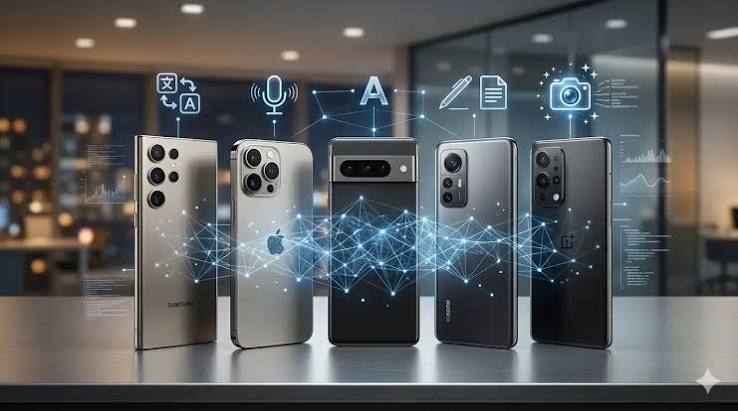

Artificial intelligence has become one of the biggest differences between today’s premium smartphones and older generations.
Modern smartphones can now summarize documents, translate conversations, remove unwanted objects from photos, rewrite messages, search through information using natural language, and improve photography using machine-learning models.
But buying an AI smartphone is not simply about choosing the phone with the longest list of AI features. Some tools are genuinely useful in everyday life, while others may be features you rarely use. Processing also varies between phones: some AI tasks happen directly on the device, while others depend on an internet connection and cloud servers.
For Kenyan buyers, there are additional considerations. AI features may have different availability by country or language, some cloud-based functions require reliable mobile data or Wi-Fi, and the price difference between flagship phones and more affordable models can be significant.
This guide looks at what makes a smartphone an AI phone, the major models competing in this space, what their AI features are actually useful for, and what you should consider before buying one.
What Is an AI Smartphone?
An AI smartphone is a phone that uses machine-learning models and dedicated hardware to perform tasks that traditionally required more manual input.
Modern AI features can be used for:
- Photo and video enhancement
- Object removal and generative editing
- Voice transcription
- Translation
- Text summarisation
- Writing assistance
- Intelligent search
- Call assistance
- Battery optimisation
- Personalised recommendations
- Gaming optimisation
- Document analysis
Many newer processors also include a Neural Processing Unit (NPU) or similar AI acceleration hardware. These components are designed to handle machine-learning workloads more efficiently than relying entirely on the CPU or GPU.
On-device AI vs cloud AI
This distinction is important when comparing smartphones.
On-device AI processes information directly on the phone. It can offer faster responses and can improve privacy because certain tasks do not need to be sent to a remote server.
Cloud-based AI sends some processing to online servers. This can enable more computationally demanding features, but usually requires an internet connection.
Many flagship smartphones use a combination of both approaches.
What Should You Look for in an AI Smartphone?
Before buying a phone because it has an “AI” label, consider these factors.
1. AI hardware
A powerful processor with a capable NPU can make AI features faster and more efficient.
However, processor specifications alone do not tell the entire story. Software optimisation and the actual AI features provided by the manufacturer are equally important.
2. Useful AI features
Look beyond marketing terms.
A useful AI feature should solve a real problem. For example, automatic transcription can save time during meetings, while photo object removal can be useful when editing images.
3. Camera processing
AI is increasingly important in smartphone photography.
Modern phones use computational photography to improve HDR, night photography, portraits, skin tones, zoom processing and video stabilisation.
4. Privacy
Check whether AI processing happens locally or through the cloud.
If you regularly use AI to process documents, messages or other sensitive information, understanding where that data goes is particularly important.
5. Software support
AI features can improve through software updates.
A smartphone with strong long-term software support may therefore remain useful for longer than a phone whose AI capabilities receive few updates.
6. Battery efficiency
AI workloads can consume additional processing power. A good smartphone should balance performance with battery efficiency rather than simply offering the most powerful chip.
1. Samsung Galaxy S26 Ultra
Samsung’s Ultra series is positioned as one of the company’s most capable smartphone platforms, combining high-end hardware with a broad collection of Galaxy AI features.
The main advantage is the depth of integration. AI is not limited to one application; it can appear across communication, photography, productivity and search.
AI Features
Depending on software version and regional availability, Samsung’s AI ecosystem includes tools for:
- Writing and text assistance
- Call and communication support
- Photo editing
- Object removal
- Note summarisation
- Transcription
- Visual search
- Translation
- Generative editing
- Personal productivity
Why it stands out
Samsung’s biggest strength is the breadth of its AI ecosystem.
For someone who uses a smartphone for work, photography, communication and productivity, having several AI tools integrated into the operating system can be more useful than having one impressive AI application.
Best for
- Professionals
- Content creators
- Smartphone photographers
- Heavy multitaskers
- Users who want a feature-rich Android flagship
Potential drawbacks
The Ultra-class hardware comes at a premium price, and not every AI feature will be equally useful to every user.
2. Google Pixel 11 Pro
Google’s approach to smartphone AI is closely connected to its Android and Gemini ecosystem.
The Pixel range has traditionally placed significant emphasis on computational photography, voice features and software-based intelligence.
AI Features
The Pixel experience focuses on areas such as:
- Gemini assistance
- Photo editing
- Call-related features
- Voice transcription
- Translation
- Smart replies
- Image processing
- Contextual assistance
Why it stands out
Google’s biggest advantage is its software and AI expertise.
The Pixel approach demonstrates why an AI smartphone is not simply about having a powerful processor. Google’s ability to integrate AI into Android and photography can make relatively complex tasks feel straightforward.
Best for
- Photography enthusiasts
- Google ecosystem users
- People who prefer software-focused smartphones
- Users who frequently use voice and AI assistance
Potential drawbacks
Some Google AI features can vary by market, language and account configuration. Kenyan buyers should therefore confirm that the specific features they want are available in their region.
3. iPhone 18 Pro Max
Apple’s approach to AI is centred around Apple Intelligence and the company’s wider hardware and software ecosystem.
For iPhone users, one of the biggest advantages is integration across Apple’s applications and devices.
AI Features
The platform focuses on areas including:
- Writing assistance
- Notification management
- Photo editing
- Intelligent search
- Siri improvements
- Personalised assistance
- Image and emoji generation
- Context-aware features
Why it stands out
Apple’s strength is ecosystem integration.
For someone already using a Mac, iPad, Apple Watch or other Apple products, AI features can become more useful because they work within an ecosystem rather than as isolated smartphone functions.
Best for
- Existing Apple users
- Professionals
- Privacy-conscious buyers
- Users who own multiple Apple devices
Potential drawbacks
The price can be considerably higher than many Android alternatives, while some AI capabilities may depend on supported languages, regions and software versions.
4. Vivo X300 FE
Vivo has increasingly focused on AI-powered photography and everyday smartphone intelligence.
The X300 FE is particularly interesting for buyers who want strong camera processing and battery performance without necessarily choosing the most expensive Ultra-class flagship.
AI Features
Vivo’s AI implementation can assist with areas such as:
- Photo enhancement
- Portrait processing
- Image editing
- Translation
- Note assistance
- Noise reduction
- Battery optimisation
- Video processing
Why it stands out
The combination of camera processing, performance and battery life makes this type of device particularly attractive to users who spend a lot of time taking photos, recording video or using demanding applications.
Best for
- Photography enthusiasts
- Social media creators
- Users who prioritise battery life
- Buyers looking for a balance between flagship features and price
Potential drawbacks
AI functionality and software support can vary between markets. Buyers should check the exact regional model before purchasing.
5. Xiaomi Ultra Series
Xiaomi has integrated AI into several parts of its software experience, particularly photography, productivity and search.
The company’s high-end phones combine powerful processors with extensive camera hardware, giving AI software plenty of data to work with.
AI Features
Depending on the model and software version, Xiaomi’s AI tools can include:
- Generative photo editing
- Image expansion
- Writing assistance
- Translation
- AI search
- Meeting summaries
- Voice assistance
- Battery optimisation
Why it stands out
Xiaomi’s strongest area is the combination of advanced camera hardware and computational photography.
For users who want a phone capable of taking detailed photos while also providing AI editing tools, the Ultra series is worth considering.
Potential drawbacks
Xiaomi’s software experience can be more complex than stock Android, and specific AI services may differ between regions.
6. OnePlus Flagship Series
OnePlus has increasingly incorporated AI into its software while maintaining its traditional focus on performance and responsiveness.
Its AI tools are generally designed around practical smartphone tasks rather than making AI the entire identity of the device.
Useful AI Features
Depending on the device and software version, users may find tools for:
- Call summaries
- Notes
- Photo editing
- Intelligent search
- Battery management
- Gaming optimisation
- Writing assistance
Why it stands out
OnePlus can be attractive to users who want a fast Android phone but do not necessarily want an AI-heavy interface.
Best for
- Performance-focused users
- Gamers
- Android enthusiasts
- Users who want practical AI tools
Potential drawbacks
Its AI ecosystem may not be as extensive as Samsung or Google in some areas.
7. Honor Magic Series
Honor has also invested heavily in AI, particularly in photography, privacy and productivity.
Some of its AI features focus on identifying unusual images, improving photographs and helping users work with documents.
AI Features
Depending on the model, Honor’s AI ecosystem may include:
- Camera optimisation
- AI privacy protection
- Document scanning
- Translation
- Meeting assistance
- Image enhancement
- Deepfake detection
- Productivity tools
Why it stands out
Honor is particularly interesting for buyers who want AI features beyond photo editing and text generation.
Security-related AI applications, for example, could become increasingly important as synthetic media and deepfakes become more common.
AI Smartphone Comparison
| Smartphone | Main AI Strength | Best For | Main Consideration |
|---|---|---|---|
| Samsung Galaxy S26 Ultra | Broad AI ecosystem | Productivity & photography | Premium price |
| Google Pixel 11 Pro | Google AI & computational photography | Photography & software | Regional feature availability |
| iPhone 18 Pro Max | Apple Intelligence & ecosystem | Apple users | High price |
| Vivo X300 FE | Camera AI & battery optimisation | Photography & battery life | Regional availability |
| Xiaomi Ultra Series | AI photography & editing | Camera enthusiasts | Software complexity |
| OnePlus flagship | Practical AI & performance | Power users & gamers | Smaller AI ecosystem |
| Honor Magic Series | AI imaging & privacy | Productivity & security-conscious users | Feature availability varies |
Which AI Smartphone Is Best for You?
There is no single AI smartphone that is perfect for everyone.
Best overall AI experience: Samsung Galaxy S26 Ultra
Choose Samsung if you want a broad collection of AI tools covering photography, communication, productivity and search.
Best for AI photography: Google Pixel 11 Pro
The Pixel is a strong choice if computational photography and Google’s software ecosystem are your priorities.
Best for Apple users: iPhone 18 Pro Max
The iPhone makes the most sense if you already use Apple’s ecosystem and want AI integrated across your devices.
Best for battery-focused users: Vivo X300 FE
Vivo is worth considering if long battery life, camera features and a more compact smartphone experience are important to you.
Best for camera enthusiasts: Xiaomi Ultra Series
Xiaomi’s Ultra phones are particularly interesting for users who prioritise advanced camera hardware alongside AI-powered editing.
Best for performance-focused users: OnePlus
OnePlus remains attractive to people who put speed, gaming and responsiveness ahead of having the largest possible AI feature set.
Best alternative for AI privacy and imaging: Honor Magic Series
Honor deserves consideration if privacy-related AI tools, imaging and productivity are high on your list.
What AI Smartphones Can Actually Do for You
The most useful way to evaluate AI is to look at everyday scenarios.
For students
AI features can help with:
- Summarising long documents
- Transcribing lectures
- Translating information
- Organising notes
- Improving written communication
However, AI-generated information should still be checked before being used in academic work.
For professionals
AI smartphones can help with:
- Meeting transcription
- Email drafting
- Document summaries
- Translation
- Scheduling
- Communication
This can reduce the amount of repetitive work performed directly on the phone.
For photographers
AI can improve:
- HDR processing
- Portraits
- Night photography
- Object removal
- Image sharpening
- Video stabilisation
The important distinction is that AI processing cannot completely replace good camera hardware. Sensor quality, lenses, stabilisation and image processing all matter.
For content creators
AI can help with:
- Removing objects from photos
- Editing images
- Generating captions
- Cleaning audio
- Improving video
- Creating quick social-media content
Creators should also understand the limitations of generative editing, particularly when authenticity matters.
What Kenyan Buyers Should Know
For Kenyan consumers, choosing an AI smartphone requires looking beyond specifications.
Check local pricing
Flagship smartphones can have significant differences between international launch prices and Kenyan retail prices.
Before purchasing, compare prices from reputable local retailers and check whether the phone is officially supported in Kenya.
Check network compatibility
A phone advertised as 5G does not automatically mean every 5G band will work on every network.
Before importing a device, check its supported network bands against the operator you intend to use.
Consider data usage
Some AI functions require cloud processing.
If you primarily use mobile data, cloud-dependent AI tools could consume additional data compared with features processed directly on the phone.
Check regional AI availability
This is one of the most important considerations.
Manufacturers may restrict certain AI features according to:
- Country
- Language
- Account
- Software version
- Age requirements
- Regulatory restrictions
Do not assume that every feature advertised on an international product page will work identically in Kenya.
Consider after-sales support
A cheaper imported flagship is not necessarily a better deal if obtaining warranty service, replacement parts or software support becomes difficult.
For an expensive smartphone, local support can be worth paying more for.
Do You Really Need an AI Smartphone?
Not necessarily.
If you mainly use your phone for WhatsApp, calls, social media, browsing, banking and streaming, you may not benefit enough from an expensive AI flagship to justify the price.
A mid-range smartphone can handle these tasks very well.
An AI flagship becomes more compelling when you regularly use:
- Advanced photography
- Video creation
- Document processing
- Voice transcription
- Multitasking
- Translation
- Generative editing
- AI assistants
- Demanding applications
The best phone is therefore not necessarily the one with the most AI features. It is the one whose AI capabilities solve problems you actually have.
The Future of AI Smartphones
AI is likely to become less visible and more integrated into smartphones over the coming years.
Instead of opening a dedicated AI application, users may increasingly interact with their phones naturally through voice, text, images and context.
Future smartphones are likely to place greater emphasis on:
- On-device AI
- Personalised assistants
- AI-powered cameras
- Real-time translation
- Local language support
- Smarter battery management
- Context-aware applications
- Privacy-preserving AI processing
The processor will remain important, but software will increasingly determine how useful a smartphone’s AI capabilities actually are.
Final Verdict
AI has become a major part of the premium smartphone market, but the biggest mistake buyers can make is treating an AI feature list as a substitute for overall phone quality.
A good AI smartphone should combine capable hardware, useful software, strong cameras, reliable battery life, good security and long-term updates.
For buyers who want the broadest Android AI experience, Samsung’s flagship approach is particularly compelling. Google remains highly competitive through its AI and computational photography expertise, while Apple focuses on deep ecosystem integration. Vivo, Xiaomi, OnePlus and Honor offer alternative approaches that may be better suited to specific priorities.
For Kenyan buyers, however, price, local availability, network compatibility, warranty support and regional AI feature availability should be part of the buying decision.
Ultimately, the smartest smartphone is not the one that simply advertises the most AI features. It is the one that uses AI to make everyday tasks genuinely easier.
Quick Buying Guide
Choose Samsung if: You want the most comprehensive Android AI toolkit.
Choose Google Pixel if: Photography and Google’s AI software are your priorities.
Choose iPhone if: You already use Apple’s ecosystem and want integrated AI.
Choose Vivo if: Battery life, photography and everyday performance matter most.
Choose Xiaomi if: You want advanced camera hardware and AI editing.
Choose OnePlus if: Performance and gaming are more important than having the biggest AI ecosystem.
Choose Honor if: AI imaging, productivity and privacy features interest you.
Before You Buy
Check these five things before spending money on an AI smartphone:
- Does the AI feature you want work in Kenya?
- Does the phone support your mobile network’s bands?
- Is the advertised price the actual Kenyan retail price?
- Does the manufacturer provide reliable software updates and warranty support?
- Will you actually use the AI features enough to justify the price?
AI is changing what smartphones can do, but that does not mean every buyer needs the most expensive AI phone available.
