
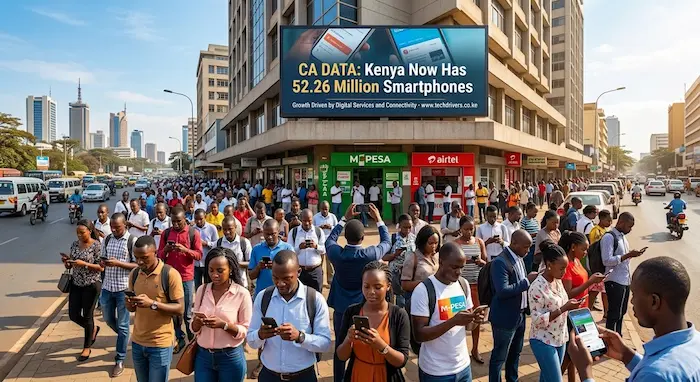

Kenya’s smartphone market continued to expand in the three months to June 2026, with 52.26 million smartphones connected to mobile networks, according to the latest data from the Communications Authority of Kenya (CA).
The figure represents a 4.2% increase from 50.18 million smartphones recorded in March 2026.
At the same time, feature-phone connections continued to decline, falling from 28.53 million in March to 27.42 million in June, a quarterly decline of 3.9%.
The numbers point to a broader change in how Kenyans access mobile services: smartphones are becoming increasingly central to internet access, digital payments, social media, entertainment, work and online services.
Kenya’s smartphone connections reach 52.26 million
The CA’s latest Sector Statistics Report for the fourth quarter of the 2025/26 financial year shows that smartphone connections rose by approximately 2.09 million between March and June 2026.
Feature-phone connections, meanwhile, declined by about 1.11 million during the same period.
This means the growth in smartphones was accompanied by a continued shift away from basic handsets.
The CA has linked rising smartphone adoption to the expansion of 4G and 5G mobile networks across Kenya.
Importantly, the 52.26 million figure should be understood as smartphones connected to mobile networks, not as a count of individual Kenyan smartphone owners.
One person can have more than one device or mobile connection, so the figure should not be interpreted as 52.26 million people owning smartphones.
Smartphones now make up about two-thirds of connected mobile phones
Kenya had approximately 79.68 million connected mobile phone devices in June 2026 when smartphones and feature phones are combined.
Of these:
| Device type | June 2026 connections | Approx. share |
|---|---|---|
| Smartphones | 52.26 million | 65.6% |
| Feature phones | 27.42 million | 34.4% |
| Total | 79.68 million | 100% |
Smartphones therefore accounted for roughly 65.6% of connected mobile phone devices.
That represents an important change in Kenya’s mobile ecosystem because smartphones can support substantially more internet-based services than traditional feature phones.
Feature phones continue to lose ground
The decline in feature phones has been consistent with the broader shift toward smartphones.
Between March and June 2026:
- Smartphone connections increased 4.2%
- Feature-phone connections declined 3.9%
- Smartphones added about 2.09 million connections
- Feature phones lost about 1.11 million connections
The trend suggests that replacement and upgrading are playing an important role in the changing composition of Kenya’s mobile-device market.
The CA has previously noted that smartphone adoption has been supported by the expansion of mobile broadband infrastructure.
4G and 5G are helping drive smartphone adoption
A smartphone becomes more useful when supported by reliable mobile broadband.
The latest CA data shows Kenya had 54.93 million mobile broadband subscriptions by June 2026, up from 52.85 million in March.
Total mobile data subscriptions reached 64.26 million, up 2.6% during the quarter.
Mobile broadband therefore accounted for approximately 85.5% of mobile data subscriptions.
The CA also reported continued growth in data consumption over 4G and 5G networks, while 3G consumption declined.
This combination of more smartphones, broader broadband availability and rising data usage is changing what Kenyans expect from their mobile devices.
What are Kenyans using smartphones for?
The shift from feature phones to smartphones is more than a hardware upgrade.
A modern smartphone can serve as:
- A mobile banking device
- A mobile-money tool
- A work device
- A camera
- A navigation system
- A streaming device
- A social-media platform
- An online shopping tool
- A learning device
- A communication platform
For many users, the smartphone is effectively becoming their primary internet-connected computer.
This is particularly significant in a country where mobile connectivity plays such an important role in accessing digital services.
Mobile money is also part of the smartphone story
Kenya’s smartphone growth is happening alongside continued expansion of mobile financial services.
The CA recorded 54.01 million mobile-money subscriptions at the end of June 2026, up from 53.37 million in March.
Smartphones can provide users with access to mobile-money applications and broader financial services beyond basic USSD transactions.
This does not mean every mobile-money user owns a smartphone, but the growth of smartphones creates a larger potential user base for app-based financial services.
For banks, fintech companies, mobile operators and merchants, the shift therefore has commercial implications.
Kenya’s data market is growing with smartphone adoption
The growth of smartphones is also happening alongside increased demand for mobile data.
Kenya recorded 64.26 million mobile data subscriptions in June 2026, compared with 62.65 million in March.
Mobile broadband subscriptions reached 54.93 million.
The distinction matters because smartphones generally encourage more data-intensive activities, including video, social media, cloud applications, online gaming and video calls.
As more users move from feature phones to smartphones, demand for affordable and reliable data becomes increasingly important.
What does this mean for smartphone buyers in Kenya?
The growing smartphone base could have several implications for consumers.
More demand for affordable smartphones
As smartphone adoption expands beyond higher-income consumers, affordable devices are likely to remain important in Kenya’s market.
Buyers increasingly need phones that offer a balance between price, battery life, storage, camera quality, performance and network compatibility.
4G support is becoming increasingly important
For someone buying a smartphone in Kenya today, 4G support is increasingly important.
The decline of 3G usage and continued expansion of 4G and 5G networks suggest that buyers should consider network support when choosing a device.
Software support matters more
As smartphones become more central to banking, work and personal communication, software updates and security support become increasingly important.
A cheap phone that stops receiving security updates quickly may not provide the same long-term value as a slightly more expensive device with longer software support.
Battery life matters
More smartphone use also means more screen time and data consumption.
For Kenyan users who spend long periods away from Wi-Fi, battery life can be particularly important.
Features such as fast charging, efficient processors and larger batteries can make a noticeable difference in everyday use.
What does the trend mean for Kenyan businesses?
The smartphone shift is not only a consumer story.
It also changes how businesses reach customers.
A company that previously depended on physical branches, SMS or traditional advertising can increasingly use:
- Mobile applications
- Social media
- Mobile websites
- Digital payments
- Online customer support
- Mobile advertising
- E-commerce platforms
For small businesses, smartphones can also provide relatively affordable access to tools for marketing, payments, accounting, communication and customer management.
The growing smartphone base therefore expands the potential audience for Kenya’s digital economy.
The smartphone boom is changing digital advertising
More smartphone users also means more people consuming digital content on mobile screens.
For Kenyan publishers and advertisers, this has implications for how content is created and distributed.
Websites need to work well on mobile devices, while businesses need to consider mobile-first advertising, social media and search.
For technology publishers such as TechDrivers, the trend also creates opportunities for practical content around smartphones, apps, mobile data, cybersecurity, digital payments and consumer technology.
Kenya’s smartphone market still has challenges
The growth in smartphone connections does not mean every Kenyan has equal access to smartphones or high-speed internet.
The cost of devices, mobile data and charging infrastructure can still influence how people use technology.
There is also a difference between owning a smartphone and being able to make full use of it.
A user with a low-cost handset, limited storage, expensive data or poor network coverage may have a very different digital experience from someone using a premium 5G smartphone with unlimited broadband access.
Digital skills and online safety are additional considerations.
As more people move online, issues such as scams, phishing, account security and personal-data protection become increasingly important.
Kenya’s smartphone market is moving toward a data-first economy
The most significant implication of the latest CA figures may be the relationship between devices and connectivity.
Kenya is not simply adding smartphones.
It is simultaneously expanding mobile broadband, increasing mobile-data use and moving more digital services onto internet-connected platforms.
The result is a mobile market increasingly built around data rather than voice calls and SMS alone.
This has implications for telecommunications companies, smartphone manufacturers, banks, fintech companies, advertisers, retailers and consumers.
Frequently Asked Questions
How many smartphones are connected to mobile networks in Kenya?
The Communications Authority recorded 52.26 million smartphone connections at the end of June 2026.
Does 52.26 million smartphones mean 52.26 million Kenyans own smartphones?
No. The CA figure represents smartphones connected to mobile networks. It should not be interpreted as the number of individual smartphone owners because individuals can have multiple devices or connections.
How many feature phones are in Kenya?
The CA recorded 27.42 million feature-phone connections in June 2026, down from 28.53 million in March.
Are smartphones more common than feature phones in Kenya?
Based on the CA’s connected-device figures, yes. Smartphones accounted for approximately 65.6% of the 79.68 million connected mobile phones in June 2026.
Why are smartphone connections increasing in Kenya?
The CA has linked smartphone uptake to the expansion of mobile broadband networks, particularly 4G and 5G.
How many mobile data subscriptions does Kenya have?
Kenya had 64.26 million mobile data subscriptions at the end of June 2026, according to the CA.
How many mobile broadband subscriptions does Kenya have?
Mobile broadband subscriptions reached 54.93 million in June 2026.
What does Kenya’s smartphone growth mean for consumers?
It means more Kenyans can access internet-based services such as mobile banking, social media, streaming, online shopping, digital work tools and other applications directly from their phones.
Editorial Note
This article is based primarily on the Communications Authority of Kenya’s Sector Statistics Report for the fourth quarter of the 2025/26 financial year, covering April to June 2026.
The CA explains that its quarterly sector statistics are based on information collected from licensed service providers and are used to monitor developments in Kenya’s communications sector. The regulator also notes that the data can be subject to revisions.
The smartphone figure refers to devices connected to mobile networks and should not be interpreted as a survey-based measure of individual smartphone ownership.
Market shares and percentages calculated by TechDrivers are derived from the CA’s published figures and may differ slightly because of rounding.
Conclusion
Kenya’s smartphone market has reached another significant milestone.
The country recorded 52.26 million smartphones connected to mobile networks by June 2026, up 4.2% from March. At the same time, feature-phone connections fell to 27.42 million.
The shift is happening alongside growth in mobile broadband and data subscriptions, showing that Kenya’s digital transformation is increasingly being driven by smartphones and internet connectivity.
For consumers, the trend means smartphones are becoming more important for everyday services, from mobile money and banking to entertainment, communication and work.
For businesses, it creates a larger mobile audience.
And for Kenya’s telecommunications sector, the numbers suggest that the future of connectivity will increasingly revolve around smartphones, data and faster mobile networks.
