

Microfinance loans provide an important source of credit for individuals, small businesses and other borrowers who may not always qualify for conventional bank financing.
In Kenya, the microfinance sector has evolved significantly alongside the growth of digital financial services. Microfinance institutions can provide credit and other financial products to customers who may be underserved by traditional financial institutions.
But taking a microfinance loan is still borrowing.
Before applying, borrowers should understand the eligibility requirements, interest and other charges, repayment period, total cost of credit and consequences of late repayment.
This guide explains how microfinance loans work in Kenya and what to consider before signing a loan agreement.
What Is a Microfinance Loan?
A microfinance loan is a relatively small loan designed to provide financing to individuals, entrepreneurs, small businesses or other customers who may have limited access to conventional financial services.
Microfinance institutions can offer products designed around the needs of their target customers.
Depending on the institution, these may include:
- Personal loans
- Business loans
- Working-capital loans
- Asset-financing loans
- Emergency loans
- Group loans
- Agricultural financing
- Education-related financing
The exact products, loan amounts and eligibility requirements vary between institutions.
How Does Microfinance Work in Kenya?
Kenya’s microfinance sector includes different types of institutions.
The country’s National Financial Inclusion Strategy identifies microfinance banks regulated by the Central Bank of Kenya (CBK) as one part of the sector and distinguishes them from non-deposit-taking microfinance institutions.
This distinction matters because borrowers should first establish who is providing the loan and which regulatory framework applies to that institution.
Before borrowing, check the lender’s official information and applicable regulatory status rather than relying only on advertisements or social-media claims.
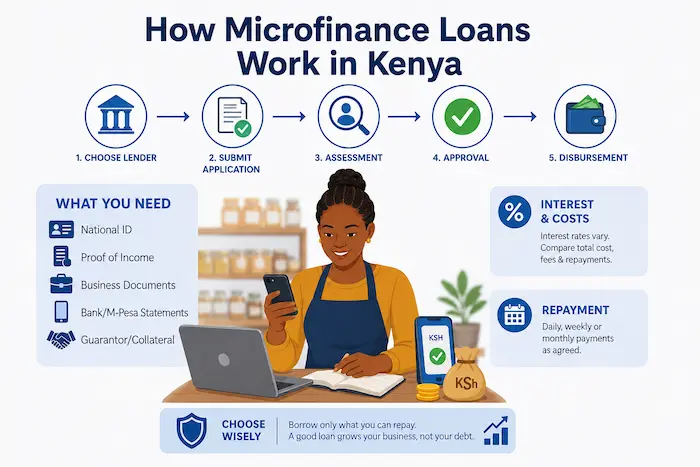
How a Microfinance Loan Works
The basic process is usually straightforward.
1. Choose a lender
Start by identifying a microfinance institution that offers the type of loan you need.
Consider:
- Loan purpose
- Available loan amount
- Interest and other charges
- Repayment period
- Security requirements
- Eligibility criteria
- Customer service
- Regulatory status
2. Submit an application
The application process depends on the lender.
You may apply through:
- A branch
- Website
- Mobile application
- USSD service
- Loan officer
- Other authorised channels
3. Provide the required information
The lender may request information such as:
- Identification documents
- Contact details
- Proof of income
- Business information
- Bank or mobile-money statements
- Security or collateral information, where applicable
- Credit information
The exact requirements vary depending on the institution and loan product.
4. Credit assessment
The lender assesses your application before deciding whether to approve the loan.
This may involve reviewing your income, ability to repay, existing obligations, credit history and other information relevant to the particular loan.
5. Loan approval and agreement
If approved, the lender should provide the relevant loan terms.
Read the agreement carefully before accepting.
6. Disbursement
Once the agreement is completed, the approved amount is disbursed through the lender’s specified payment channel.
7. Repayment
You then repay the loan according to the agreed schedule.
Depending on the product, repayment could be weekly, monthly or based on another agreed schedule.
What Are the Requirements for a Microfinance Loan in Kenya?
There is no single set of requirements for every microfinance loan.
Different institutions have different eligibility criteria.
Common requirements can include:
Kenyan identification
A lender may require an official identification document when processing an application.
Proof of income
The lender may want evidence that you have the ability to repay the loan.
For employed borrowers, this could include payslips or other income information.
For business owners, the lender may request business records, statements or other evidence of business activity.
Bank or mobile-money statements
Some lenders may request transaction history to understand income and cash flow.
Business information
Entrepreneurs applying for business financing may need to provide information about the business, its operations and expected cash flow.
Security or collateral
Some larger or specialised loans may require collateral or another form of security.
Other products may be unsecured.
Credit history
A lender may assess your existing borrowing and repayment history as part of its credit assessment.
The important point is that requirements depend on the specific lender and loan product.
How Much Can You Borrow?
There is no universal maximum amount for microfinance loans in Kenya.
The amount you can borrow can depend on factors such as:
- Your income
- Business cash flow
- Credit history
- Loan purpose
- Repayment ability
- Existing debts
- Security provided
- The lender’s credit policy
A first-time borrower may also receive a different offer from an established customer with a longer repayment history.
Rather than choosing a lender because it advertises the largest loan amount, focus on how much you can realistically repay.
Microfinance Loan Interest Rates in Kenya
One of the most important things to understand is that there is no single microfinance interest rate in Kenya.
Rates can vary according to the institution, product, borrower risk, loan size, repayment period and pricing model.
Kenya’s wider lending environment is also influenced by monetary policy and market conditions.
As of August 11, 2026, the Central Bank of Kenya’s Central Bank Rate stood at 8.75%. CBK’s published June 2026 average lending rate was 14.38%. These figures should not be confused with the rate a particular microfinance borrower will receive.
For bank loans with variable rates, CBK’s revised Risk-Based Credit Pricing Model uses KESONIA plus a lender-specific premium, with fees and charges contributing to the total cost of credit.
Microfinance products can use different pricing structures, so borrowers should always examine the actual loan agreement rather than assuming a market-wide rate.
Don’t Look at Interest Alone
A common mistake is comparing loans only by their advertised interest rate.
The actual cost of borrowing can also include:
- Processing fees
- Insurance
- Application fees
- Valuation fees
- Legal fees
- Other administrative charges
- Late-payment charges
Before accepting a loan, ask:
How much money will I receive?
How much will I repay in total?
What fees will I pay?
When does repayment begin?
What happens if I repay late?
These questions are often more useful than looking at the headline interest rate alone.
Example of a Microfinance Loan
Consider a hypothetical borrower who receives a KSh 50,000 loan.
The borrower should not assume that the cost is simply:
KSh 50,000 + interest.
The final amount could also depend on applicable fees and other charges.
For example, before accepting the loan, the borrower should obtain a clear breakdown showing:
| Item | Amount |
|---|---|
| Amount borrowed | KSh 50,000 |
| Interest | Confirm with lender |
| Fees | Confirm with lender |
| Insurance, if applicable | Confirm with lender |
| Total repayment | Confirm with lender |
| Repayment period | Confirm with lender |
This is why borrowers should compare the total repayment amount, not just the advertised rate.
How Long Do Microfinance Loans Take to Repay?
Repayment periods vary considerably.
A short-term working-capital loan could have a relatively short repayment period, while a larger business or asset-financing facility could be repaid over a much longer period.
Your repayment schedule may be:
- Weekly
- Monthly
- Quarterly
- Another agreed schedule
The longer the repayment period, the more important it becomes to understand how the lender calculates the total cost.
What Happens If You Miss a Repayment?
Missing a repayment can have financial consequences.
Depending on the loan agreement, you may face:
- Late-payment charges
- Additional interest or costs
- Collection activity
- Changes to your credit record
- Other consequences specified in the agreement
Before accepting a loan, make sure you understand what happens if you cannot pay on time.
If you expect difficulty making a repayment, contact the lender as early as possible rather than simply ignoring the missed payment.
Can a Microfinance Loan Affect Your Credit Record?
Yes, borrowing and repayment behaviour can be relevant to your credit history.
Credit information plays an important role in Kenya’s financial system, and lenders may use credit information as part of their assessment of borrowers.
That makes responsible repayment important.
Repeatedly taking loans and missing payments can make future borrowing more difficult or more expensive.
Microfinance Loans for Small Businesses
Microfinance can be particularly relevant to small businesses that need additional working capital.
A business owner could use financing for purposes such as:
- Buying inventory
- Expanding a shop
- Purchasing equipment
- Managing short-term cash flow
- Financing agricultural activities
- Supporting business expansion
However, borrowing should be connected to a realistic repayment plan.
For example, if a business borrows KSh 100,000 to purchase stock, the owner should estimate how the additional stock will generate enough cash flow to cover the loan repayment.
Microfinance vs Bank Loan
Microfinance and conventional bank loans are not necessarily direct substitutes.
| Feature | Microfinance | Bank loan |
|---|---|---|
| Target customers | Often underserved individuals and small businesses | Broad range of customers |
| Loan size | Varies by product | Varies widely |
| Application | Can be branch or digital | Branch and increasingly digital |
| Security | Depends on product | Depends on product |
| Eligibility | Depends on institution | Depends on bank and product |
| Repayment | Depends on agreement | Depends on agreement |
| Cost | Varies | Varies |
Neither option is automatically cheaper or better.
The right choice depends on the borrower’s circumstances and the specific terms being offered.
Microfinance Loans vs Digital Loans
These two categories can sometimes overlap, but they should not automatically be treated as identical.
A digital loan generally refers to how the credit is delivered, such as through an app, website or mobile platform.
Microfinance refers more broadly to the type of financial service and institution serving particular segments of the market.
A microfinance institution may therefore offer products through digital channels as well as physical branches.
This distinction is useful when comparing financial products.
How to Choose a Microfinance Institution
Before applying, check the following:
1. Verify the institution
Confirm the institution’s identity and applicable regulatory status.
2. Compare the total cost
Don’t compare interest rates alone.
3. Check repayment terms
Make sure the repayment schedule fits your income or business cash flow.
4. Understand penalties
Find out what happens if you miss a payment.
5. Read the agreement
Don’t accept a loan without understanding the terms.
6. Protect your information
Only provide personal and financial information through legitimate channels.
7. Borrow for a clear purpose
Know why you are borrowing and how the money will be repaid.
Questions to Ask Before Taking a Microfinance Loan
Before signing a loan agreement, ask the lender:
- What is the interest rate?
- Is the rate fixed or variable?
- What is the total cost of the loan?
- Are there processing or other fees?
- How much will I repay in total?
- How frequently must I make repayments?
- What happens if I pay late?
- Is collateral required?
- Are there insurance costs?
- Can I repay early?
- Are there charges for early repayment?
- What is the complaints process?
A reputable lender should be able to explain the terms clearly.
Is a Microfinance Loan Right for You?
A microfinance loan may make sense when the borrower has a clear need for financing and a realistic repayment plan.
It may be useful for:
- Business working capital
- Productive investments
- Equipment
- Education
- Agricultural activities
- Other planned expenses
But borrowing simply because money is available can create unnecessary financial pressure.
Before taking the loan, calculate your expected income and existing financial commitments.
If the new repayment would leave you unable to cover essential expenses, reconsider the borrowing decision.
Advantages of Microfinance Loans
Microfinance can provide several benefits.
Access to credit
It can help people and small businesses access formal financing.
Business support
Loans can provide working capital for small enterprises.
Flexible products
Different institutions offer different loan structures for different needs.
Financial inclusion
Microfinance can help expand access to financial services among underserved groups. Kenya’s National Financial Inclusion Strategy identifies the microfinance sector as an important component of the country’s financial-inclusion ecosystem.
Potential Risks
Borrowing also comes with risks.
High total borrowing costs
The total cost can be higher than borrowers initially expect if fees and other charges are added.
Repayment pressure
Short repayment periods can create pressure on household or business cash flow.
Multiple borrowing
Taking several loans simultaneously can make repayment difficult.
Late-payment consequences
Missed payments can lead to additional costs and potentially affect future access to credit.
Bottom Line
Microfinance loans can provide an important source of financing for Kenyans who need money for personal, business or other productive purposes.
But the most important question is not simply:
“How much can I borrow?”
It is:
“How much will this loan actually cost me, and can I comfortably repay it?”
Interest rates, fees, eligibility requirements and repayment periods vary between institutions and loan products.
Before borrowing:
- Verify the lender.
- Understand the interest and fees.
- Calculate the total repayment amount.
- Check the repayment schedule.
- Understand the consequences of late payment.
- Borrow only an amount you can realistically repay.
For Kenyan borrowers, taking time to compare the full terms of a loan can be more valuable than choosing the lender offering the largest amount or fastest approval.
TechDrivers’ Take
Microfinance remains an important part of Kenya’s evolving digital and financial ecosystem.
As financial services become increasingly accessible through mobile and digital channels, consumers and small businesses have more ways to access credit.
That convenience, however, makes financial literacy even more important.
A good borrowing decision starts with understanding the lender, the cost and the repayment obligation — not simply how quickly the money can reach your account.
Important: This article is for general educational purposes and is not financial advice. Interest rates, fees, eligibility requirements and loan terms can change. Always confirm current terms directly with the relevant lender and review the loan agreement before borrowing.
