
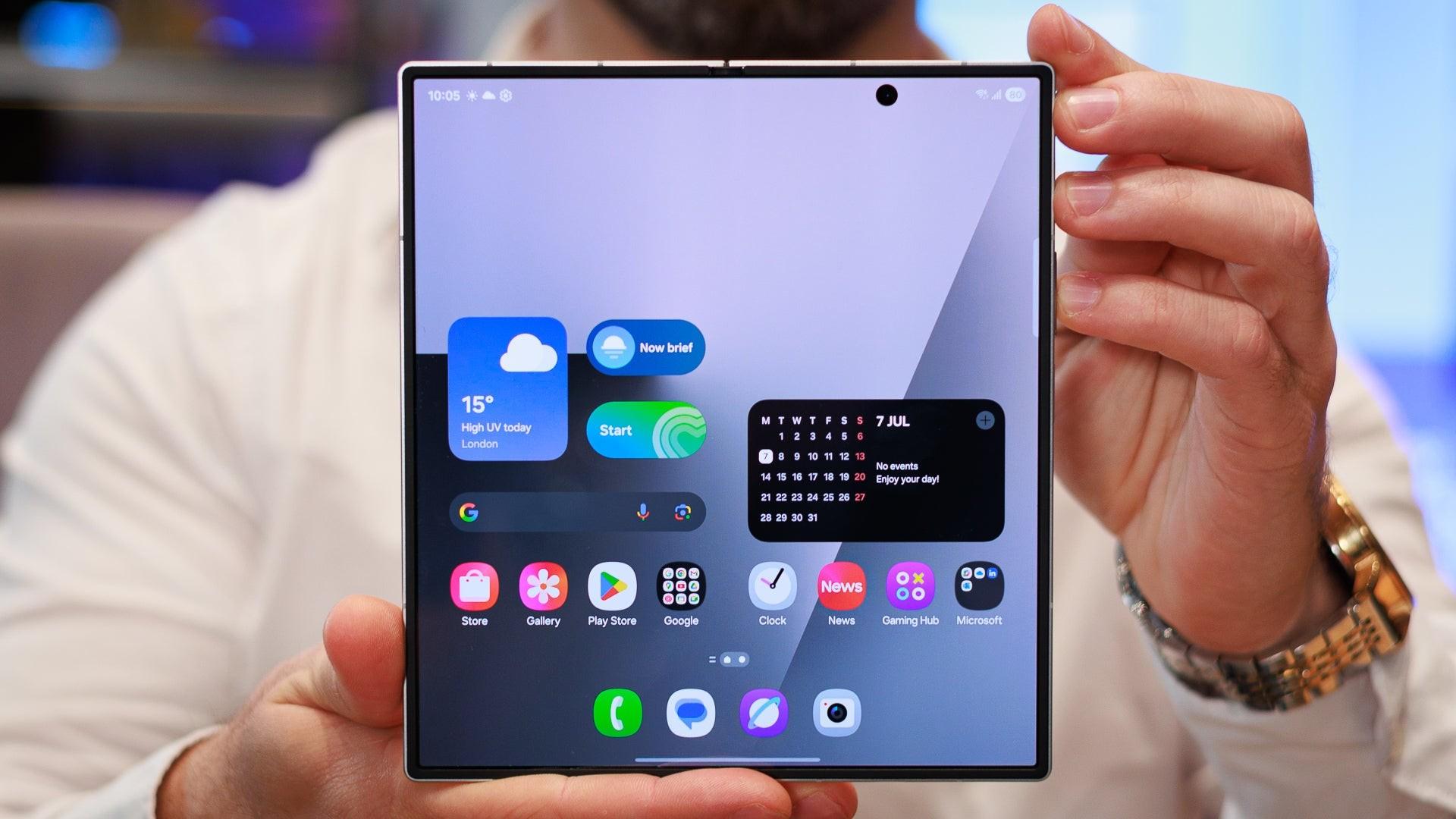

The Samsung Galaxy Z Fold8 is one of Samsung’s most ambitious foldable smartphones for 2026. Instead of simply making the previous generation faster, Samsung has redesigned the Fold around a wider, more compact form factor while reducing its weight to 201 grams.
The result is a foldable phone designed to work as both a conventional smartphone and a larger productivity device. When closed, it has a 5.5-inch cover display; when opened, it becomes a 7.6-inch Dynamic AMOLED 2X display designed for multitasking, entertainment and content creation.
But at a premium price in Kenya, is the Galaxy Z Fold8 actually worth buying?
This review looks at its design, displays, performance, cameras, battery, software, AI features, pricing and the type of Kenyan buyer who is most likely to benefit from it.
Samsung Galaxy Z Fold8: Key Specifications
| Feature | Galaxy Z Fold8 |
|---|---|
| Cover display | 5.5-inch Dynamic AMOLED 2X |
| Main display | 7.6-inch Dynamic AMOLED 2X |
| Refresh rate | Up to 120Hz |
| Processor | Snapdragon 8 Elite Gen 5 for Galaxy |
| RAM | 12GB / 16GB |
| Storage | 256GB / 512GB / 1TB |
| Rear cameras | 50MP wide + 50MP ultra-wide |
| Cover camera | 10MP |
| Main-screen camera | 10MP |
| Battery | 4,800mAh |
| Weight | 201g |
| Operating system | Android 17 with One UI 9 |
| Connectivity | 5G, Wi-Fi, Bluetooth, NFC, USB-C |
| Samsung DeX | Yes |
Samsung’s official specifications confirm the 7.6-inch main display, 5.5-inch cover display, 4,800mAh battery, 50MP + 50MP rear camera system and storage configurations up to 1TB.
1. Design: The Biggest Change
The most noticeable improvement is the Fold8’s physical design.
Samsung has made the phone lighter and wider, giving it a different feel from previous Galaxy Z Fold generations. At 201g, Samsung describes it as its lightest book-style foldable yet.
When unfolded, the phone is approximately 4.5mm thick, while the folded dimensions are approximately 123.9 × 81.9 × 9.7mm.
The wider shape is important because earlier foldable phones often had narrow outer screens that could feel cramped for typing.
The Fold8’s 5.5-inch cover screen uses a 10:16 aspect ratio, while the inner display uses a wider 4:3 format. Samsung designed these proportions around different types of usage: quick smartphone tasks on the outside and more immersive work or entertainment when unfolded.
Why the lighter design matters
A foldable phone is naturally more complicated than a conventional smartphone because it contains two display sections, a hinge and additional structural components.
Reducing the weight to 201g makes the Fold8 more practical for people who carry their phone throughout the day.
For Kenyan professionals who move between meetings, offices, travel and field work, that reduction in weight could be more meaningful than simply adding another processor upgrade.
2. Display: The Main Reason to Buy a Foldable
The Galaxy Z Fold8 has two displays.
The outer screen measures 5.5 inches, while the main foldable display measures 7.6 inches. Both use Samsung’s Dynamic AMOLED 2X technology and support refresh rates of up to 120Hz.
The inner display has a resolution of 1848 × 2448, while the cover display has a resolution of 1972 × 1248.
Samsung also lists brightness of up to 3,000 nits for the displays and an anti-reflective treatment on the main screen.
What this means in everyday use
The cover screen is useful for:
- WhatsApp messages
- Calls
- Quick web browsing
- Social media
- Notifications
- Navigation
- Short tasks
Opening the phone makes more sense when you need:
- Multitasking
- Reading documents
- Editing content
- Watching videos
- Browsing websites
- Working with spreadsheets
- Comparing information side by side
This is where a foldable has an advantage over a conventional large-screen smartphone.
3. Performance: Built for Heavy Users
The Galaxy Z Fold8 is powered by the Snapdragon 8 Elite Gen 5 for Galaxy.
Samsung says the customized processor combines a CPU, GPU and NPU designed to handle demanding applications, graphics and AI workloads.
Storage options include:
- 256GB with 12GB RAM
- 512GB with 12GB RAM
- 1TB with 16GB RAM
The 1TB model is particularly suited to users who regularly store large video files, photographs, documents and applications.
Who needs this level of performance?
The Fold8’s hardware is excessive for someone who mainly uses WhatsApp, Facebook, TikTok and calls.
It makes more sense for:
- Business professionals
- Content creators
- Mobile gamers
- Developers
- Heavy multitaskers
- People who edit photos and videos
- Users who want to keep a phone for several years
For an average smartphone user, a much cheaper flagship or mid-range device may provide better value.
4. Multitasking Is Where the Fold8 Makes Sense
The biggest advantage of the Fold8 isn’t simply its processor.
It is the amount of information you can see at once.
The 7.6-inch display allows applications to run side by side, making the phone closer to a small tablet when unfolded.
Samsung’s One UI 9 also supports multi-window functionality, including two-way and three-way split-screen arrangements.
For example, you could have:
WhatsApp + Chrome
or
Email + document
or
YouTube + notes
on the larger screen.
This can make the Fold8 particularly useful for people who work primarily from their phones.
5. Galaxy AI: More Than a Marketing Feature
Artificial intelligence is another major part of Samsung’s Fold8 experience.
The phone includes Galaxy AI features such as Photo Assist and Now Nudge.
Photo Assist can use AI to help users move, resize or remove objects from photographs and generate edits using prompts.
Now Nudge is designed to understand what’s happening on the screen and suggest relevant next actions.
For example, if you’re discussing an appointment in a messaging application, the phone can provide a prompt that helps you move toward the relevant calendar action.
Why AI matters on a foldable
The larger screen gives AI tools more room to display information.
Instead of simply generating an answer, users can potentially work with the result alongside another application.
That makes the Fold8’s AI features more relevant to productivity than simply having an AI chatbot built into the phone.
6. Camera: A Different Approach
The Galaxy Z Fold8 uses a dual 50MP rear camera system consisting of:
- 50MP wide camera
- 50MP ultra-wide camera
It also has a 10MP cover camera and a 10MP camera on the main screen. Samsung lists optical image stabilization on the rear cameras and up to 10x digital zoom.
Samsung’s ProVisual Engine also uses software processing to improve image and video quality, particularly in challenging lighting conditions.
The important limitation
The Fold8 isn’t necessarily the best choice for someone who wants the most advanced smartphone photography system available.
Samsung’s own specifications show that this model uses a dual rear-camera setup rather than the more elaborate camera systems found on some flagship Ultra smartphones.
Therefore, buyers should decide what matters more:
Foldable productivity and versatility
or
maximum camera hardware.
If photography is your number-one priority, another flagship may make more sense.
7. Battery Life
The Galaxy Z Fold8 has a 4,800mAh battery.
Samsung rates the phone for up to 26 hours of video playback, although real-world battery life will vary depending on network conditions, brightness, applications, gaming and how frequently the large inner display is used.
For Kenyan users, network conditions can also influence battery consumption. A phone searching between different network technologies or spending significant time on mobile data can use more power than expected.
The Fold8 is therefore better viewed as an all-day productivity device rather than a phone designed to deliver several days of battery life.
8. Software and Long-Term Support
The Galaxy Z Fold8 launches with Android 17 and One UI 9.
Samsung has also committed to an extended software-support period. Its business specifications list security updates through July 2033, while Samsung advertises up to seven OS upgrades and security updates for the device.
This is an important advantage for an expensive smartphone.
If you’re spending more than KSh 200,000 on a phone, long-term software support becomes part of the value proposition.
A phone that remains secure and receives new software for years is easier to justify than a device that becomes outdated quickly.
9. Storage: Which Model Should You Buy?
There are three storage configurations:
256GB + 12GB RAM
Best for users who:
- Stream most content
- Take moderate numbers of photos
- Use cloud storage
- Don’t record large amounts of video
512GB + 12GB RAM
The best balance for most power users.
It provides significantly more space for photographs, videos, applications and documents without paying for the maximum configuration.
1TB + 16GB RAM
Best for:
- Professional content creators
- Heavy video recording
- Large file libraries
- Advanced mobile workflows
- Users who rarely want to delete files
For most Kenyan buyers, the 512GB model is likely to provide the most sensible balance between capacity and price.
10. Samsung Galaxy Z Fold8 Price in Kenya
Kenyan prices vary considerably depending on the seller, storage configuration, warranty and whether the device is officially sourced.
A Samsung Brandstore listing currently shows the Galaxy Z Fold8 at KSh 239,900, while Kenyan retailers and marketplaces list lower prices depending on the configuration and seller.
For example, current marketplace listings show some 256GB units around KSh 195,000–KSh 210,000, while 512GB and 1TB models can cost substantially more. These marketplace prices should be treated as indicative rather than a fixed official retail price.
What Kenyan buyers should check before paying
Because the Fold8 is an expensive device, don’t choose a seller based only on the lowest price.
Check:
- Warranty coverage
- Whether the phone is new or refurbished
- Exact storage configuration
- Model number
- SIM/eSIM compatibility
- Return policy
- Official receipt
- Availability of Samsung service support
- Whether the device is region-locked
A saving of KSh 20,000 is not worthwhile if it leaves you with an imported phone that has limited warranty support.
11. Is the Galaxy Z Fold8 Practical in Kenya?
This is an important question because the Fold8 is not simply an expensive smartphone.
It is a different category of device.
For someone who spends most of the day working from a phone, the large internal display can reduce the need to carry a separate tablet.
A journalist could use it to:
- Research stories
- Read documents
- Take notes
- Communicate with sources
- Review photographs
- Manage email
A business owner could use it for:
- Customer communication
- Presentations
- Documents
- Video calls
- Business applications
A content creator could use it for:
- Photo editing
- Video review
- Social media management
- Research
- Script writing
That makes the Fold8 easier to justify for professionals than for casual smartphone users.
12. What Are the Main Advantages?
Pros
- Lightweight for a book-style foldable
- Large 7.6-inch productivity display
- Excellent AMOLED screens
- Powerful Snapdragon processor
- Strong multitasking capabilities
- Useful Galaxy AI features
- Up to 1TB storage
- Long software-support commitment
- Samsung DeX support
- More compact design than earlier Folds
Samsung confirms that the Fold8 supports Samsung DeX, making it possible to use the phone in a more desktop-oriented setup with compatible accessories.
13. What Are the Disadvantages?
Cons
- Very expensive compared with conventional smartphones
- Foldable display technology remains more complex than standard smartphone screens
- Camera system isn’t the main reason to buy this phone
- Battery capacity is not dramatically larger despite the phone’s size
- Not everyone will benefit from the large internal display
- Repairing an expensive foldable can be a bigger financial concern than repairing a conventional phone
The biggest issue is therefore value.
If you don’t regularly use multitasking, the Fold8 can be difficult to justify over a conventional flagship.
Galaxy Z Fold8 vs a Conventional Flagship
The choice becomes much easier when you consider how you use your phone.
| If you prioritize… | Better choice |
|---|---|
| Multitasking | Galaxy Z Fold8 |
| Large portable screen | Galaxy Z Fold8 |
| Mobile productivity | Galaxy Z Fold8 |
| Gaming on a larger display | Galaxy Z Fold8 |
| Maximum camera capability | Consider an Ultra-style flagship |
| Lower purchase price | Conventional flagship |
| Simpler design | Conventional smartphone |
| Easy repairs | Conventional smartphone |
| Pocket-friendly size | Conventional smartphone |
Who Should Buy the Galaxy Z Fold8?
The Galaxy Z Fold8 makes the most sense for people who will actually use its defining feature: the large foldable display.
It is particularly suitable for:
- Professionals
- Entrepreneurs
- Content creators
- Mobile-first workers
- Business travellers
- Heavy multitaskers
- Technology enthusiasts
- Users replacing both a smartphone and a lightweight tablet
Who Should Not Buy It?
You probably don’t need the Fold8 if you mainly use your phone for:
- TikTok
- Calls
- YouTube
- Mobile banking
- Basic photography
A conventional smartphone can perform those tasks for considerably less money.
Final Verdict
The Samsung Galaxy Z Fold8 is more than a faster version of Samsung’s previous foldables. Its biggest improvement is the combination of a lighter 201g body, wider form factor, 5.5-inch cover display and 7.6-inch inner display.
Its Snapdragon 8 Elite Gen 5 for Galaxy processor, up to 1TB of storage, Galaxy AI features and long software-support commitment make it a serious productivity device rather than simply a luxury gadget.
However, its high Kenyan price means it isn’t a phone that everyone should buy.
For a professional who regularly multitasks, works from a phone or wants one device that can bridge the gap between a smartphone and tablet, the Fold8 can make a strong case for itself.
For a typical smartphone user, a conventional flagship will probably deliver better value.
TechDrivers Verdict: 4.5/5
Best for: Professionals, entrepreneurs, creators and power users.
Think twice if: You mainly want excellent cameras, basic smartphone functions or the best value for your money.
Our recommended configuration: 512GB + 12GB RAM for most power users because it offers a practical balance between storage and price.
Frequently Asked Questions
Is the Samsung Galaxy Z Fold8 available in Kenya?
Yes. Kenyan retailers and Samsung-focused stores are listing the Galaxy Z Fold8, although pricing and availability vary by storage configuration and seller.
How much does the Galaxy Z Fold8 cost in Kenya?
Current Kenyan listings vary widely. A Samsung Brandstore listing shows KSh 239,900, while some independent retailers and marketplace listings advertise lower prices. Buyers should verify the exact configuration, warranty and seller before purchasing.
Does the Galaxy Z Fold8 support 5G?
Yes. The Fold8 supports 5G connectivity, making it suitable for compatible 5G networks in Kenya.
How much storage does the Galaxy Z Fold8 have?
Samsung offers 256GB, 512GB and 1TB storage options. The 256GB and 512GB versions have 12GB RAM, while the 1TB model has 16GB RAM.
Is the Galaxy Z Fold8 good for business?
Yes. Its large foldable display, multitasking capabilities, Samsung DeX support, powerful processor and long software support make it particularly suitable for professionals who work from their phones.
Should you buy the Galaxy Z Fold8 in Kenya?
If you need a premium smartphone that can also function as a compact productivity device, the Fold8 is worth considering. If your priority is affordability or conventional smartphone photography, a standard flagship may offer better value.
