
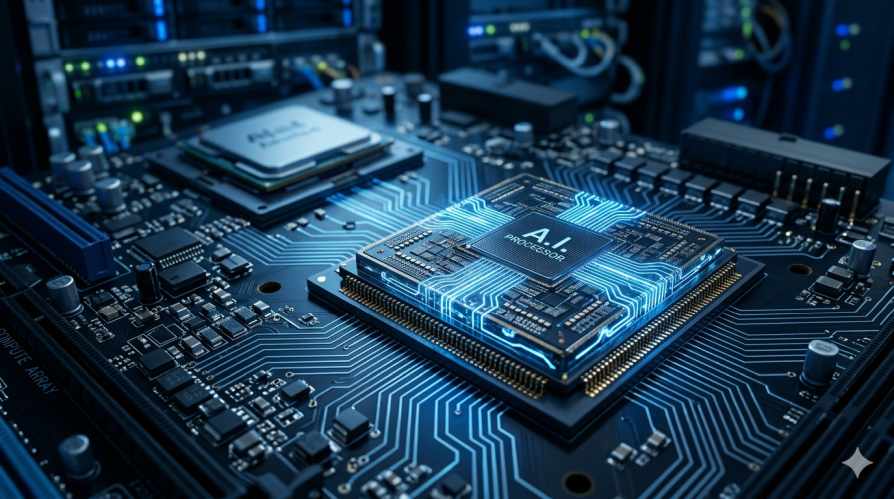

Artificial intelligence is changing how people work, communicate, shop, create content and use technology. But behind every AI chatbot, image-generation tool, voice assistant and intelligent smartphone is another technology that receives far less attention: the AI chip.
AI models need enormous amounts of computing power. Traditional computer processors can run AI applications, but specialized processors can handle many of the mathematical operations involved in machine learning more efficiently.
This has turned AI chips into one of the most important areas of the semiconductor industry.
Companies are developing increasingly powerful processors for data centres, smartphones, laptops, cars, robots and other connected devices. At the same time, governments are treating advanced semiconductors as strategically important technology.
But what exactly is an AI chip, how is it different from a normal processor, and why does it matter to consumers and businesses?
What Is an AI Chip?
An AI chip is a processor or accelerator designed to efficiently perform workloads used by artificial intelligence and machine learning systems.
AI applications rely heavily on operations involving large matrices of numbers. Specialized hardware can perform many of these operations simultaneously, allowing AI models to train or respond more efficiently.
AI processors are used for tasks such as:
- Machine learning
- Generative AI
- Computer vision
- Speech recognition
- Natural-language processing
- Recommendation systems
- Image and video processing
- Robotics
- Autonomous systems
The term AI chip covers several different types of processors rather than one specific technology.
Why AI Needs Specialized Hardware
A conventional CPU is designed to perform a wide range of computing tasks.
It is excellent for running operating systems, applications, web browsers and everyday software. However, AI workloads can involve performing huge numbers of similar mathematical operations simultaneously.
This is where specialized processors become useful.
Instead of relying entirely on a CPU, an AI system can distribute workloads across accelerators designed for parallel computation.
The result can be:
- Faster AI processing
- Better energy efficiency for suitable workloads
- Higher computing capacity
- Lower processing time
- Improved ability to run large AI models
This does not mean CPUs are becoming obsolete.
Modern AI systems typically use different processors together, with each component handling the tasks it is best suited to perform.
CPU vs GPU vs NPU vs TPU
Understanding the different types of processors makes it easier to understand the AI hardware market.
1. CPU — The General-Purpose Processor
The Central Processing Unit (CPU) is the general-purpose processor found in computers, smartphones and servers.
It handles tasks such as:
- Running applications
- Managing operating-system processes
- Handling instructions
- Coordinating other hardware
- Performing general computing operations
CPUs remain essential even in AI systems.
An AI server may use CPUs to manage the overall workload while specialized accelerators handle computationally intensive AI operations.
2. GPU — Powerful Parallel Processing
A Graphics Processing Unit (GPU) was originally developed primarily for graphics and gaming.
However, GPUs are particularly useful for AI because they contain large numbers of processing cores capable of performing many calculations in parallel.
This makes them well suited to:
- AI model training
- Large language models
- Image generation
- Computer vision
- Scientific computing
- AI inference
Companies such as NVIDIA and AMD have developed GPUs specifically optimized for modern AI workloads.
NVIDIA’s CUDA software ecosystem has also played an important role in making GPUs widely used by AI researchers and developers.
3. NPU — AI Processing Inside Devices
A Neural Processing Unit (NPU) is designed specifically for neural-network and AI workloads.
NPUs are increasingly appearing in:
- Smartphones
- Laptops
- Tablets
- PCs
- Edge devices
The advantage is that some AI tasks can run directly on the device instead of being sent to a cloud server.
For example, an NPU can help process:
- Voice commands
- Image enhancement
- Background blur
- Noise reduction
- Translation
- Writing assistance
- Object recognition
This is commonly called on-device AI or edge AI.
4. TPU — Google’s AI Accelerator
A Tensor Processing Unit (TPU) is a specialized processor developed by Google for machine-learning workloads.
Google uses TPUs to support AI-related workloads across its infrastructure and cloud services.
The key idea behind a TPU is the same as other AI accelerators: dedicate hardware resources to operations commonly used by machine-learning models.
Why GPUs Became So Important to AI
The modern AI boom has significantly increased demand for high-performance computing.
Training a large machine-learning model can involve processing enormous datasets and performing vast numbers of calculations.
GPUs are particularly effective because their architecture allows many operations to be performed in parallel.
This helped make GPUs a central component of AI data centres.
NVIDIA became one of the most important companies in this market, while AMD and other semiconductor companies have developed competing AI accelerators.
However, the industry is moving beyond general-purpose GPUs.
Cloud providers and technology companies are increasingly developing custom silicon designed around their specific AI workloads.
What Are AI Accelerators?
An AI accelerator is a processor designed to speed up artificial-intelligence workloads.
It can be a GPU, NPU, TPU or another specialized architecture.
The goal is generally the same: perform AI calculations more efficiently than relying on a general-purpose CPU alone.
Custom accelerators can give companies greater control over:
- Performance
- Energy consumption
- Operating costs
- Hardware availability
- Data-centre design
This is one reason major technology companies are investing in their own silicon.
Why Generative AI Is Increasing Demand for AI Chips
Generative AI systems can create text, images, audio, video and software code.
Running these systems requires substantial computing resources.
A company offering an AI service may need large numbers of processors to serve users simultaneously.
As AI applications become more popular, businesses need infrastructure capable of handling:
- Model training
- Model fine-tuning
- AI inference
- Data processing
- Storage
- Networking
This is helping drive investment in AI data centres and specialized computing hardware.
Training vs Inference: Why the Difference Matters
AI chips are used during two major stages of an AI system’s lifecycle.
AI Training
Training is the process of teaching a model using large datasets.
The system repeatedly adjusts the model’s parameters to improve its ability to perform a particular task.
Training can require substantial computing resources.
AI Inference
Inference happens when a trained model is used to produce an answer or prediction.
For example, when you ask an AI chatbot a question, the system performs inference to generate a response.
Inference can happen:
- In a cloud data centre
- On a smartphone
- On a laptop
- On an edge device
The hardware requirements can vary significantly depending on the size and complexity of the model.
Why AI Chips Are Moving Into Smartphones
AI is increasingly being processed directly on smartphones.
Modern phones can perform tasks that previously required cloud services.
Examples include:
- AI-powered photography
- Real-time translation
- Voice transcription
- Image editing
- Noise reduction
- Face and object recognition
- Generative editing
- Personalization
Running AI locally can provide several advantages.
Faster Response
The device does not always need to send information to a remote server.
Better Privacy
Some sensitive processing can remain on the device instead of being uploaded to the cloud.
Reduced Cloud Dependency
Certain AI functions can continue working even when internet connectivity is limited.
Lower Network Usage
Processing some tasks locally reduces the amount of information that needs to be transmitted.
However, cloud AI remains important for larger and more computationally demanding models.
AI Chips Are Also Changing Laptops
The same trend is happening in personal computers.
Modern AI-focused laptops increasingly include dedicated NPUs alongside their CPUs and GPUs.
This enables developers to build applications that use local AI processing for tasks such as:
- Video conferencing effects
- Background removal
- Live captions
- Document processing
- Image editing
- Productivity assistants
The rise of AI PCs means consumers are beginning to encounter AI processors even if they never specifically shop for an “AI chip.”
AI Chips and Data Centres
The biggest AI computing systems are found in data centres.
AI data centres can contain large numbers of accelerators connected through high-speed networking and supported by specialized cooling and power infrastructure.
A modern AI data centre therefore requires much more than processors.
It also needs:
- High-speed memory
- Networking equipment
- Storage
- Power systems
- Cooling infrastructure
- Backup systems
- Data-centre management software
This creates opportunities for companies beyond the semiconductor industry.
Energy providers, networking companies, construction firms and data-centre operators are all becoming part of the wider AI infrastructure ecosystem.
Why AI Chips Consume So Much Energy
Power consumption has become an important consideration as AI computing expands.
High-performance processors require electricity, and large AI data centres can contain thousands of processors operating simultaneously.
Cooling systems also consume energy because powerful processors generate significant amounts of heat.
This creates an important challenge for the industry.
Future AI infrastructure needs to deliver more computing power while improving performance per watt.
This is why chip efficiency is becoming nearly as important as raw processing performance.
Why Memory and Networking Matter Too
It is easy to think that faster AI chips alone will solve the industry’s computing challenges.
In reality, AI systems depend on an entire hardware ecosystem.
Processors need fast access to data.
That makes high-bandwidth memory extremely important.
Similarly, when thousands of processors work together, they need extremely fast networking to exchange information.
As a result, the AI hardware industry includes:
- AI accelerators
- High-bandwidth memory
- Advanced packaging
- Networking hardware
- Data-centre storage
- Cooling systems
- Power infrastructure
The performance of the complete system matters more than the performance of one chip.
Who Makes AI Chips?
Several major technology companies are competing across different parts of the AI semiconductor market.
NVIDIA
NVIDIA is one of the most important suppliers of GPUs and AI computing platforms used for training and running AI models.
Its hardware is supported by a large software ecosystem used by researchers and developers.
AMD
AMD produces CPUs and GPUs and has expanded its portfolio of data-centre AI accelerators.
Its products compete for workloads across cloud computing and enterprise infrastructure.
Intel
Intel remains a major CPU manufacturer while also developing products aimed at AI acceleration and data-centre computing.
Google develops its own TPUs for machine-learning workloads and uses them across parts of its AI and cloud infrastructure.
Apple
Apple designs its own silicon for iPhones, iPads and Macs.
Its chips include dedicated neural-processing capabilities designed to support on-device AI features.
Qualcomm
Qualcomm develops mobile processors with dedicated AI capabilities for smartphones, PCs and other connected devices.
Amazon and Microsoft
Major cloud providers are also investing in custom AI silicon and specialized infrastructure to reduce costs and improve control over their cloud platforms.
The competition demonstrates how important AI computing has become to the technology industry.
Why Governments Care About AI Chips
AI chips are increasingly viewed as strategically important because advanced computing affects:
- Artificial intelligence
- Telecommunications
- Defence
- Scientific research
- Cybersecurity
- Manufacturing
- Economic competitiveness
Semiconductor manufacturing is also highly concentrated geographically.
This has encouraged governments to invest in domestic semiconductor production, research and supply-chain resilience.
Export controls and international competition have further increased the strategic importance of advanced AI hardware.
Why Making Advanced AI Chips Is Difficult
Designing an AI chip is only one part of the challenge.
Producing advanced semiconductors requires sophisticated manufacturing facilities, specialized equipment and highly developed supply chains.
Companies must also deal with:
- Extremely complex chip designs
- Advanced manufacturing processes
- Packaging technology
- Memory requirements
- Testing
- Yield management
- Software compatibility
The result is a highly specialized industry with enormous barriers to entry.
What AI Chips Mean for Businesses
Businesses do not necessarily need to buy expensive AI servers to benefit from AI.
Cloud platforms allow organizations to rent computing resources when needed.
Small and medium-sized businesses can therefore access AI capabilities without building their own data centres.
For many organizations, the more important decisions are:
- Which AI applications solve a real business problem?
- Should processing happen locally or in the cloud?
- How much data should be sent to third-party services?
- What are the ongoing computing costs?
- How should customer data be protected?
AI hardware matters because it influences the cost, speed and scalability of these services.
What AI Chips Mean for Kenyan Businesses
Kenyan businesses are unlikely to manufacture advanced AI processors themselves in the near term, but they can still benefit from the AI hardware boom.
Businesses can access AI computing through cloud platforms and software services without owning specialized hardware.
Potential applications include:
- Customer-service automation
- Fraud detection
- Financial analysis
- Agricultural technology
- Logistics optimization
- Marketing automation
- Document processing
- Cybersecurity
- Data analysis
For local businesses, the immediate opportunity is therefore less about manufacturing chips and more about using AI infrastructure intelligently.
Kenya’s Opportunity in the AI Infrastructure Economy
Kenya can participate in the broader AI ecosystem by strengthening the infrastructure and skills required to use AI effectively.
Important areas include:
Data Centres
Reliable local data-centre infrastructure can support cloud services and digital businesses.
Affordable and Reliable Electricity
AI computing requires significant electricity, making energy reliability and cost important considerations.
AI Skills
Universities, technical institutions and private training programs can help build expertise in machine learning, software engineering, cloud computing and data science.
Local AI Applications
Kenyan developers can build AI solutions around local challenges in areas such as agriculture, financial services, logistics, education and public services.
Connectivity
Reliable broadband and mobile connectivity are essential for accessing cloud-based AI services.
The opportunity for Kenya is therefore not limited to semiconductor manufacturing.
It is about becoming a strong consumer, developer and infrastructure participant in the global AI economy.
On-Device AI vs Cloud AI
Consumers will increasingly encounter two different approaches to AI.
On-Device AI
The AI model or part of the processing runs directly on a phone, laptop or other device.
Advantages:
- Lower latency
- Potentially better privacy
- Can work without constant cloud communication
- Reduced network usage
Cloud AI
The processing happens on remote servers.
Advantages:
- Access to much larger models
- More computing power
- Easier centralized model updates
- Suitable for demanding AI workloads
Neither approach is universally better.
Future devices will likely combine both, using local processing for suitable tasks and cloud computing for more demanding operations.
What Consumers Should Look for in an AI Device
If you’re buying a smartphone or laptop marketed as an AI device, don’t focus only on the word “AI.”
Instead, consider:
- What AI features are actually available?
- Does the device have a dedicated NPU?
- Which applications support local AI processing?
- How long will the manufacturer provide software updates?
- How much RAM and storage does the device have?
- Does it require an internet connection for important AI functions?
- How does the AI processing affect battery life?
- Are your data and privacy protected?
A device with an impressive AI specification is not automatically a better purchase.
The usefulness of the software matters just as much as the hardware.
The Future of AI Chips
AI processors are likely to become more specialized as artificial intelligence becomes embedded into more products.
Future developments may include:
- More powerful smartphone NPUs
- More efficient AI data-centre accelerators
- Specialized chips for robotics
- AI processors for vehicles
- Lower-power edge AI hardware
- Greater use of custom silicon
- Improved memory technologies
- More efficient AI computing
The goal will not simply be to make chips faster.
It will be to make AI more efficient, affordable, accessible and practical.
Final Thoughts
AI chips are becoming one of the foundations of modern artificial intelligence.
GPUs, NPUs, TPUs and other accelerators allow computers to perform AI workloads more efficiently, while CPUs continue to handle general-purpose computing.
The technology is already affecting products people use every day. Smartphones can process AI photography locally, laptops are gaining dedicated neural processors, and massive data centres are being built to support increasingly sophisticated AI services.
For businesses, the AI chip revolution will influence the cost and availability of computing power. For consumers, it will increasingly determine what smartphones, laptops and other devices can do locally.
For Kenya and Africa, the biggest opportunity may not be designing the world’s most advanced semiconductor. It may be building the skills, connectivity, data-centre infrastructure and businesses capable of turning AI computing into useful products and services.
As artificial intelligence continues to develop, understanding the hardware behind it will become just as important as understanding the AI models themselves.
Frequently Asked Questions
What is an AI chip?
An AI chip is a processor or accelerator designed to perform artificial-intelligence and machine-learning workloads efficiently.
Is a GPU an AI chip?
A GPU can function as an AI accelerator and is widely used for AI training and inference because it can perform many calculations in parallel.
What is an NPU?
An NPU, or Neural Processing Unit, is a specialized processor designed for neural-network and AI workloads. It is increasingly found in smartphones, laptops and other personal devices.
Are AI chips replacing CPUs?
No. CPUs remain important for general-purpose computing. AI accelerators work alongside CPUs to handle specialized workloads.
Why are AI chips important for smartphones?
They allow smartphones to perform certain AI tasks locally, including photography enhancements, voice processing, translation and other intelligent features.
Does every AI application need an AI chip?
No. AI applications can run on CPUs, GPUs, NPUs, cloud servers or combinations of different processors depending on the workload.
Can Kenya benefit from AI chips?
Yes. Kenya can benefit by using AI infrastructure for sectors such as fintech, agriculture, logistics, healthcare technology, cybersecurity and education while developing the skills and infrastructure needed to support AI adoption.
Will AI chips make AI cheaper?
They can help reduce the cost of AI computing by improving performance and energy efficiency, although the overall cost also depends on software, electricity, memory, networking, data-centre infrastructure and the size of the AI model.
Artificial intelligence (AI) has rapidly evolved fro
