

Kenya’s Certificate of Good Conduct, officially known as a Police Clearance Certificate (PCC), is moving from a largely manual fingerprint-processing system to a more digital biometric process.
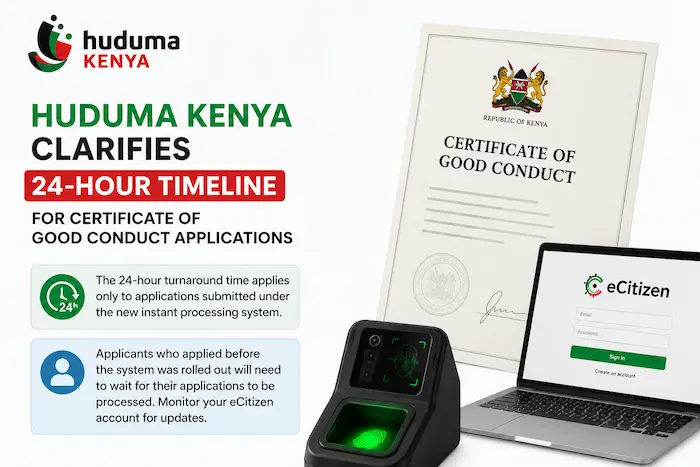
The change is being driven by the Directorate of Criminal Investigations (DCI)’s Multi-Biometric Identification System (MBIS), which is designed to reduce the time required to process Police Clearance Certificates from the previous two-week timeline toward 24-hour processing where the new system is operational.
But there is an important distinction:
The DCI’s current public FAQ still states that, under its general procedure, applicants should allow at least two weeks from fingerprinting for a certificate to be ready. This means applicants should follow the instructions attached to their specific application and the service point where their fingerprints are captured.
Here’s how the new system works and what Kenyans need to know.
What Is a Certificate of Good Conduct?
The Certificate of Good Conduct is a Police Clearance Certificate issued by the Directorate of Criminal Investigations.
It is commonly required when applying for:
- Jobs
- Overseas employment
- Visas and immigration
- Work permits
- Certain professional opportunities
- Some government services
- Other situations where proof of criminal-record status is required
The DCI is responsible for processing and issuing the certificate through its forensic fingerprint identification function.
What Has Changed?
Previously, Police Clearance Certificate processing relied heavily on fingerprint capture, paperwork and subsequent identification processing.
The DCI has been upgrading this process through the Multi-Biometric Identification System (MBIS).
The DCI says the system is intended to improve processing speed from the previous 14 days to one day and help clear the backlog of applications.
The system also supports live fingerprint scanning, reducing reliance on the traditional paper-based process.
According to the DCI, MBIS is being rolled out to Huduma Centres, with live-scan capability intended to make PCC processing faster and more accessible.
This is the technology behind the move toward 24-hour processing.
How Does the Multi-Biometric Identification System Work?
The simplest way to understand MBIS is to think of it as a more automated biometric identification system.
Instead of relying primarily on physical fingerprint forms that have to move through several stages, the applicant’s biometric information can be captured digitally.
The process broadly works like this:
eCitizen application
↓
Payment and appointment/location selection
↓
Live biometric capture
↓
Digital transmission to DCI systems
↓
Fingerprint/biometric identification and records processing
↓
Certificate generation
↓
Certificate downloaded through eCitizen
The DCI says MBIS supports live scanning of PCC applications and is intended to reduce paperwork and processing delays.
Why Are Biometrics Important?
A Police Clearance Certificate depends on correctly establishing the identity of the person being checked.
Fingerprints are particularly useful because they are biometric identifiers that can be matched against records.
The new system therefore does more than simply digitise a form.
It connects:
Applicant identity → biometric information → criminal-record identification process → certificate
This helps reduce the manual handling involved in the previous process.
Do You Still Need to Have Your Fingerprints Taken?
Yes.
Applying online through eCitizen does not mean the entire Police Clearance Certificate process can necessarily be completed from your phone.
Applicants still have to undergo fingerprint capture at the designated location.
The DCI says Kenyan applicants can have their fingerprints taken at:
- Huduma Centres
- DCI Headquarters
- Other designated locations indicated during the application process
The DCI specifically instructs applicants to select their fingerprinting location during the eCitizen application.
This is an important point.
eCitizen digitises the application.
MBIS digitises and accelerates biometric processing.
The applicant still has to provide the required biometrics.
How to Apply for a Certificate of Good Conduct Through eCitizen
For an adult Kenyan applicant, the DCI’s official procedure is straightforward.
Step 1: Log into eCitizen
Go to the DCI’s Police Clearance service through the official eCitizen system.
The DCI directs Kenyan applicants to dci.ecitizen.go.ke for the application.
Create an eCitizen account if you do not already have one.
Step 2: Select Police Clearance Certificate
After logging in, select the Police Clearance Certificate service.
For an adult Kenyan applicant, choose the appropriate adult application.
Step 3: Complete the Application
Enter the requested information carefully.
Make sure your details correspond with your identification documents.
Errors in personal information can create unnecessary delays.
Step 4: Select Your Fingerprinting Location
The application process requires you to select where your fingerprints will be captured.
The DCI lists Huduma Centres and DCI Headquarters among the locations where fingerprinting can take place.
The exact location available to you will be indicated during the application process.
Step 5: Pay the Required Fee
After completing the application, select the available payment option and pay the Police Clearance Certificate fee through the official process.
Huduma Kenya explains that government services can involve the core service fee set by the responsible government agency, as well as an eCitizen convenience fee.
Always confirm the amount displayed on the official application before paying.
Step 6: Download and Print the Required Documents
The DCI instructs applicants to download and print:
- Two copies of the invoice
- One copy of the C24 form printed on both sides of A4 paper
These documents are presented during fingerprint capture.
Step 7: Go for Fingerprinting
Take the required documents and your original National ID to the selected fingerprinting location.
The DCI says adult Kenyan applicants should present:
- Original National ID
- C24
- Invoices
at the selected fingerprinting location.
This is where the biometric part of the process takes place.
Step 8: Your Fingerprints Are Captured
Under the newer MBIS system, fingerprint capture can be performed through live scanning rather than relying exclusively on traditional ink-and-paper fingerprinting.
The DCI says the MBIS rollout supports live scans at Huduma Centres and other designated locations.
This is one of the biggest technological changes to the process.
Step 9: DCI Processes Your Biometrics
Once your fingerprints are captured, the information enters the DCI’s identification and Police Clearance processing system.
The system checks the biometric information against the relevant records.
This is where automation can significantly reduce processing time.
The DCI’s stated objective is to reduce the PCC processing turnaround from approximately two weeks to one day using MBIS.
Step 10: Download Your Certificate
When the Police Clearance Certificate is ready, the DCI says the applicant receives an SMS notification and can download the certificate through their eCitizen account.
You therefore do not necessarily have to return to a government office simply to collect a printed certificate.
Is the Certificate Really Available in 24 Hours?
This is where applicants need to be careful.
The DCI’s Forensic Fingerprint Identification Bureau says one of its initiatives is to reduce PCC turnaround time from the initial two weeks to 24 hours.
The DCI’s published material on MBIS similarly describes the upgrade as reducing processing from about 14 days to one day.
However, the DCI’s current FAQ still says that applicants should allow at least two weeks from fingerprinting under its general published procedure.
Therefore, the safest interpretation is:
MBIS is designed to enable much faster, potentially 24-hour processing at locations and stages where the new system is operational, but applicants should not treat 24 hours as an unconditional guarantee for every application.
This distinction is important for anyone applying because of an urgent job, visa or travel deadline.
What Happens to the Old Two-Week Process?
The two-week figure relates to the older/general processing timeline published by the DCI.
The MBIS upgrade is intended to replace that slower process with a more automated biometric workflow.
The DCI specifically says MBIS was introduced in response to concerns about delays and is designed to increase processing speed and reduce the backlog.
So the technology is not simply an additional feature.
It is part of a broader effort to modernise Police Clearance Certificate processing.
Which Huduma Centres Support the New System?
The MBIS rollout has been expanding.
The DCI has said that the system is being rolled out to Huduma Centres to support live fingerprint capture and faster PCC processing.
However, applicants should not assume that every location has identical equipment or processing capability at all times.
The safest approach is to:
- Select your preferred fingerprinting location through the official application.
- Follow the location shown on your C24.
- Confirm requirements before travelling.
Huduma Kenya currently publishes its list of centres and operating hours online.
What If You Live Outside Nairobi?
You do not necessarily have to travel to Nairobi.
The DCI says fingerprints for Police Clearance Certificates can be taken at Huduma Centres countrywide, in addition to DCI Headquarters and other designated locations.
The expansion of MBIS to Huduma Centres is intended to make the service more accessible.
This is particularly important because Kenya’s Huduma network provides government services through centres across the country.
What About Kenyans Living Abroad?
Kenyans living outside Kenya can also apply for a Police Clearance Certificate.
The DCI lists Kenyan embassies and high commissions among locations where fingerprints can be taken for applicants in the diaspora.
Applicants should follow the instructions provided through the official eCitizen application for their specific circumstances.
What About Foreigners in Kenya?
Foreign residents can also apply.
The DCI’s procedure requires foreign applicants to use the eCitizen Police Clearance service, provide documents relevant to their immigration status and demonstrate residence in Kenya for the required period.
The required documents depend on whether the applicant is, for example:
- A work-permit holder
- Dependant
- Student
- Diplomat
- Visitor
- Stateless person
The DCI provides separate instructions for these categories.
What About Applicants Under 18?
The DCI states that only minors aged 16 or 17 qualify to apply for a Police Clearance Certificate.
Applications for minors are made through a parent or guardian’s eCitizen account using the appropriate child application option.
The required supporting documents are different from those for adult applicants.
Can Someone Else Take Your Fingerprints for You?
No.
The biometric component exists specifically to establish that the applicant is the person making the application.
Fresh fingerprints are required for every new Police Clearance Certificate application, according to the DCI.
This is why simply reusing an old fingerprint record is not the normal procedure.
How Do You Verify a Certificate of Good Conduct?
The DCI provides an online verification mechanism.
According to its FAQ, a Police Clearance Certificate can be authenticated through the DCI verification service, or through the DCI’s USSD service.
This adds another layer of digital verification to the process.
It also helps organisations confirm whether a certificate presented to them is authentic.
What You Should Carry to the Huduma Centre
For an adult Kenyan applicant, prepare:
Required
- Original National ID
- Printed C24
- Two printed copies of the invoice
The DCI specifically lists these requirements for fingerprinting.
Also consider
- Your eCitizen login details
- Your phone
- Payment confirmation
- A copy of relevant documents if requested
Most importantly, make sure the information on your application matches your identification documents.
Common Mistakes That Can Delay Your Application
1. Entering incorrect personal information
Double-check your names and identification details.
2. Going to the wrong fingerprinting location
Use the location selected during your application and shown on the relevant documents.
3. Forgetting the C24
The DCI requires the C24 during fingerprinting.
4. Forgetting the invoices
The DCI instructs applicants to print two copies.
5. Assuming the certificate is guaranteed within 24 hours
The MBIS initiative targets much faster processing, but the DCI’s general FAQ still carries a longer processing timeline.
6. Using unofficial agents
Avoid sending money to people on WhatsApp or social media who promise to “speed up” your certificate.
Use the official government channels.
Why MBIS Matters Beyond the Certificate of Good Conduct
The new system is significant because it demonstrates how biometric technology can transform a traditional government service.
The old workflow involved significant manual handling.
The newer model increasingly looks like:
Digital application
→ Digital payment
→ Live biometric capture
→ Automated identification
→ Digital certificate
This can reduce paperwork, shorten processing times and make government services more accessible.
The DCI says MBIS is also being expanded to support live scanning across Huduma Centres.
eCitizen Is Becoming the Front Door to Government Services
The Certificate of Good Conduct process is also an example of Kenya’s broader shift toward digital public services.
Instead of starting with a physical government office, citizens can begin the process online.
Huduma Kenya describes its digital and physical channels as part of an integrated approach to delivering government services.
The result is a model where:
eCitizen handles the digital application journey
while
Huduma Centres provide physical and assisted services, including biometric capture where applicable.
Final Verdict
The 24-hour Certificate of Good Conduct initiative is real, but the technology behind it is more important than the headline.
Kenya’s DCI is replacing a slower, more manual Police Clearance Certificate workflow with the Multi-Biometric Identification System, which supports live fingerprint capture and is designed to reduce processing from roughly two weeks to about one day.
The process for most adult Kenyan applicants remains:
1. Apply through eCitizen
2. Pay the required fee
3. Select a fingerprinting location
4. Print the C24 and invoices
5. Present your original ID
6. Have your fingerprints captured
7. Wait for DCI processing
8. Receive notification
9. Download the certificate through eCitizen
The important caveat is that 24 hours should currently be viewed as the intended faster turnaround enabled by MBIS, not a guaranteed deadline for every applicant. The DCI’s public FAQ still advises applicants to allow at least two weeks under its general procedure.
For Kenyans, the bigger story is the technology: biometrics, eCitizen integration and automated processing are turning one of the country’s most commonly requested government documents into an increasingly digital service.
