

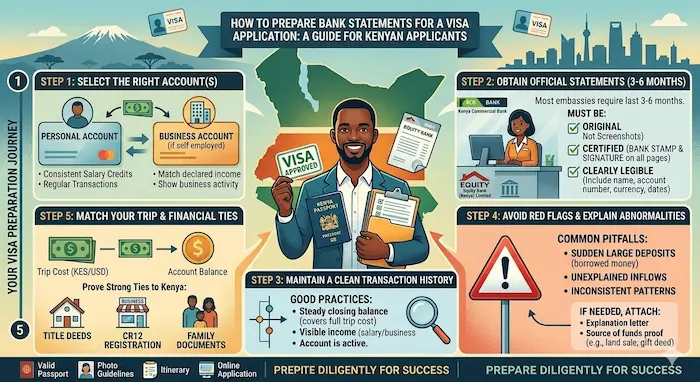

Bank statements are an important part of many visa applications. They can help demonstrate that you have access to enough funds to support your proposed trip and that your financial circumstances are genuine.
However, simply having a large balance in your account does not guarantee visa approval. Visa authorities may look at your overall financial circumstances, income, spending patterns and the purpose of your trip.
If you’re applying for a visa from Kenya, here’s how to prepare your bank statements properly.
Important: Financial requirements vary by country and visa category. There is no universal bank balance that guarantees visa approval. Always check the official requirements for the specific visa you’re applying for.
1. Check the Visa Requirements First
Before downloading your bank statements, find out exactly what the destination country requires.
Some visa authorities may specify:
- Number of months of statements
- Minimum balance or available funds
- Whether statements must be stamped
- Whether online statements are accepted
- Whether a bank reference letter is required
- Whether statements must be accompanied by payslips
- Whether documents need to be translated
For example, one visa application may request several months of bank statements while another may have different requirements.
Don’t use another applicant’s checklist as your guide.
2. Use Your Genuine Bank Account
Your bank statements should come from an account that genuinely belongs to you or is legitimately used for your financial affairs.
Depending on the visa requirements, this could be:
- Personal current account
- Personal savings account
- Business account
- Joint account
- Sponsor’s account
If you are relying on someone else to fund your trip, follow the destination country’s sponsorship requirements instead of presenting their money as your own.
3. Provide the Required Period
One of the most important things is providing the correct period of statements.
If the official requirements request six months, don’t submit only two or three months unless the visa authority specifically allows it.
Make sure the statements:
- Cover the entire requested period
- Show your name
- Show the account details where appropriate
- Clearly display transactions
- Show the statement dates
Avoid submitting incomplete screenshots of your mobile banking application when the authority requires official statements.
4. Get Official Statements
Where required, obtain official statements directly from your bank.
Depending on your bank, you may be able to obtain them through:
- Internet banking
- Mobile banking
- A bank branch
- Email banking services
Some visa applications may require bank statements to be stamped or certified by the bank.
Don’t assume this is necessary for every country. Check the official visa instructions first.
5. Make Sure Your Name Is Clearly Visible
Your bank statement should normally identify the account holder.
Check that:
- Your name is correct
- Your account information is visible where required
- The statement belongs to the account you are presenting
- The dates are clear
If the name on your bank account differs significantly from the name on your passport, investigate whether additional documentation is needed.
6. Your Transactions Should Make Sense
Visa authorities may look beyond the final balance.
They may consider whether your transactions are consistent with your stated circumstances.
For example, if you say you earn KSh 80,000 per month but your account suddenly receives KSh 2 million shortly before your application, you should be able to explain the legitimate source of that money if asked.
The goal isn’t to make your bank account look perfect.
The goal is to provide genuine and credible financial evidence.
7. Avoid Unexplained Large Deposits
This is one of the biggest mistakes applicants can make.
Some applicants may borrow money or temporarily transfer a large amount into their account shortly before applying in an attempt to make their finances appear stronger.
This can raise questions about the source of the funds.
If you legitimately received a large amount, keep evidence showing where it came from.
For example:
- Sale of property
- Business payment
- Salary arrears
- Loan
- Investment proceeds
- Legitimate gift
- Other documented income
If the visa authority asks about the transaction, provide an honest explanation and supporting evidence where appropriate.
8. Don’t Try to Create a “Perfect” Bank Statement
A visa application isn’t about making your bank statement look artificially clean.
Normal accounts have:
- Bills
- Food purchases
- Rent
- Transfers
- Withdrawals
- Mobile payments
- Business transactions
- Other everyday expenses
A normal transaction history isn’t automatically a problem.
What matters is that your financial situation is genuine and reasonably supports your application.
9. Match Your Bank Statement to Your Income
Your financial documents should tell a consistent story.
For example, if you are employed, your:
Employment letter → Salary → Bank deposits → Payslips
should generally make sense together.
If you own a business, your:
Business activity → Business income → Bank transactions → Financial records
should be reasonably consistent.
This doesn’t mean every transaction must be identical to your stated income, but major discrepancies may require explanation.
10. Calculate the Cost of Your Trip
Before applying, prepare a realistic estimate of your travel expenses.
Consider:
- Flights
- Accommodation
- Food
- Local transportation
- Travel insurance
- Visa fees
- Activities
- Emergency funds
- Other planned expenses
Then compare your expected expenses with your available funds.
Remember that the required amount depends on the destination and visa category.
Don’t assume that having a particular amount of money automatically qualifies you for a visa.
11. Include Other Financial Evidence Where Required
Bank statements may be only one part of your financial evidence.
Depending on the visa requirements, you may also need:
For employees
- Employment letter
- Payslips
- Approved leave letter
- Employment contract, where requested
For business owners
- Business registration documents
- Business bank statements
- Tax documents
- Business permits
- Other evidence of business activity
For students
- Sponsorship documents
- Scholarship information
- Parent/guardian financial documents, where applicable
For sponsored travellers
- Sponsorship letter
- Sponsor’s bank statements
- Proof of relationship
- Sponsor’s identification
- Other documents required by the destination country
12. If You Have Multiple Bank Accounts
If you use several accounts, check the visa requirements carefully.
You may need to provide statements from more than one account if those accounts are relevant to demonstrating your finances.
For example:
Account 1: Salary account
Account 2: Savings account
Account 3: Business account
Don’t hide relevant financial information if the application specifically requires it.
13. Don’t Submit Edited or Fake Statements
Never alter a bank statement.
This includes:
- Changing balances
- Removing transactions
- Editing dates
- Changing account numbers
- Adding fake deposits
- Using fake bank stamps
- Creating fake statements
Submitting fraudulent documents can have serious consequences, including refusal and potentially more serious immigration problems.
Always obtain financial documents directly from legitimate sources.
14. Organize Your Bank Documents
Keep your financial documents together in a clearly labelled section.
For example:
FINANCIAL DOCUMENTS
1. Bank Statement — Current Account
2. Bank Statement — Savings Account
3. Bank Reference Letter
4. Payslips
5. Employment Letter
6. Sponsorship Documents
7. Supporting Evidence for Major Transactions
This makes your application easier to review.
15. What If Your Account Balance Is Low?
Having a low balance doesn’t necessarily mean you cannot obtain a visa.
However, you should not suddenly borrow a large amount of money just to make your account appear stronger.
Instead, make sure your application accurately explains:
- Your income
- Your genuine savings
- Who is paying for the trip
- Your travel expenses
- Your employment or business circumstances
If someone is legitimately sponsoring your trip, follow the official sponsorship requirements for the visa.
16. What If You Are Self-Employed?
Self-employed applicants may need to provide additional evidence because their income may not appear as a regular monthly salary.
Depending on the destination, relevant documents could include:
- Business registration
- Business bank statements
- Tax records
- Business permits
- Invoices
- Contracts
- Evidence of ongoing business operations
Only provide documents specifically relevant to the application and required by the visa authority.
17. What If Someone Else Is Paying for Your Trip?
If your parents, spouse, employer, friend or another person is paying for your trip, don’t simply submit their bank statement without explanation.
Follow the destination’s official sponsorship requirements.
You may need to provide:
- Sponsorship letter
- Sponsor’s bank statements
- Proof of relationship
- Sponsor’s identification
- Proof of employment or income
- Evidence of accommodation or other support
The requirements vary considerably between countries.
Bank Statement Visa Checklist
Before submitting your application, check:
- I have checked the official visa requirements.
- I have provided the required number of months.
- My name is clearly shown.
- The statements are genuine and complete.
- The dates cover the required period.
- My income is reasonably consistent with my financial records.
- I can explain significant transactions if asked.
- I have included required payslips or employment evidence.
- I have included sponsorship documents if applicable.
- I have not altered or edited any financial document.
- My documents are organized and easy to find.
- My finances reasonably support my proposed trip.
Common Bank Statement Mistakes to Avoid
❌ Submitting screenshots when official statements are required
Always follow the destination’s document requirements.
❌ Showing only the current balance
The transaction history can be important, depending on the visa requirements.
❌ Making a large unexplained deposit
Be prepared to demonstrate the legitimate source of significant funds.
❌ Borrowing money temporarily
Don’t artificially inflate your account balance for a visa application.
❌ Using fake statements
This can create much more serious problems than a normal visa refusal.
❌ Ignoring other financial evidence
Your bank statements may need to be supported by employment, business or sponsorship documents.
❌ Providing inconsistent information
Your application, employment details, income and financial records should be truthful and reasonably consistent.
How Much Should Be in Your Bank Account for a Visa?
There is no single bank balance that guarantees visa approval.
The amount you need depends on factors such as:
- Destination country
- Visa category
- Length of stay
- Accommodation
- Travel expenses
- Whether someone is sponsoring you
- Your personal financial circumstances
Some countries publish specific financial requirements, while others assess an applicant’s overall circumstances.
Therefore, don’t rely on claims such as:
“You need KSh 500,000 for a visa.”
Such statements can be misleading without knowing the destination and visa category.
Final Thoughts
Preparing bank statements for a visa application is about more than showing a large balance.
Your financial documents should provide a genuine and credible picture of your financial circumstances and support the purpose of your trip.
The safest approach is to:
Check the official requirements → obtain genuine statements → provide the requested period → explain legitimate unusual transactions → organize your documents → submit accurate information.
Never manipulate your bank account or create fake financial documents simply to improve your chances of getting a visa.
And remember: a bank statement alone does not guarantee visa approval.
Always check the latest financial requirements directly with the destination country’s official embassy, consulate or immigration authority before submitting your application.
