

Every major technological breakthrough comes with predictions about what it will make obsolete.
When smartphones became powerful enough to browse the internet, run sophisticated applications and handle tasks once reserved for PCs, many people wondered whether computers were approaching the end of their relevance.
Today, artificial intelligence is generating an even bigger prediction: AI will replace humans.
The comparison is not perfect. AI can perform tasks that previous technologies could not, particularly in areas involving language, analysis, software and information processing.
But the history of smartphones offers an important lesson.
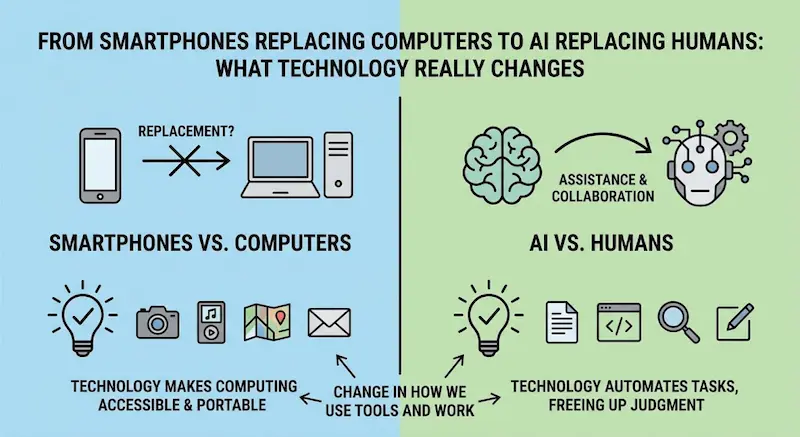
Technology does not always eliminate what came before. Sometimes it changes how we use it.
The same could happen with AI and human work.
Smartphones Did Not Replace Computers
Smartphones absorbed many functions that once required separate devices.
They became cameras, navigation systems, music players, communication tools and increasingly capable computing devices. People could also use them for banking, shopping, work and entertainment from almost anywhere.
Yet computers did not disappear.
Laptops and desktops remained valuable for programming, professional design, large-scale data work, complex business applications and tasks requiring a larger screen and physical keyboard.
The smartphone did not make computing unnecessary.
It made computing more accessible and portable.
That distinction matters when considering artificial intelligence.
Why AI Is a Bigger Disruption
AI is different because it can work directly with information and increasingly perform parts of knowledge-based work.
It can generate text, analyse documents, write and review code, summarize information, create images and assist with research and customer service.
That makes AI more disruptive to office and professional work than many earlier consumer technologies.
But there is an important distinction between automating a task and eliminating an entire occupation.
Most jobs consist of multiple activities.
A journalist, for example, may research a subject, interview people, verify information, analyse documents, write and edit stories.
AI can assist with some of these activities. It does not automatically assume responsibility for the entire job.
The same principle applies across accounting, marketing, software development, education, customer service and many other fields.
The First Impact Will Be on Tasks
Rather than asking whether AI will eliminate a profession overnight, it is more useful to ask which parts of that profession can be automated.
Tasks that are repetitive, predictable and primarily digital are among the easiest candidates.
These can include:
- Basic data processing
- Transcription
- Routine document preparation
- Simple customer support
- Basic reporting
- Repetitive administrative work
- Some forms of content production
Automation could reduce the amount of time people spend on these activities.
For businesses, that may mean higher productivity and lower operating costs.
For workers, it could mean that some responsibilities disappear while others become more important.
That is where the real transformation begins.
AI Could Change What Employers Look For
As AI handles more routine work, employers may place greater value on abilities that are difficult to automate effectively.
These include:
- Critical thinking
- Communication
- Leadership
- Problem-solving
- Creativity
- Decision-making
- Domain expertise
- Relationship building
The ability to use AI itself may also become a professional skill.
Consider two employees doing similar work. One uses AI to organize information, automate repetitive tasks and produce initial drafts. The other performs the same work entirely manually.
If the quality is comparable, the AI-assisted employee may be able to accomplish more in less time.
This means the future competition may not simply be between people and machines.
It may increasingly be between people who know how to use AI and people who do not.
What AI Could Mean for Kenya
The impact will not be limited to Silicon Valley or large technology companies.
Kenyan businesses are already accustomed to adopting digital tools for payments, communication, commerce and business operations. AI could become another layer of that digital transformation.
A small business could use AI to draft marketing material, analyse customer feedback, prepare documents or assist with customer enquiries without building a large technology team.
Developers can use AI coding assistants to accelerate parts of software development.
Journalists can use AI to organize large amounts of information and assist with research, while retaining responsibility for accuracy and editorial judgment.
Students can use AI as a learning and research assistant.
But the benefits will not be evenly distributed.
Workers whose roles depend heavily on repetitive digital tasks may face pressure to acquire new skills. Businesses may also need to rethink how they train employees and organize work.
For Kenya, therefore, the AI conversation should not only be about automation.
It should also be about skills, productivity and access to opportunity.
Not Every AI Prediction Will Come True
Technology forecasts often focus on what a system can technically accomplish.
Real-world adoption is more complicated.
Cost, reliability, regulation, infrastructure, customer preferences and trust all influence whether businesses actually replace a human process with software.
A company may have an AI system capable of performing a task but still require a person to supervise it because mistakes could have financial, legal or reputational consequences.
This is why technological capability does not automatically translate into complete replacement.
The technology has to work in the real world.
Some Jobs Will Still Change Dramatically
None of this means workers should ignore the risks.
AI-driven automation will almost certainly reduce demand for some types of work.
Some businesses may require fewer employees to perform particular functions. Certain entry-level roles could become harder to access if companies automate tasks traditionally given to junior workers.
Entire occupations may also be redesigned as AI capabilities improve.
That creates a difficult transition.
A worker whose role changes may need training before they can move into the next opportunity. Businesses will have to decide how much of that responsibility they are prepared to take on.
Governments and education systems will also face pressure to ensure that people can acquire relevant digital skills.
The important point is that technological progress can create winners and losers during the transition.
The Smartphone Lesson Is Not “Technology Never Replaces Anything”
There is a danger in taking the smartphone comparison too far.
Technology does replace things.
Smartphones reduced the need for standalone cameras, MP3 players, GPS devices and other products.
Similarly, AI may eliminate certain tasks and reduce demand for some services.
The lesson is not that people should ignore predictions of disruption.
It is that replacement is only one part of technological change.
New technology can also create entirely new products, businesses and forms of work.
The smartphone created an enormous app economy that would have been difficult to imagine before mobile computing became widespread.
AI could produce similarly unexpected opportunities.
The Next Generation May See AI Differently
For people entering the workforce today, AI may eventually become as ordinary as search engines, smartphones and cloud software.
The question may no longer be whether AI should be used.
Instead, it could become:
Which parts of this task should be handled by AI, and which require human judgment?
That is a significant change in how work is organized.
A marketer may focus more on strategy while AI handles parts of content production.
A developer may spend less time writing routine code and more time designing systems and reviewing outputs.
An analyst may spend less time preparing data and more time interpreting what it means.
The job remains, but the balance of activities changes.
The Bigger Question Is Human Adaptation
The debate over AI often presents two extreme futures.
In one, AI changes almost nothing.
In the other, machines take every job and humans become economically irrelevant.
Reality is likely to be considerably more complicated.
Some work will disappear.
Some jobs will be transformed.
New opportunities will emerge.
And many workers will use AI to become more productive rather than being replaced by it.
The people best positioned for this transition are likely to be those who combine professional knowledge with technological adaptability.
Knowing how to use AI is useful.
Knowing when not to use it may be just as important.
AI May Change Human Work More Than It Eliminates It
The computer did not eliminate office workers.
The internet did not eliminate businesses.
The smartphone did not eliminate computers.
Each technology changed what people could do and how they did it.
AI is now reaching deeper into the process of knowledge work, which makes its impact potentially much larger.
But the central question should not simply be whether AI will replace humans.
It should be:
What will humans do when machines can handle more of the work?
The answer will depend on how quickly workers adapt, how businesses deploy the technology and whether education systems keep pace.
The future may not belong to humans who compete directly with machines.
It may belong to those who understand how to combine human judgment with machine capability.
The smartphone changed computing without making computers irrelevant.
AI could change work without making humans irrelevant.
But unlike previous technological shifts, this time the responsibility for adapting may be much more personal: learn the technology, understand its limits and find the work where human judgment creates the greatest value.
Frequently Asked Questions
Will AI replace humans completely?
There is no simple evidence that AI will eliminate the need for humans across every profession. Its more immediate impact is likely to involve automating specific tasks and changing how many jobs are performed.
Will AI replace jobs?
Yes, some tasks and potentially some roles are likely to be automated. At the same time, AI can create new opportunities and increase productivity in existing jobs.
Did smartphones replace computers?
No. Smartphones replaced some standalone devices and expanded access to computing, but computers remain important for many professional and complex tasks.
Which jobs are most exposed to AI?
Work involving repetitive, predictable and highly digital tasks is generally more exposed to automation. However, exposure does not necessarily mean an entire occupation will disappear.
What skills will matter in the AI era?
Critical thinking, communication, creativity, problem-solving, domain expertise, decision-making and the ability to use AI effectively are likely to become increasingly valuable.
Final Takeaway
The history of technology shows that the biggest changes do not always come from one device completely replacing another.
They come from technology changing what becomes possible.
Smartphones changed computing.
AI is now changing the possibilities of work.
The winners may not be those who predict whether AI will replace humans.
They may be those who understand the transformation early enough to adapt.
