
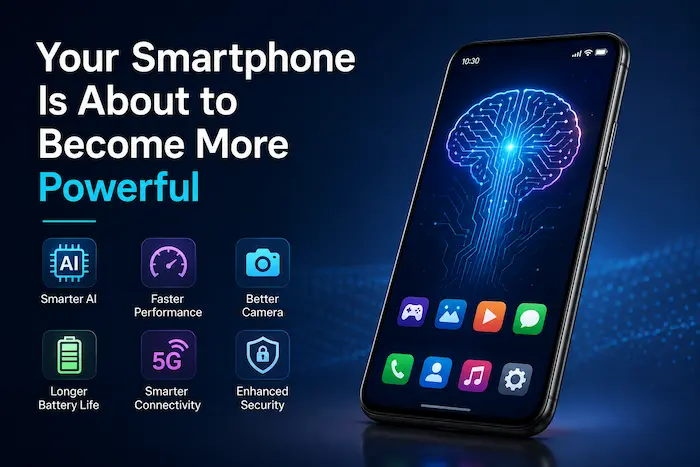

For more than a decade, smartphone innovation was easy to understand.
Manufacturers competed over larger displays, better cameras, faster processors and bigger batteries.
Those improvements still matter.
But the smartphone industry is now entering another phase.
The biggest changes are increasingly happening inside the phone’s processor and software rather than simply on the specification sheet.
Modern smartphones can process AI workloads locally, understand images and speech, edit photographs automatically and, on supported devices and networks, communicate through satellites when conventional cellular coverage isn’t available.
This raises an important question for anyone buying a smartphone in 2026:
What should you actually look for in a modern phone?
The answer increasingly goes beyond megapixels and processor speed.
Here are the technologies changing smartphones and what they could mean for Kenyan users.
1. Smartphones Are Becoming AI Computers
One of the biggest changes is the movement of artificial intelligence from the cloud toward the device itself.
Traditionally, many AI services worked like this:
Phone → Internet → Cloud server → AI processing → Phone
Your smartphone collected the request and sent it to a remote data centre, where the AI model processed the information before returning a response.
Increasingly, some AI workloads can happen directly on the smartphone.
The process can instead look like:
Phone → AI processor → Result
This is known as on-device AI.
Depending on the application and hardware, a phone can perform tasks such as:
- Voice transcription
- Image recognition
- Photo editing
- Translation
- Text summarisation
- Generative AI
- Voice processing
- Personalisation
- AI-assisted search
without necessarily sending every part of the task to a remote server.
That does not mean cloud computing is disappearing.
Large AI models still require substantial computing resources, and many smartphone AI services continue to depend on internet connectivity.
The future is more likely to be a combination of:
On-device AI + edge computing + cloud AI.
2. Why the NPU Matters
Most smartphone buyers know about the CPU and GPU.
The CPU handles general computing tasks.
The GPU is particularly important for graphics and parallel workloads.
Modern smartphones increasingly add another component: the Neural Processing Unit, or NPU.
An NPU is designed to accelerate certain artificial-intelligence and machine-learning workloads.
A simple way to understand the difference is:
CPU → General computing
GPU → Graphics and parallel processing
NPU → AI and machine-learning workloads
This matters because AI applications can require large amounts of computation.
Instead of making the CPU handle every AI task, manufacturers can use specialised hardware to process certain workloads more efficiently.
For smartphone buyers, this means the processor name alone may no longer tell the complete story.
Two phones can have similarly named CPUs but offer very different AI capabilities depending on their NPU, memory, software and supported models.
3. The Smartphone Processor Is Becoming an AI Platform
Qualcomm, Apple, MediaTek and Samsung are increasingly designing mobile platforms with AI processing as a central capability rather than an afterthought.
The latest high-end smartphone processors combine CPUs, GPUs, NPUs and image-processing hardware to handle different workloads.
This allows smartphones to perform increasingly complex tasks locally.
For example, an AI-enabled phone can potentially analyse a photograph, identify objects and improve the image without requiring every step to happen in the cloud.
The same principle can apply to speech.
A smartphone can process voice input, convert speech into text and perform other language-related tasks locally when the necessary model and hardware are available.
This changes the role of the processor.
It is no longer simply about:
“How fast does the phone open applications?”
It is increasingly about:
“What can the phone intelligently process by itself?”
4. What On-Device AI Means for Kenyan Users
On-device AI is particularly interesting in markets where connectivity can vary significantly between locations.
Consider someone travelling outside a major Kenyan town.
A cloud-based AI feature may struggle if the internet connection is slow or unavailable.
An AI feature designed to operate locally could continue performing certain tasks without a constant connection.
Potential benefits include:
Faster responses
Local processing can reduce the need to send information to a remote server and wait for a response.
Reduced dependence on mobile data
Certain AI tasks can potentially be performed without continuously uploading information.
Greater privacy
When processing happens locally, some personal information may not need to leave the device.
Offline functionality
Some AI capabilities can remain available even when the phone temporarily has no internet connection.
However, buyers should not assume that all AI features work offline.
Many smartphone AI services still require an internet connection.
The important question is therefore not simply whether a phone has AI.
It is:
Which AI features actually run on the device?
5. AI Agents Could Change How We Use Smartphones
Today’s AI assistants are primarily designed to answer questions and generate information.
The next step is increasingly focused on AI agents.
An AI agent is designed to perform multiple steps toward completing a task rather than simply answering a single question.
For example, instead of asking:
“Find restaurants near me.”
a future AI assistant could potentially handle a broader instruction such as:
“Find a suitable restaurant nearby, check its availability and put the booking in my calendar.”
The important difference is that the AI is potentially performing a sequence of actions.
This requires the smartphone to understand more context.
It may need access to information such as:
- Calendar
- Location
- Contacts
- Messages
- Photos
- Applications
- Voice commands
- Current activity
That makes the smartphone an interesting platform for personal AI.
It is already one of the devices people carry everywhere and use throughout the day.
6. Smartphones Are Becoming More Context-Aware
A modern phone already knows a surprising amount about its environment.
It can determine things such as:
- Location
- Time
- Battery level
- Network availability
- Movement
- Screen activity
- Calendar events
- Camera input
- Voice input
AI can use some of that information to provide more context-aware experiences.
Imagine your phone recognising that you are travelling, checking your calendar and identifying that you have an upcoming meeting.
Instead of simply answering a question, an AI assistant could eventually help you prepare for the next activity.
However, this capability also introduces an important issue:
privacy.
The more context an AI system can access, the more carefully permissions and personal-data protection need to be designed.
For consumers, AI capability should therefore be evaluated alongside privacy controls and security.
7. Satellite Connectivity Is Changing What “Mobile” Means
AI isn’t the only technology changing smartphones.
Connectivity is also evolving.
For decades, mobile phones have primarily relied on a simple model:
Phone → Cellular tower → Mobile network
That model works extremely well in populated areas.
But it becomes more difficult in remote locations where building and maintaining cellular infrastructure is expensive.
Satellite-to-phone technology introduces another possibility:
Phone → Satellite → Network
This can potentially extend connectivity beyond the physical reach of conventional towers.
The technology is particularly interesting because some emerging systems are designed to communicate with compatible smartphones without requiring users to carry a traditional satellite phone.
8. Why Satellite Connectivity Could Matter in Kenya
Kenya has a wide geographic area containing cities, rural communities, highways, agricultural regions, conservation areas and remote locations.
Traditional cellular infrastructure cannot economically provide identical coverage everywhere.
Satellite connectivity could eventually provide an additional layer of communication in locations where terrestrial networks are unavailable.
Potential applications include:
- Emergency communication
- Remote travel
- Conservation work
- Long-distance transport
- Humanitarian operations
- Remote businesses
- Rural communities
- Disaster response
For example, a traveller driving through a remote area could potentially use a compatible smartphone to send a message even after leaving conventional cellular coverage.
That could be much more important than simply having another way to browse the internet.
9. Satellite Connectivity Won’t Replace 4G and 5G
It is important to keep expectations realistic.
Satellite connectivity isn’t necessarily a replacement for conventional mobile networks.
For most people in Nairobi, Mombasa or other areas with strong cellular coverage, a normal 4G or 5G connection will remain the primary option.
Satellite networks are better understood as an additional connectivity layer.
A simplified hierarchy could look like:
Wi-Fi → primary connection where available
4G/5G → primary mobile connectivity
Satellite → remote or backup connectivity
The exact capabilities depend on the satellite system, smartphone, mobile operator and regulatory approval in each country.
This means consumers should not buy a phone simply because it has a “satellite” feature without checking exactly what that feature supports.
10. AI Is Also Transforming Smartphone Cameras
Smartphone photography has changed dramatically.
The camera sensor is still important, but the final image increasingly depends on computational photography.
Instead of simply:
Capture → Photograph
the process can involve:
Capture → Analyse → Combine → Enhance → Final image
AI and computational photography can assist with:
- HDR
- Noise reduction
- Portrait effects
- Night photography
- Image sharpening
- Object removal
- Video stabilisation
- Scene recognition
- Image enhancement
This is why comparing smartphone cameras purely by megapixels can be misleading.
A 200MP camera isn’t automatically better than a 50MP camera.
Image quality depends on a combination of:
Sensor + lens + image signal processor + AI processing + software.
For buyers, this means camera reviews should increasingly focus on actual image quality, not just the number printed on the specification sheet.
11. RAM Is Becoming More Important for AI
Memory is another area that smartphone buyers should pay attention to.
AI workloads can require significant memory because models and associated data need to be accessible while applications are running.
This makes RAM increasingly relevant as manufacturers add more AI functionality.
That doesn’t mean everyone needs a phone with the largest possible RAM configuration.
A normal user who mainly uses WhatsApp, Facebook, TikTok, banking applications and web browsers has different requirements from someone running demanding games, editing video or using advanced AI tools.
But buying a phone with extremely limited RAM can reduce its ability to handle increasingly demanding software several years into the future.
This is one reason future-proofing matters when buying a smartphone.
12. Smartphones Are Moving Closer to PCs
Another trend is the growing computing power of smartphones.
High-end mobile processors are now capable of handling workloads that previously required a laptop or desktop computer.
Samsung’s DeX platform provides one example of this direction by allowing compatible Galaxy phones to provide a desktop-style experience with appropriate external hardware.
The idea is simple:
One powerful computer in your pocket.
Instead of maintaining separate devices for every task, a sufficiently powerful smartphone could potentially handle communication, entertainment, photography, productivity and some desktop workloads.
However, smartphones are not automatically laptop replacements.
A laptop still offers advantages such as:
- Larger screen
- Physical keyboard
- Better multitasking
- More ports
- Desktop operating systems
- Greater storage options
The important trend is not that smartphones are replacing PCs today.
It is that the performance gap between the two categories continues to narrow for certain workloads.
13. What Should You Look for When Buying a Smartphone in 2026?
The changing smartphone market means buyers should look beyond traditional specifications.
Instead of asking only:
“How many megapixels does it have?”
consider asking:
Does the processor have dedicated AI acceleration?
Which AI features work offline?
How much RAM does the phone have?
How long will the manufacturer provide software updates?
Does it support 5G?
Does it support satellite communication?
How good is the camera in real-world use?
How long is the battery likely to last?
Does the manufacturer provide security updates?
Is the AI functionality actually useful for your daily routine?
These questions provide a better picture of a phone’s long-term value.
14. What This Means for Kenyan Smartphone Buyers
These changes are not simply technological experiments.
They can eventually affect how Kenyans use smartphones every day.
AI could reduce dependence on the cloud
Some tasks may increasingly be performed locally, reducing the need for constant connectivity.
Remote communication could improve
Satellite-to-phone services could provide another communication option in locations where conventional networks aren’t available.
Smartphone cameras could become more intelligent
Computational photography may matter as much as camera hardware.
Phones could remain useful for longer
Devices with capable processors and long software-support periods may have a better chance of handling future applications.
Smartphones may become more expensive
There is also a trade-off.
More advanced processors, AI hardware, cameras and connectivity systems can increase manufacturing costs.
That means consumers may have to decide which capabilities actually matter to them.
15. Do You Need an AI Smartphone in 2026?
Not necessarily.
The fact that a phone has AI does not automatically make it a better purchase.
If you mainly use your smartphone for:
- Calls
- Social media
- Mobile banking
- YouTube
- Music
- Basic photography
you may not need the most powerful AI smartphone available.
However, AI capabilities become more interesting if you regularly:
- Create content
- Record interviews
- Study
- Edit photographs
- Translate information
- Research topics
- Use AI assistants
- Work from your phone
For these users, dedicated AI hardware and software can provide practical benefits.
The important thing is to buy according to your workload, not the marketing label.
The Bigger Change: Smartphones Are Becoming More Intelligent
The smartphone industry is moving beyond the traditional race for bigger specifications.
The next phase is increasingly about what the device can understand, process and do.
Four technologies are driving much of that change:
On-device AI → more processing directly on the phone
AI accelerators → faster specialised workloads
Satellite connectivity → communication beyond conventional cellular coverage
AI agents → software that can potentially perform multi-step tasks
At the same time, improvements in cameras, memory, batteries and processors are making smartphones more capable computers.
For Kenya, these developments could be particularly significant.
A smartphone could increasingly become a tool that works in more environments, performs more tasks locally and provides connectivity beyond the reach of traditional mobile towers.
But consumers should be careful about the hype.
Not every phone marketed as an “AI phone” offers the same capabilities.
Not every satellite-enabled device provides satellite internet.
And more RAM or more megapixels do not automatically mean a better smartphone.
The smarter way to buy a phone in 2026 is to look at the entire system:
Processor + NPU + RAM + camera processing + connectivity + software support + battery + real-world usefulness.
The biggest smartphone upgrade of the next few years may therefore not be the camera on the back or the screen on the front.
It may be the intelligence happening inside the device.
