


The smartphone is no longer just a device for calls, messaging, social media and photography. It is rapidly becoming a pocket-sized computer capable of handling tasks that once required powerful laptops or even cloud servers.
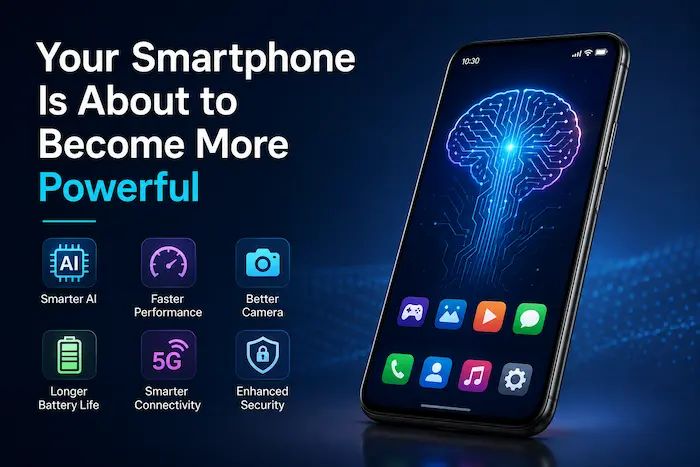
From on-device artificial intelligence and faster processors to improved cameras, satellite connectivity and smarter batteries, the next generation of smartphones is set to become significantly more capable.
For users in Kenya and across Africa, these changes could have an even bigger impact as smartphones increasingly become the primary way people access the internet, banking services, entertainment, education and digital work.
AI Is Turning Smartphones Into Smarter Computers
One of the biggest changes coming to smartphones is the rapid integration of artificial intelligence.
Modern flagship phones already include dedicated hardware for AI processing, allowing them to perform certain tasks directly on the device rather than sending everything to the cloud.
This trend is expected to accelerate.
Future smartphones will increasingly be able to:
- Summarize calls, messages and documents
- Translate conversations in real time
- Edit photos automatically
- Remove unwanted objects from images
- Generate or improve text
- Organize information across different apps
- Provide personalized recommendations
- Recognize objects and scenes through the camera
- Assist with productivity tasks
The important change is that AI will become less of a separate feature and more of a built-in layer across the entire smartphone experience.
Instead of opening an AI chatbot and asking it a question, users could simply tell their phone what they want done.
For example, you might say:
“Find the message John sent me about tomorrow’s meeting and add the meeting to my calendar.”
The smartphone could potentially understand the request, search the relevant information and complete the task.
Smartphone Processors Are Becoming More Powerful
The processor inside your phone is becoming increasingly important.
Companies such as Qualcomm, MediaTek, Apple and Samsung continue to develop chips that deliver higher CPU and GPU performance while improving energy efficiency.
But raw performance is no longer the only goal.
Chip manufacturers are increasingly focusing on specialized processing units for AI, image processing, security and other workloads.
This means future phones won’t simply be “faster.” They will be better at specific tasks.
A phone could simultaneously handle gaming, video editing, AI processing, photography and background applications without the performance limitations users experienced on older devices.
That could also reduce the gap between smartphones and entry-level laptops for everyday computing.
Your Phone Could Become Your AI Assistant
The next major evolution could be the smartphone becoming a genuinely useful personal assistant.
Current voice assistants can answer questions and perform simple commands, but AI-powered assistants are becoming much more capable.
Instead of simply asking your phone for the weather, you could eventually ask it to:
- Compare flight prices
- Summarize your emails
- Prepare a shopping list
- Analyze a document
- Draft a business proposal
- Find information from your phone
- Plan your schedule
- Translate conversations
- Help you research a topic
The biggest breakthrough will come when AI assistants can understand context.
Your phone could know what you are working on, which applications you are using and what information is relevant to your request.
That could make smartphones dramatically more useful for students, entrepreneurs, professionals and content creators.
Cameras Are Becoming Computational Systems
Smartphone photography has already changed dramatically.
Modern phones use computational photography to produce images that would have been difficult to capture with traditional smartphone cameras.
AI can improve:
- Low-light photography
- Portrait photography
- Zoom
- Image stabilization
- HDR
- Skin tones
- Object detection
- Video quality
The future could take this much further.
Instead of simply capturing what the camera sees, your smartphone could increasingly understand what it sees.
For example, AI could identify a document, automatically correct its perspective, remove shadows and create a clean digital copy.
For content creators, this could mean producing professional-looking photos and videos without expensive equipment.
On-Device AI Could Improve Privacy
There is another important reason smartphone companies are investing in on-device AI.
Privacy.
If an AI task can be performed directly on your phone, there may be less need to send sensitive information to remote servers.
This could be particularly important for:
- Personal documents
- Private messages
- Photos
- Financial information
- Voice recordings
- Business information
Not every AI task will be processed locally. Cloud computing will remain important for larger workloads.
However, the combination of on-device and cloud AI could give users a balance between performance, privacy and convenience.
Smartphones Could Become More Useful Without Internet Access
Another interesting development is the ability to run more sophisticated AI models directly on smartphones.
That means some features could continue working even when internet connectivity is poor or unavailable.
This is particularly relevant in markets such as Kenya, where connectivity quality can vary depending on location.
Imagine being able to use your phone to translate text, summarize a document or perform certain AI-powered tasks while offline.
That would make smartphones more useful in rural areas, during travel and in situations where mobile data is unavailable.
Battery Technology Remains Critical
There is one major challenge.
More powerful processors and AI features can consume more energy.
This is why battery technology will be just as important as processor performance.
Smartphone manufacturers are working on improving battery capacity, charging speeds and power efficiency.
Future phones could deliver longer battery life not necessarily because batteries become dramatically larger, but because processors and software become more efficient.
AI could also help manage power consumption by learning how users interact with their devices and intelligently controlling background processes.
Connectivity Is Getting Smarter
Smartphones are also becoming more connected.
5G networks are already available in many markets, while satellite connectivity is emerging as another important capability.
Satellite communication could eventually allow smartphones to send messages or emergency information in locations without conventional mobile network coverage.
This could be particularly valuable in remote parts of Africa.
Meanwhile, improvements in Wi-Fi, Bluetooth and cellular technologies will continue to make smartphones better connected to cars, computers, smart home devices and other electronics.
Your Smartphone Could Replace More Devices
As smartphones become more powerful, they could gradually replace some devices people currently use separately.
A powerful smartphone can already function as:
- A camera
- GPS navigation system
- Music player
- Gaming device
- Video player
- Mobile banking terminal
- E-reader
- Voice recorder
- Portable hotspot
- Work computer
With better processors, AI and connectivity, the list could become even longer.
For some users, a smartphone connected to a monitor, keyboard and mouse could become a lightweight desktop computer.
This could be especially important in emerging markets where buying several separate computing devices is expensive.
Gaming Will Become More Powerful
Mobile gaming is another area that will benefit from stronger hardware.
Modern flagship smartphones can already run sophisticated games with console-like graphics.
As GPUs become more powerful, developers will be able to create increasingly complex games for mobile platforms.
Better displays, faster refresh rates and improved cooling systems will also help.
Cloud gaming could further expand the possibilities by allowing smartphones to stream demanding games from remote servers.
Smartphones Will Become More Personalized
The smartphone of the future may also feel much more personal.
AI systems can learn how users communicate, work, consume content and interact with their devices.
This could allow phones to adapt automatically.
For example, your smartphone might recognize that you are travelling and automatically provide translation tools, maps and relevant travel information.
When you are working, it could prioritize productivity applications and notifications.
When you are driving, it could simplify the interface and reduce distractions.
The goal is to make the smartphone less of a collection of apps and more of an intelligent computing companion.
What This Means for Kenya
Kenya is already a highly mobile-first market.
Smartphones are central to mobile money, online shopping, social media, digital banking, ride-hailing, education and business.
As smartphone capabilities improve, more services could move onto mobile devices.
Small businesses could use smartphones for accounting, marketing, customer management and AI-powered content creation.
Students could use AI tools for research and learning.
Creators could produce high-quality videos without investing heavily in cameras and computers.
Entrepreneurs could manage entire businesses from their phones.
And mobile financial services could become even more sophisticated.
This makes the smartphone not just a consumer gadget but an increasingly important economic tool.
But More Powerful Does Not Always Mean Better
There are still challenges.
More advanced smartphones are likely to remain expensive at the high end.
AI features could also raise questions around privacy, misinformation and data security.
Battery life remains a concern.
Software support will become increasingly important because many AI capabilities depend on updates.
There is also the risk that consumers will be encouraged to upgrade unnecessarily when their existing phones are still perfectly capable.
The real test will therefore not be how many AI features manufacturers can add, but how useful those features actually become.
The Smartphone Is Becoming a Computer You Carry Everywhere
The smartphone industry is entering a new phase.
The next major smartphone upgrade may not be defined by a slightly better camera or a processor that is 10% faster.
Instead, the biggest transformation could be the combination of AI, powerful chips, better cameras, improved batteries, faster connectivity and smarter software.
Your phone is gradually becoming something more than a communication device.
It is becoming a personal computer, AI assistant, camera, financial tool and digital workspace—all in your pocket.
And as these technologies become cheaper and move from flagship devices into affordable smartphones, their impact could be even greater in markets such as Kenya and the rest of Africa.
The smartphone revolution is far from over.
The next smartphone may not simply be more powerful. It may be significantly smarter.
