
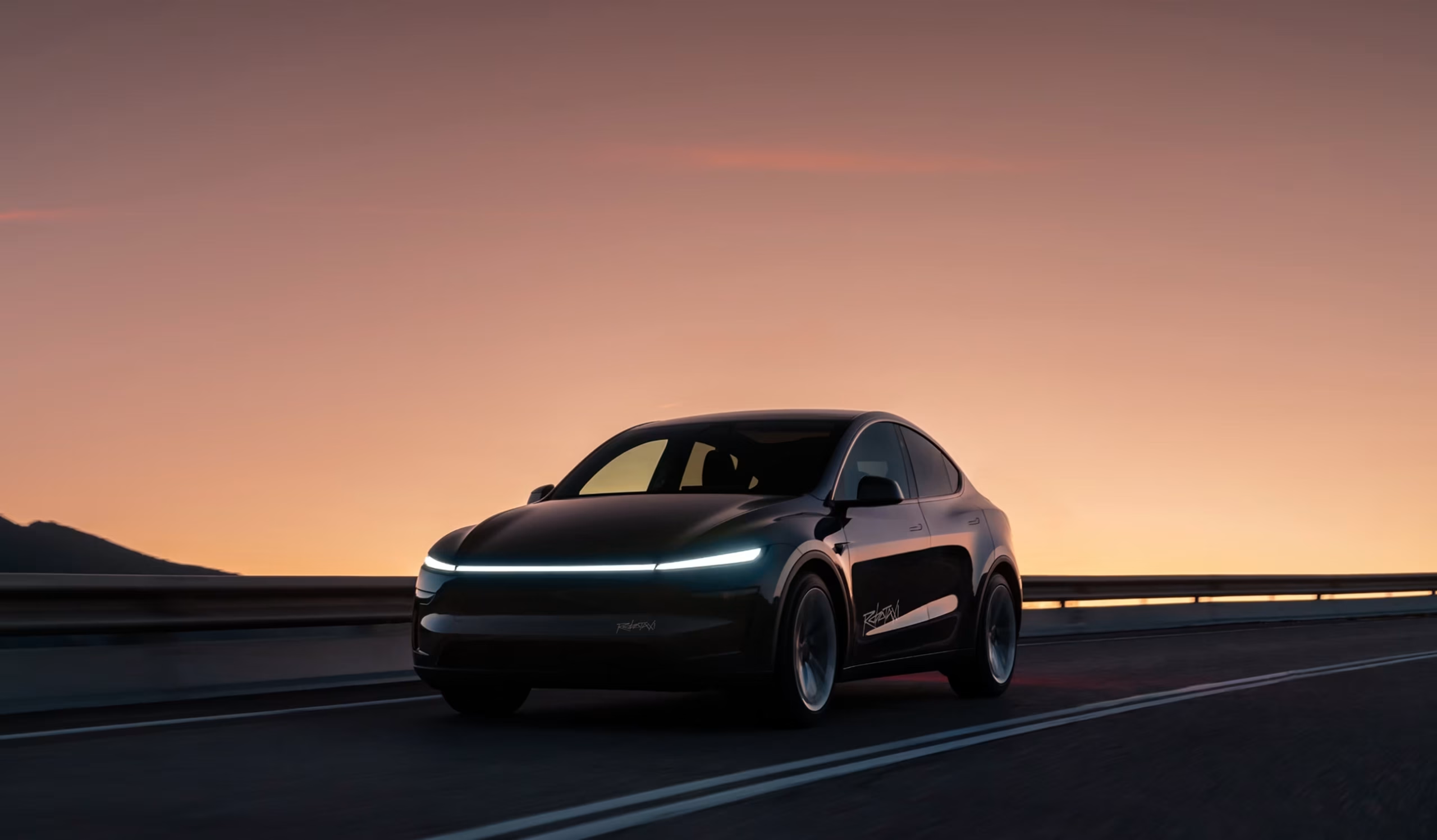

Baidu is taking another step toward expanding its autonomous-driving technology internationally with the introduction of its Apollo Go robotaxi service in London.
The London programme gives Baidu an opportunity to test its autonomous-driving technology in one of Europe’s most complicated urban environments. The company is working with established mobility platforms Lyft and FREENOW as it explores how autonomous vehicles could eventually become part of London’s wider transportation ecosystem.
The move is significant because autonomous driving is increasingly shifting from controlled demonstrations and technology trials toward real-world testing involving everyday roads, passengers and traffic conditions.
For Baidu, London is not simply another city to test its vehicles. It is a demanding environment that can provide valuable information about how autonomous systems perform outside the company’s established Chinese operating markets.
What Is Baidu’s Apollo Go?
Apollo Go is Baidu’s autonomous ride-hailing platform.
Instead of relying entirely on a human driver, the system combines sensors, computing hardware, mapping technology and artificial intelligence to help vehicles understand their surroundings and navigate roads.
Autonomous vehicles typically use multiple sources of information, including:
- Cameras
- Radar
- LiDAR
- High-definition mapping
- Positioning systems
- On-board computing
- Artificial intelligence software
The different systems work together to identify objects and road conditions and help the vehicle determine an appropriate driving response.
An important part of autonomous driving is redundancy. A vehicle cannot safely depend on a single sensor because cameras, radar and LiDAR each have different strengths and weaknesses.
Why London Is an Important Test
London presents a particularly demanding environment for autonomous vehicles.
The city’s roads combine modern infrastructure with historic streets that were not necessarily designed for today’s traffic volumes.
An autonomous vehicle operating in London may encounter:
- Heavy traffic
- Narrow streets
- Complex intersections
- Roundabouts
- Pedestrians
- Cyclists
- Buses
- Motorcycles
- Emergency vehicles
- Road construction
- Temporary lane closures
- Unpredictable traffic behaviour
These situations require autonomous-driving systems to respond to constantly changing conditions rather than simply following predetermined routes.
For Baidu, operating successfully in such an environment could provide useful evidence about how adaptable Apollo Go is outside the road environments where it has already accumulated significant operating experience.
Why the Lyft and FREENOW Partnerships Matter
Baidu’s collaboration with Lyft and FREENOW is important because autonomous transportation is not only a technology challenge.
A robotaxi service also needs a customer-facing platform, vehicle operations, routing, payment systems and a way for passengers to request rides.
Working with established mobility platforms could help connect autonomous vehicles with existing transportation infrastructure and customers.
For passengers, the long-term vision is relatively straightforward: instead of opening a completely separate application, a user could potentially request an autonomous ride through a familiar mobility platform.
However, the exact availability of autonomous rides and the role of each partner will depend on the scope and regulatory conditions of the London programme.
How a Robotaxi Works
A robotaxi needs to perform many of the same tasks as a human driver, but using sensors and software rather than human perception and judgement.
The system must continuously answer questions such as:
What is around the vehicle?
The sensors identify vehicles, pedestrians, cyclists, road markings, traffic signals and other objects.
Where is the vehicle?
Positioning technology and mapping help determine the vehicle’s location and the road it is travelling on.
What is likely to happen next?
AI software analyses the surrounding environment and attempts to predict the movement of other road users.
What should the vehicle do?
The autonomous-driving system determines actions such as slowing down, stopping, changing direction or continuing along the route.
This process happens continuously while the vehicle is operating.
London Will Test More Than the Technology
One of the most important aspects of an autonomous-driving pilot is that it tests the entire operating system, not just the vehicle.
Baidu must demonstrate that its technology can function within a real transportation environment involving:
- Traffic regulations
- Passenger safety
- Vehicle maintenance
- Remote assistance
- Customer support
- Emergency procedures
- Insurance requirements
- Data management
- Road infrastructure
A robotaxi can perform well in a controlled demonstration but still face challenges when deployed at scale.
Real-world operation therefore provides information that cannot easily be obtained from laboratory testing alone.
Regulation Will Be Critical
Technology is only one part of the autonomous-driving equation.
The UK’s regulatory framework plays a major role in determining where, when and how autonomous vehicles can operate.
Companies must demonstrate that their systems meet applicable safety and operational requirements before expanding autonomous services.
Regulation is particularly important because an autonomous vehicle makes decisions that can directly affect pedestrians, cyclists and other road users.
The industry therefore faces a difficult balance:
Regulation must protect public safety without preventing useful autonomous-driving technology from being tested and improved.
Public Trust Could Be Just as Important as Technology
Even if autonomous vehicles meet technical safety requirements, passengers still need to trust them.
A person may be comfortable allowing an AI system to recommend a restaurant or summarise an email but feel very differently about allowing that system to control a vehicle travelling through busy city streets.
Public acceptance will depend on factors such as:
- Safety performance
- Transparency
- Reliability
- Passenger experience
- How emergencies are handled
- How companies respond to accidents or technical failures
Early robotaxi programmes therefore serve another purpose: familiarising the public with autonomous transportation.
What Could Robotaxis Change?
If autonomous ride-hailing becomes commercially viable, its impact could extend beyond replacing human drivers.
Greater Transportation Availability
Robotaxis could potentially provide transportation during periods when traditional driver availability is limited.
Accessibility
Autonomous transportation could eventually provide additional mobility options for some elderly passengers and people with disabilities, provided the vehicles and services are designed with accessibility in mind.
Fleet-Based Transportation
Instead of every person owning a private vehicle, autonomous fleets could operate continuously and transport multiple passengers throughout the day.
Changes to Ride-Hailing Economics
Driver costs are a major component of traditional ride-hailing operations. Autonomous fleets could change the economics of the industry, although vehicles, maintenance, insurance, computing infrastructure and regulatory compliance would still create substantial costs.
It is therefore too early to assume that robotaxis will automatically be cheaper than conventional taxis or ride-hailing services.
The Competition Is Becoming Global
Baidu is entering an increasingly competitive autonomous-driving market.
Companies including Waymo, Tesla, Zoox, Mobileye, Pony.ai and WeRide are pursuing different approaches to autonomous transportation.
Some focus heavily on robotaxi operations, while others are developing autonomous-driving technology for passenger vehicles, commercial fleets or other transportation applications.
The competition is no longer limited to improving self-driving software.
Companies must also solve the difficult problems of:
- Safety
- Regulation
- Fleet management
- Mapping
- Computing infrastructure
- Vehicle manufacturing
- Insurance
- Customer adoption
The winners may ultimately be the companies capable of solving all of these problems rather than simply developing the most advanced driving algorithm.
What Could Baidu Learn From London?
The London deployment could provide Baidu with valuable operational data.
The company can potentially learn how its autonomous systems respond to situations that are more common in European cities than in many of its existing markets.
Examples include complex road layouts, different driving behaviours, cycling infrastructure, traffic patterns and local road regulations.
That information could help Baidu improve Apollo Go before expanding into additional international markets.
What About Safety?
Safety should remain the most important measure of any autonomous-driving programme.
It is not enough for a robotaxi to demonstrate that it can drive from one location to another.
A commercially viable autonomous system must also be capable of handling unexpected events.
For example:
- A pedestrian suddenly entering the road
- A cyclist changing direction
- An emergency vehicle approaching
- A blocked lane
- A temporary road closure
- Unclear road markings
- Aggressive behaviour from another driver
- Severe weather conditions
These edge cases are among the hardest problems in autonomous driving.
The ability to handle unusual situations safely will be one of the major factors determining whether robotaxis can expand beyond limited pilot programmes.
What This Means for the Future of Transport
Baidu’s London initiative is part of a much larger shift in transportation.
Cars are increasingly becoming software-defined platforms containing powerful computers, sensors and connected systems.
Autonomous driving takes this development further by attempting to automate one of the most complex tasks humans perform every day: driving safely through unpredictable environments.
If the technology matures, transportation could eventually become less dependent on individual vehicle ownership and human drivers.
But that future is not guaranteed.
Technical reliability, regulation, economics, public trust and infrastructure will all determine how quickly autonomous vehicles become mainstream.
Could Robotaxis Become Common in Other Cities?
Potentially, but success in one city does not automatically guarantee success elsewhere.
Every city has its own:
- Road design
- Traffic rules
- Weather conditions
- Driving culture
- Mapping requirements
- Regulatory framework
- Passenger expectations
A robotaxi system that works effectively in London may require additional testing and adaptation before operating in Nairobi, Johannesburg, Paris or another major city.
This is why international pilots are important. They help autonomous-driving companies understand how their technology performs across different environments.
Our Take
Baidu’s expansion of Apollo Go into London is significant because it represents another step toward testing autonomous transportation outside China.
The partnership with Lyft and FREENOW also highlights an important development in the industry: autonomous vehicles may eventually become another layer within existing transportation networks rather than operating as completely separate services.
However, it is still too early to conclude that robotaxis are ready to replace conventional taxis or private vehicles on a large scale.
The technology must continue to demonstrate reliable performance in difficult situations, while regulators and the public must gain confidence in its safety.
Bottom Line
Baidu’s London robotaxi programme is an important test of whether autonomous driving can operate effectively in a complex European city.
The real significance of the project will not simply be how many rides Apollo Go completes, but what the company learns about safety, reliability, regulation and passenger acceptance.
If autonomous vehicles can consistently handle London’s challenging streets and integrate successfully with existing mobility services, the lessons could help accelerate the development of robotaxi networks in other cities around the world.
For now, London’s roads are becoming another real-world laboratory for one of the technology industry’s most ambitious goals: making transportation increasingly autonomous.
