
Top AI Tools for Small Businesses
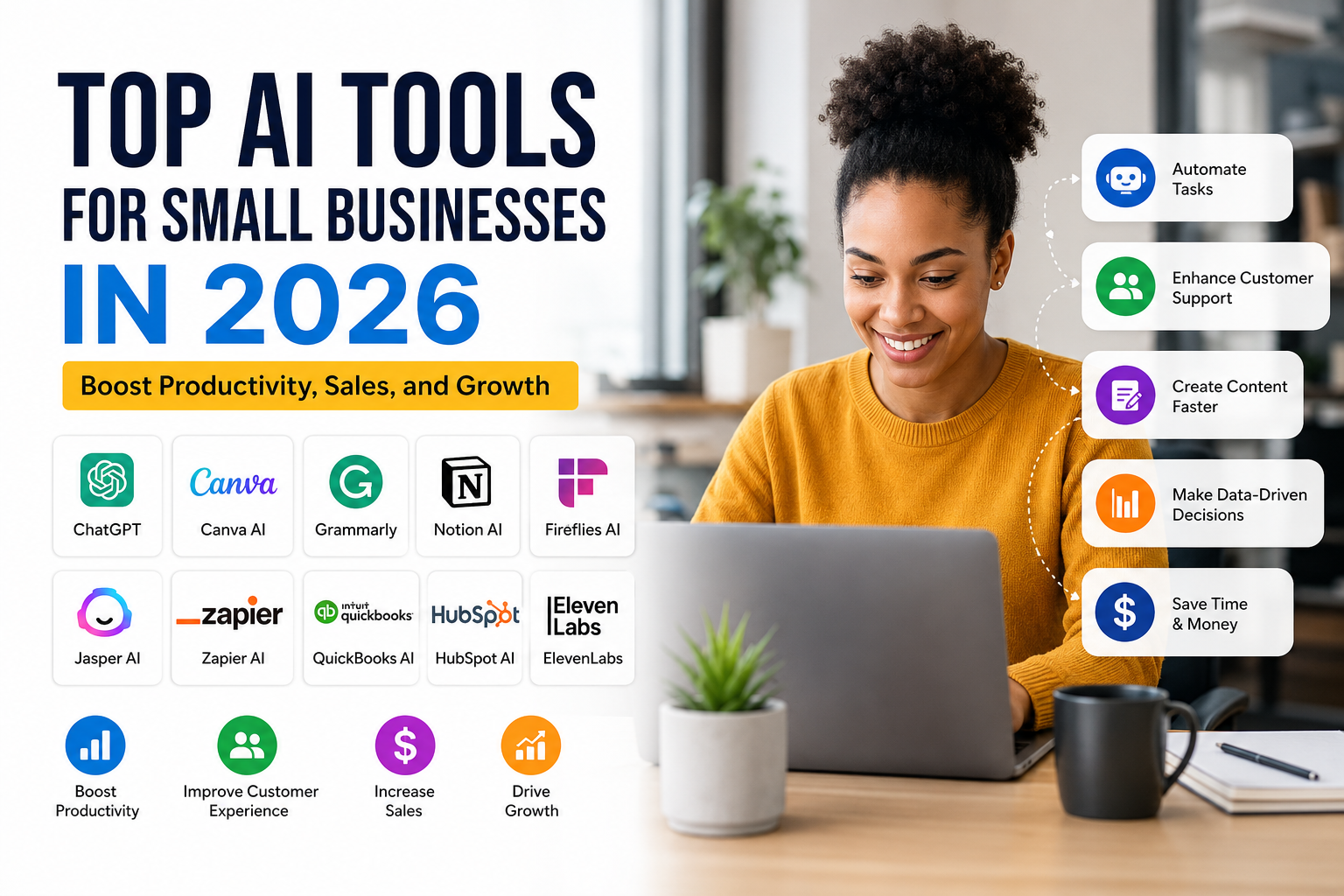
Artificial Intelligence (AI) is no longer a technology reserved for large corporations. In 2026, affordable AI-powered tools have made it possible for small businesses to automate routine tasks, improve customer service, reduce costs, and compete more effectively.
Whether you run an online store, a retail shop, a consulting firm, or a startup, AI can help you work smarter instead of harder. From generating marketing content to analyzing customer data and automating repetitive processes, AI is transforming the way businesses operate.
In this guide, we’ll explore the top AI tools every small business should consider using in 2026.
Why Small Businesses Should Use AI
Small businesses often operate with limited staff and tight budgets. AI helps by:
- Automating repetitive work
- Saving time
- Improving customer service
- Increasing productivity
- Reducing operational costs
- Making better business decisions through data analysis
- Enhancing marketing campaigns
- Improving sales conversion rates
Businesses that embrace AI early are often better positioned to respond to customer needs and market changes.
1. ChatGPT – The Ultimate AI Assistant
One of the most versatile AI tools available today is ChatGPT.
It can help small businesses:
- Write blog articles
- Draft emails
- Create social media posts
- Produce product descriptions
- Generate marketing campaigns
- Brainstorm business ideas
- Answer customer inquiries
- Summarize reports
For entrepreneurs who wear many hats, ChatGPT can significantly reduce the time spent on writing and research.
Best for: Content creation, customer communication, planning, and productivity.
2. Canva AI – Design Like a Professional
Professional graphic design used to require expensive software and specialized skills. Canva AI simplifies the process by enabling businesses to create:
- Social media graphics
- Flyers
- Posters
- Presentations
- Business cards
- Advertisements
- Website banners
Its AI-powered features can generate images, suggest layouts, and remove backgrounds with minimal effort.
Best for: Marketing materials and branding.
3. Grammarly – Improve Professional Communication
Clear communication builds trust with customers.
Grammarly uses AI to improve:
- Grammar
- Spelling
- Tone
- Clarity
- Business emails
- Reports
- Website content
It also helps ensure your writing is professional and easy to understand.
Best for: Business communication and content editing.
4. Notion AI – Smarter Project Management
Managing projects, meeting notes, and business documentation becomes much easier with Notion AI.
Features include:
- Automatic meeting summaries
- Task generation
- Document drafting
- Brainstorming ideas
- Knowledge management
It’s an excellent solution for small teams that want to stay organized.
Best for: Productivity and team collaboration.
5. Fireflies AI – Never Miss Important Meeting Details
Fireflies AI records and transcribes meetings automatically.
It can:
- Capture conversations
- Create meeting summaries
- Highlight action items
- Share notes with team members
This is especially useful for remote businesses and consultants.
Best for: Meeting management.
6. Jasper AI – Marketing Content at Scale
Jasper specializes in marketing.
Businesses use it to generate:
- Sales copy
- Product descriptions
- Facebook ads
- Google Ads
- Landing pages
- Blog posts
- Email campaigns
It helps maintain consistent messaging while saving hours of writing time.
Best for: Digital marketing.
7. Zapier AI – Automate Repetitive Work
Zapier connects thousands of business applications.
Instead of manually moving information between apps, AI-powered automation can:
- Save email attachments
- Update spreadsheets
- Send invoices
- Notify teams
- Manage leads
- Automate customer workflows
This reduces repetitive administrative work.
Best for: Business automation.
8. QuickBooks AI – Smarter Accounting
Managing finances is easier with AI-powered accounting.
QuickBooks helps businesses:
- Track expenses
- Generate invoices
- Monitor cash flow
- Categorize transactions
- Prepare financial reports
This allows business owners to spend less time on bookkeeping and more time growing their businesses.
Best for: Financial management.
9. HubSpot AI – Grow Sales Faster
HubSpot combines customer relationship management (CRM) with AI.
It assists businesses by:
- Managing leads
- Automating emails
- Tracking customer interactions
- Creating sales reports
- Improving customer relationships
Its AI tools also help generate marketing content and personalize outreach.
Best for: Sales and customer relationship management.
10. ElevenLabs – Professional AI Voice Generation
Need voiceovers for marketing videos or training materials?
ElevenLabs creates realistic AI-generated voices suitable for:
- YouTube videos
- Product demos
- Podcasts
- Customer service messages
- E-learning content
It helps businesses produce professional audio without hiring voice actors.
Best for: Audio content creation.
How AI Can Help Different Types of Small Businesses
Retail Stores
AI can:
- Forecast inventory
- Improve customer support
- Personalize promotions
- Analyze buying trends
Online Shops
AI helps with:
- Product recommendations
- Automated customer support
- Order tracking
- Marketing automation
Consultants
Consultants can use AI for:
- Proposal writing
- Research
- Presentation preparation
- Client communication
Restaurants
Restaurants benefit from AI through:
- Reservation management
- Demand forecasting
- Marketing campaigns
- Customer feedback analysis
Tips for Choosing the Right AI Tool
Before investing in AI software, consider:
- Your business needs
- Ease of use
- Integration with existing systems
- Data security
- Pricing
- Customer support
- Scalability as your business grows
Starting with one or two tools and expanding gradually is often more practical than adopting many platforms at once.
The Future of AI for Small Businesses
AI technology is evolving rapidly. Future tools are expected to offer even more advanced capabilities, including autonomous AI agents that can manage multi-step business tasks, improved personalization, and deeper integration across software platforms.
Small businesses that adopt AI thoughtfully can improve efficiency, enhance customer experiences, and stay competitive in an increasingly digital marketplace.
Final Thoughts
Artificial Intelligence is becoming an essential business tool rather than a luxury. Whether you need help creating marketing content, managing finances, automating workflows, or improving customer service, there are AI solutions designed for businesses of every size.
The best approach is to identify your biggest operational challenges and choose AI tools that address those specific needs. As your business grows, you can expand your AI toolkit to support additional functions.
Businesses that combine human expertise with AI-powered efficiency are likely to be better positioned for long-term success in 2026 and beyond.
Frequently Asked Questions (FAQ)
Which AI tool is best for a small business?
It depends on your needs. ChatGPT is excellent for content creation, Canva AI for design, HubSpot AI for sales and CRM, QuickBooks AI for accounting, and Zapier AI for workflow automation.
Is AI expensive for small businesses?
Not necessarily. Many AI tools offer free plans or affordable subscriptions, making them accessible to startups and small businesses.
Can AI replace employees?
AI is best viewed as a productivity tool that assists employees by automating repetitive tasks, allowing people to focus on creative, strategic, and customer-facing work.
What is the easiest AI tool to start with?
Many businesses begin with ChatGPT for writing and research or Canva AI for creating marketing materials because both are user-friendly and require little technical expertise.
