

Predictive AI can help startups identify customers at risk of leaving, forecast demand, prioritize sales leads and detect potential revenue problems.
But there is an important question founders should answer before buying an AI tool or building a prediction model:
What decision will this prediction actually change?
That question can determine whether predictive AI becomes a useful business tool or simply another dashboard that employees occasionally check.
For startups operating with limited budgets, small teams and incomplete data, this distinction matters even more. A sophisticated prediction is not automatically valuable. Its value comes from what the business does differently after receiving it.
What Is Predictive AI?
Predictive AI refers to systems that use historical and current data to estimate what may happen in the future.
A startup could use predictive AI to estimate:
- Which customers might churn
- Which leads are more likely to convert
- Which products may experience higher demand
- Which invoices may become overdue
- Which users may stop using an application
- Which accounts may need attention before renewal
- Which transactions could require additional review
The output might appear as a probability, score, forecast, alert or classification.
For example, a customer could receive a 78% churn-risk score.
But the number itself does not solve the business problem.
The important question is what happens next.
If the customer-success team does nothing differently, the prediction may have little practical value.
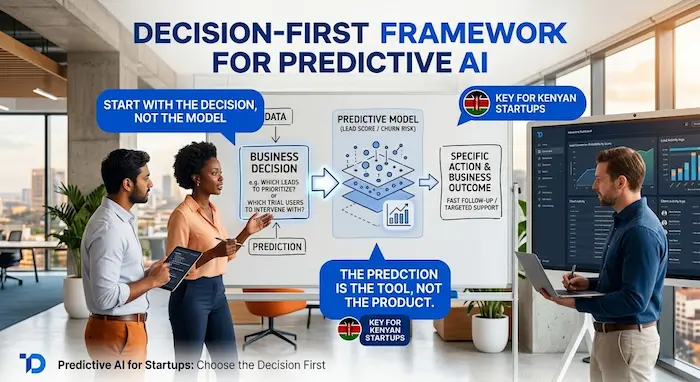
Start With the Decision, Not the Model
Many companies approach AI from the technology side.
The conversation might begin with:
Which AI platform should we use?
Or:
Which machine-learning model should we train?
Another team may start by asking what data it already has.
Those questions can eventually become important. But they should come after the business decision has been identified.
A better starting point is:
What decision do we want to improve?
For example:
We want to identify trial users who are unlikely to activate so that our team can contact them before they abandon the product.
That is more useful than simply saying:
We want to predict customer churn.
The first statement connects the prediction to a workflow.
The second describes a technical capability without explaining what the company will do with it.
Example: Using Predictive AI to Reduce Customer Churn
Imagine a Kenyan SaaS startup serving small businesses.
The company notices that some customers stop paying after several months.
Management decides to introduce a predictive AI system that identifies accounts at risk of cancelling.
The system examines information such as:
- Login frequency
- Number of active users
- Feature usage
- Customer-support interactions
- Subscription history
- Payment behaviour
- Time since the last major activity
It then assigns each account a risk score.
But what happens after the score is generated?
There are several possibilities.
Option 1: Customer-success follow-up
Accounts above a certain risk threshold could be assigned to a customer-success representative.
The representative could contact the customer and ask whether they are experiencing problems.
Option 2: Product intervention
If the risk is connected to low feature usage, the startup could send educational material or recommend specific features.
Option 3: Human review
High-risk accounts could be reviewed before an employee contacts the customer.
Option 4: No action
The prediction could simply appear on an internal dashboard.
The first three approaches create an operational response.
The fourth may create information without action.
That distinction is central to predictive AI.
The Prediction Is Not the Product
A prediction is only one part of a larger business process.
A useful way to think about it is:
Data → Prediction → Decision → Action → Outcome
For example:
Customer activity → Churn prediction → Identify account for intervention → Customer-success call → Measure retention
If the process stops at the prediction, the business may never capture the value of the technology.
This is particularly important for startups because teams are often small.
A founder may be handling sales, customer support, operations and product decisions at the same time. Adding another AI dashboard does not necessarily improve the business.
The system needs to fit into the workflow that already exists.
Kenya Example: Predicting Which Leads Need Faster Follow-Up
Consider a Kenyan B2B startup selling software to businesses.
The company receives leads through:
- Its website
- Events
- Referrals
- Digital advertising
The startup wants to use predictive AI to determine which leads are most likely to become paying customers.
That sounds reasonable.
But the more useful question is:
What happens when the system identifies a high-value lead?
The company might decide that high-priority leads should:
- Receive a response within 10 minutes.
- Be assigned to a senior salesperson.
- Receive a product demonstration.
- Get a follow-up call within 24 hours.
- Enter a specific sales sequence.
Lower-priority leads could enter a less intensive automated follow-up process.
Now the prediction has a defined purpose.
The startup is not simply predicting conversion.
It is changing how sales resources are allocated.
A Simple Framework for Defining the Decision
Before implementing predictive AI, write down three possible outcomes.
If the prediction is high
What will we do?
For example:
If churn risk is high, customer success will contact the account within one business day.
If the prediction is low
What will we do differently?
For example:
If churn risk is low, the account remains in the standard customer-success workflow.
If the system is uncertain
Who makes the final decision?
For example:
If the prediction falls within an uncertain range, a customer-success manager reviews the account manually.
This creates a practical decision framework before any model is deployed.
When You May Not Need Predictive AI
One of the most useful outcomes of this exercise is discovering that AI may not be necessary.
Suppose a startup wants to identify customers who need follow-up.
It might discover that almost every customer who has not logged in for 30 days needs attention.
In that case, a simple rule could be enough:
If a customer has not logged in for 30 days, trigger a follow-up.
There may be no reason to build a complicated predictive system.
Similarly, a sales team might discover that leads from a particular source consistently require faster follow-up.
A simple routing rule could solve the problem.
Predictive AI becomes more useful when the underlying situation is complicated enough that straightforward rules cannot capture the relevant patterns.
The goal should not be to use AI because AI is available.
The goal should be to improve a business decision.
The Decision Should Also Determine the Data You Collect
Starting with the decision can prevent startups from collecting unnecessary data.
Consider a company trying to predict which free-trial users are likely to become paying customers.
Instead of collecting every possible data point, the team can focus on information related to the decision.
Potentially useful signals could include:
- Time from registration to first action
- Number of sessions
- Features used
- Number of team members invited
- Frequency of product usage
- Trial duration
- Support requests
- Account type
- Previous interactions
The exact variables will depend on the product and business model.
The important point is that the decision determines what data matters.
Without that connection, startups can end up with large datasets that do not answer useful business questions.
Predictive AI and Kenyan Small Businesses
This approach is not limited to venture-backed technology companies.
Kenyan SMEs can also encounter decisions where prediction could eventually become useful.
A retailer, for example, might want to estimate which products are likely to sell faster during particular periods.
A digital lender might assess repayment risk.
An e-commerce business might estimate which customers are likely to make another purchase.
A logistics company could estimate delivery demand.
A subscription business could identify customers who may not renew.
However, the size of the business changes the practical requirements.
A small company may not need a sophisticated machine-learning infrastructure.
It may first need:
- Clean records
- Consistent customer information
- Reliable sales data
- Clearly defined workflows
- Basic reporting
- Consistent processes
AI cannot compensate for every underlying operational problem.
Start With One Narrow Pilot
Startups do not necessarily need to deploy predictive AI across the entire company.
A narrow pilot can be easier to measure.
For example, a startup could choose one decision:
Which trial users should receive a personal check-in?
The company could run the pilot for a defined period and track:
- Number of users identified
- Number contacted
- Response rate
- Activation rate
- Conversion rate
- Time spent by employees
- Revenue generated
- False positives
- Customers missed by the system
This creates a much clearer evaluation.
The question becomes:
Did the prediction help the company make a better decision?
rather than:
Does our AI dashboard look sophisticated?
Measure the Business Outcome, Not Just Model Accuracy
Technical metrics can be useful.
A data team might measure:
- Accuracy
- Precision
- Recall
- F1 score
- False-positive rate
- False-negative rate
But business teams should also ask different questions.
Did the system:
- Increase conversions?
- Reduce customer churn?
- Reduce response time?
- Improve inventory planning?
- Save employee time?
- Reduce unnecessary follow-ups?
- Increase revenue?
- Reduce avoidable losses?
A model can perform well statistically while producing little business value.
For example, a model may accurately identify customers who are already obviously inactive.
If employees already know which customers are inactive, the prediction may not add much value.
Human Review Still Matters
Predictive AI should not automatically become the final decision-maker for every business process.
There are situations where human review remains important.
A system could flag an account as risky, but an employee may know something the data does not capture.
For example, a customer could have reduced activity because they are temporarily closed for renovations.
A sales lead could appear inactive because the decision-maker is travelling.
A retailer’s unusual sales pattern could be caused by a temporary local event.
The model sees patterns in available data.
People may have additional context.
That is why some workflows should include a human-review stage, especially when the consequences of a wrong decision are significant.
What Startups Should Ask Before Buying a Predictive AI Tool
Before signing up for a predictive AI platform, founders can ask:
1. What decision will the system change?
Write the answer in one sentence.
2. Who will act on the prediction?
Identify the person or team responsible.
3. What happens when the prediction is wrong?
Understand the cost of false positives and false negatives.
4. What data does the system require?
Check whether the business actually has reliable access to that data.
5. Is a simpler rule sufficient?
Do not assume machine learning is necessary.
6. How will success be measured?
Define the business outcome before launching the system.
7. Can the prediction fit into an existing workflow?
A tool that requires employees to constantly check another dashboard may struggle to become part of everyday operations.
Predictive AI Should Fit the Workflow
The best starting point for many startups may not be a large AI implementation.
It may be one clearly defined operational problem.
For example:
Problem: Trial users abandon the product.
Decision: Which users should receive proactive support?
Prediction: Estimate activation risk.
Action: Contact high-risk users.
Measurement: Compare activation and conversion rates.
That sequence creates a direct connection between technology and business results.
Without the sequence, predictive AI can become another layer of complexity.
Frequently Asked Questions
What is predictive AI?
Predictive AI uses data and statistical or machine-learning techniques to estimate what may happen in the future. Businesses can use it for tasks such as forecasting demand, identifying potential churn and prioritizing sales leads.
Should startups use predictive AI?
Not every startup needs predictive AI. A startup should first identify a business decision that could improve through prediction and determine whether the available data and workflow can support it.
What is the first question to ask before using predictive AI?
A useful starting question is: What decision should this prediction change?
Does predictive AI always require machine learning?
No. Some business problems can be handled effectively with simple rules, thresholds or conventional analytics. Machine learning becomes more useful when patterns are complex and sufficient quality data is available.
What data does predictive AI need?
The required data depends on the prediction. A churn model may use product activity, subscription history and customer interactions, while a demand-forecasting system may use sales history, inventory and seasonal patterns.
Can small Kenyan businesses use predictive AI?
Yes, but the appropriate approach depends on the business, data quality, budget and decision being addressed. Small businesses may benefit from starting with a narrow use case rather than deploying a large AI system.
How should a startup measure predictive AI?
It should measure both model performance and business outcomes. Depending on the use case, relevant outcomes could include higher conversion, lower churn, faster response times, reduced costs or improved forecasting.
Conclusion
Make the Decision Clear Before Making the Prediction
Predictive AI can become a powerful tool for startups, but the prediction itself is not the end goal.
The real value comes from what happens after the prediction.
A startup should be able to explain:
If the prediction is high, we will do X.
If the prediction is low, we will do Y.
If the system is uncertain, a human will review it.
That simple framework can prevent companies from spending money on technology that does not solve a clearly defined problem.
It can also improve data collection, make pilots easier to measure and connect AI projects to actual business outcomes.
For startups in Kenya and elsewhere, the lesson is straightforward:
Before asking which predictive AI tool to use, decide which business decision you want it to improve.
The model comes later. The decision comes first.
