
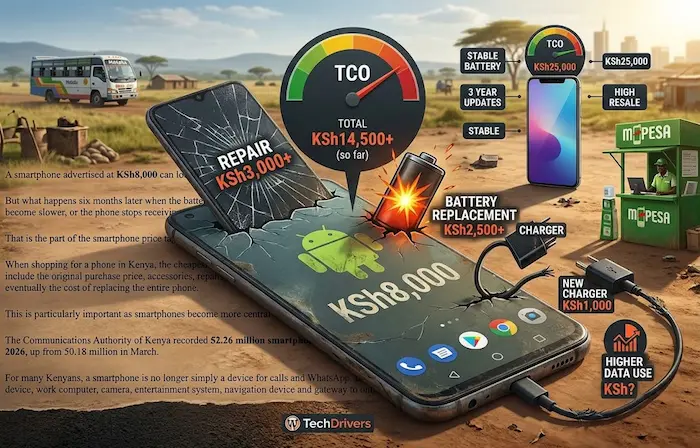

A smartphone advertised at KSh8,000 can look like a bargain.
But what happens six months later when the battery starts struggling, storage fills up, the charger needs replacing, apps become slower, or the phone stops receiving important software updates?
That is the part of the smartphone price tag many buyers do not calculate.
When shopping for a phone in Kenya, the cheapest device is not automatically the cheapest device to own. The real cost can include the original purchase price, accessories, repairs, battery replacement, software support, mobile-data usage and eventually the cost of replacing the entire phone.
This is particularly important as smartphones become more central to everyday life in Kenya.
The Communications Authority of Kenya recorded 52.26 million smartphones connected to mobile networks by June 2026, up from 50.18 million in March.
For many Kenyans, a smartphone is no longer simply a device for calls and WhatsApp. It can be a banking tool, M-PESA device, work computer, camera, entertainment system, navigation device and gateway to online services.
That makes the question bigger than:
“How much does this phone cost?”
The better question is:
“How much will this phone cost me to own?”
What Is the Total Cost of Owning a Smartphone?
The total cost of ownership (TCO) is the amount you spend on a device throughout the period you use it.
A simple calculation is:
Total ownership cost = purchase price + accessories + repairs + battery replacement + other maintenance − resale value
This does not mean every phone will require all of these expenses.
The point is to look beyond the price displayed in a shop or online listing.
For example, a KSh10,000 phone that lasts three years with minimal additional spending could potentially be cheaper to own than a KSh8,000 phone that needs a battery replacement, new charger and eventually an early replacement.
1. The Battery Can Change the Economics
Battery health is one of the biggest hidden costs of smartphone ownership.
Lithium-ion batteries naturally lose capacity as they age.
A phone that comfortably lasts a full day when new may eventually require charging much more frequently.
You might start noticing:
- Faster battery percentage drops
- More frequent charging
- Unexpected shutdowns
- Longer charging times
- Reduced performance in some situations
- The need for a battery replacement
The original phone price does not tell you how much the battery will cost to replace.
Before buying a budget phone, check whether replacement batteries are readily available in Kenya and whether authorised or reputable repair options exist.
A phone with an inexpensive battery replacement can be easier to maintain than a device whose parts are difficult to find.
2. Cheap Phones Can Become Expensive When They Need Repairs
A cracked screen is a good example.
Imagine buying a phone for KSh9,000.
A few months later, the screen breaks.
If a replacement screen and labour cost several thousand shillings, you have to ask whether repairing the phone makes financial sense.
The same applies to:
- Charging ports
- Batteries
- Speakers
- Cameras
- Buttons
- Back panels
- Motherboards
- Fingerprint sensors
Repair costs vary significantly by model, part availability and repair centre.
That is why buyers should research repairability and parts availability before buying, rather than waiting until something breaks.
3. The Cheapest Phone May Have Shorter Software Support
This is one of the costs that is easiest to overlook.
A smartphone is not just its processor, camera and screen.
It also depends on software.
Security updates help manufacturers address vulnerabilities, while operating-system updates can introduce new features, compatibility improvements and other changes.
Google’s Android Enterprise Recommended requirements show why software-support transparency matters: manufacturers are expected to publish information about guaranteed security-update periods and supported Android OS upgrades for qualifying devices.
The important lesson for consumers is simple:
Ask how long the phone will receive updates before buying it.
Two phones with similar prices and specifications can have very different support periods.
4. An Old Phone Can Become a Security Problem
Software support is not just about getting the newest Android version.
Security matters.
Your phone may contain:
- Mobile-banking applications
- M-PESA information
- Email accounts
- Social-media accounts
- Photos
- Documents
- Password managers
- Work information
If a device reaches the end of its security-support period, the risk profile changes.
That does not automatically mean the phone becomes unusable the next day.
But if you intend to keep a phone for several years, the manufacturer’s update commitment should be part of your buying decision.
5. Storage Can Become an Unexpected Expense
A phone with 32GB or 64GB of storage may look sufficient when you first buy it.
Then you install:
- TikTok
- YouTube
- Banking apps
- M-PESA-related applications
- Games
- Work apps
Add photographs, videos, downloaded music, documents and WhatsApp media.
Suddenly the storage is almost full.
A full phone can become frustrating because you have to constantly delete files or uninstall applications.
If the phone supports a microSD card, that can provide additional flexibility.
If it does not, buying a higher-storage version at the beginning may be cheaper than replacing the phone later.
6. RAM Matters More Than the Marketing Number
Budget phones often compete heavily on specifications.
You may see advertisements highlighting:
“8GB RAM!”
But buyers should check exactly what that number means.
Some manufacturers use virtual or extended memory features that borrow storage to supplement physical RAM.
That is not the same as having the same amount of physical RAM.
For everyday use, the combination of:
- Processor
- Physical RAM
- Storage type
- Software optimisation
- Storage capacity
matters more than one number on the box.
A phone that is responsive today but struggles badly after installing your everyday applications may not provide good long-term value.
7. Performance Can Become a Hidden Cost
Budget processors can be perfectly adequate for basic use.
But smartphone applications do not remain static.
Apps receive updates.
Websites become heavier.
Games become more demanding.
Operating systems evolve.
Artificial-intelligence features are also increasingly appearing in mobile applications.
A phone that feels fast when new may become less comfortable to use after several years.
This does not mean buyers need an expensive flagship.
It means you should leave some performance headroom if you intend to keep the phone for a long time.
8. Accessories Add to the Real Price
The advertised price may cover only the phone.
You may then need:
- Charger
- USB cable
- Protective case
- Screen protector
- Memory card
- Power bank
- Earphones or earbuds
If the phone does not include a compatible charger, that can immediately increase the amount you spend.
A KSh10,000 phone may therefore become a KSh11,000 or KSh12,000 setup before you have even started using it.
That difference matters when comparing several phones.
9. The Charger Can Become a Recurring Cost
A poor-quality or damaged charger can create problems ranging from slow charging to excessive heat.
That is why buyers should not automatically choose the cheapest replacement charger available.
Look for a charger that is compatible with the phone and comes from a reputable source.
This also connects with TechDrivers’ recent guide:
Why Your Phone Gets Hot While Charging: Causes, Fixes and Safety Tips
The article explains how chargers, batteries, fast charging, background apps and environmental heat can affect smartphone temperature.
10. Warranty and After-Sales Support Have a Real Value
This is particularly important in Kenya’s smartphone market.
In 2026, the Communications Authority introduced new Communications Equipment Vendor requirements requiring covered electronic communication equipment sold by licensed vendors to have at least a one-year warranty and a return policy, alongside after-sales support. Reporting on the new rules says they cover devices including mobile phones, tablets and laptops.
That gives buyers another reason to pay attention to the seller.
Ask:
- Is there a written warranty?
- Who handles repairs?
- Is the phone new or refurbished?
- Is the device officially supported?
- Will you receive a receipt?
- What happens if the device develops a fault?
The cheapest listing from an unknown seller is not necessarily the cheapest deal once after-sales support is considered.
11. Refurbished and Grey-Market Phones Need Extra Attention
Kenya has a large market for used, refurbished and imported smartphones.
That can provide buyers with more choices at lower prices.
But the lower price can come with uncertainty.
A phone may have:
- A replaced battery
- A third-party screen
- Previous water damage
- An unknown repair history
- Limited warranty
- Regional software differences
- Different network-band support
If you are considering a used or refurbished phone, don’t judge it only by its specifications.
TechDrivers’ guide How to Choose the Best Smartphone in Kenya in 2026 covers what to check when buying new, used or refurbished smartphones.
12. Network Compatibility Can Affect the Value
A phone can have an impressive specification sheet and still be the wrong device for your needs if its network compatibility is limited.
Before buying, check:
- 4G support
- 5G support if needed
- Supported frequency bands
- Dual-SIM functionality
- VoLTE support where relevant
- Compatibility with your preferred Kenyan network
Kenya’s mobile market is increasingly data-driven, with 4G and 5G networks playing a larger role in connectivity.
The Communications Authority has reported continued growth in smartphone and broadband adoption.
A phone that lacks the connectivity you need can force you to replace it earlier.
13. Camera Megapixels Can Hide the Bigger Picture
A budget phone might advertise a 108MP camera while another model has a 50MP camera.
That does not automatically make the 108MP phone better.
Image quality also depends on:
- Sensor size
- Image processing
- Lens quality
- Stabilisation
- HDR
- Low-light performance
- Camera software
- Video capabilities
If you buy based only on megapixels, you may spend money on a specification that does not significantly improve your actual photographs.
14. Resale Value Changes the Real Cost
Suppose you buy a phone for KSh15,000.
Three years later, you sell it for KSh3,000.
Your effective cost before repairs and accessories was:
KSh15,000 − KSh3,000 = KSh12,000
Now compare that with another phone bought for KSh20,000 and sold for KSh8,000.
Its effective cost would be:
KSh20,000 − KSh8,000 = KSh12,000
The second phone had a higher purchase price but the same basic ownership cost in this simplified example.
Resale value varies significantly by brand, model, condition, storage configuration and market demand.
That is why it should be considered when calculating long-term value.
A Kenya Example: KSh8,000 vs KSh15,000
Let’s look at a hypothetical comparison.
These are illustrative calculations, not claims about the actual repair costs of specific phone models.
| Cost | Phone A | Phone B |
|---|---|---|
| Purchase price | KSh8,000 | KSh15,000 |
| Charger/cable | KSh1,000 | Included |
| Case + screen protector | KSh700 | KSh700 |
| Battery replacement later | KSh2,500 | KSh0 |
| Minor repair | KSh2,000 | KSh0 |
| Resale value | -KSh1,500 | -KSh5,000 |
| Illustrative ownership cost | KSh12,700 | KSh10,700 |
The example is deliberately simplified.
Actual prices vary by phone model, retailer, repair centre, battery condition and resale demand.
But it demonstrates the point:
The phone with the lower purchase price does not necessarily have the lower ownership cost.
What Does a Cheap Smartphone Really Cost Per Year?
You can also calculate the cost annually.
Suppose:
Phone price = KSh12,000
You use it for three years and sell it for KSh3,000.
Ignoring other expenses:
(KSh12,000 − KSh3,000) ÷ 3 = KSh3,000 per year
Now imagine another phone costs KSh20,000, lasts four years and sells for KSh5,000:
(KSh20,000 − KSh5,000) ÷ 4 = KSh3,750 per year
The second phone costs more per year in this simplified calculation.
But now add battery replacements, repairs, accessories and software-support differences.
That is why TCO is a useful framework, not a single magic number.
The KSh10,000 Phone Isn’t Always a Bad Buy
It is important not to misunderstand this article.
A cheap smartphone can be an excellent purchase.
If you mainly use your phone for:
- Calls
- Mobile money
- Social media
- Light browsing
- Music
- Basic photography
you may not need a premium device.
The mistake is assuming that every cheap phone offers the same long-term value.
The right question is:
What are you getting for the money, and how long can you realistically use it?
What Should You Prioritise When Buying a Budget Phone?
Instead of chasing the biggest specification, consider these factors.
1. Battery
Look at battery capacity, charging speed and expected battery life.
2. Software support
Find out how long the manufacturer guarantees security updates and operating-system upgrades.
3. Storage
For many users, 128GB provides considerably more breathing room than 64GB.
4. RAM
Check physical RAM and don’t rely solely on virtual-memory marketing.
5. Processor
Find the exact chipset rather than judging performance from the phone’s RAM alone.
6. Repairability
Check whether batteries, screens and charging ports are available locally.
7. Warranty
Confirm the warranty period and who will handle repairs.
8. Network support
Make sure the phone works properly with your preferred Kenyan network.
9. Build quality
A slightly stronger device can potentially reduce repair expenses.
10. Resale value
Consider whether there will still be demand for the model when you eventually upgrade.
What Kenyan Buyers Should Check Before Paying
Before handing over your money, check:
Exact model: Don’t rely only on the phone’s marketing name.
RAM and storage: Confirm the exact configuration.
Network compatibility: Check 4G/5G bands where relevant.
IMEI: Verify the device identity and keep a record.
Warranty: Ask for written warranty details.
Receipt: Keep proof of purchase.
Battery: Check that the phone is behaving normally.
Charger: Confirm what is included.
Software: Check the Android version and security-patch information.
Seller: Consider the seller’s reputation and after-sales support.
TechDrivers’ 5 Smartphones Trending in Kenya Right Now and Their Latest Prices also highlights why buyers should check the exact storage configuration, warranty, network compatibility and software support rather than comparing phones based on headline prices alone.
How Kenya’s Growing Smartphone Market Changes the Equation
Kenya’s smartphone market is no longer a niche market for higher-income consumers.
The CA recorded 52.26 million smartphones connected to Kenyan networks by June 2026, representing a 4.2% increase from March.
That means affordability remains important.
But as smartphones become more central to digital life, reliability also becomes more important.
For someone who uses a phone for M-PESA, banking, work, school, social media and communication every day, replacing a faulty phone after a few months is not simply an inconvenience.
It can become an unexpected financial cost.
A Simple Smartphone Ownership Calculator
Before buying a phone, write down:
Purchase price: KSh____
Charger/accessories: KSh____
Expected repairs: KSh____
Potential battery replacement: KSh____
Expected resale value: KSh____
Expected years of use: ____ years
Then calculate:
Ownership cost = purchase price + accessories + repairs + battery costs − resale value
And:
Annual cost = ownership cost ÷ years of use
You don’t need perfect numbers.
Even rough estimates can reveal whether the cheapest phone is actually giving you the lowest long-term cost.
Frequently Asked Questions
Are cheap smartphones in Kenya worth buying?
They can be. The important factors are battery life, software support, performance, storage, network compatibility, warranty, repairability and how long you expect to use the device.
Why can a cheap phone cost more over time?
A low purchase price can be offset by repairs, battery replacement, accessories, limited storage, shorter software support or an earlier need to replace the phone.
How much should I spend on a smartphone in Kenya?
There is no universal amount. Your budget should depend on what you use the phone for and how long you expect to keep it.
Is it better to buy a more expensive phone that lasts longer?
Not automatically. A higher-priced phone can still be poor value if it does not meet your needs. Compare the expected ownership period, support, repair costs and resale value.
Does 128GB make a big difference compared with 64GB?
It can. Photos, videos, apps and offline files consume storage quickly. Buyers who keep phones for several years may benefit from choosing more storage at the beginning.
Should I buy a cheap phone with more RAM?
Don’t look at RAM alone. Check the exact processor, physical RAM, storage, software optimisation and your intended workload.
How important are software updates?
They are increasingly important because smartphones handle sensitive information such as banking, mobile-money and work accounts. Check the manufacturer’s guaranteed security-support period before buying.
Are cheap phones harder to repair?
Not necessarily. Repairability varies by model and manufacturer. However, buyers should check whether genuine or reputable replacement parts are readily available in Kenya.
Is a one-year warranty important when buying a phone in Kenya?
Yes. Kenya’s 2026 Communications Equipment Vendor requirements introduced minimum warranty and return-policy requirements for covered electronic communication equipment sold by licensed vendors. Buyers should still read the specific warranty terms and keep their receipt.
Should I buy a used smartphone instead of a cheap new phone?
It depends on the device and its condition. A used older flagship can offer strong hardware, but battery health, previous repairs, remaining software support and warranty need to be checked carefully.
How can I reduce the total cost of owning a smartphone?
Choose a device with adequate performance, good battery life, sufficient storage, long software support, available replacement parts and a reliable warranty. Protecting the phone from drops and excessive heat can also reduce avoidable repair costs.
Related TechDrivers Guides
If you’re comparing smartphone options in Kenya, these TechDrivers articles can help:
- How to Choose the Best Smartphone in Kenya in 2026: 12 Things to Check Before Buying — a broader buying checklist covering performance, battery, storage, software and used/refurbished phones.
- 5 Smartphones Trending in Kenya Right Now and Their Latest Prices — current examples across different price segments.
- Why Your Phone Gets Hot While Charging: Causes, Fixes and Safety Tips — useful for understanding charging heat, batteries and chargers.
- Kenya Now Has 52.26 Million Smartphones: What the Latest CA Data Means — the latest TechDrivers look at Kenya’s growing smartphone market.
- Samsung Galaxy S26 FE Price in Kenya, Specs and Features — an example of why software support, hardware and price should be considered together.
Editorial Note
Smartphone prices, repair costs, retailer offers and warranty terms can change.
The cost examples in this article are illustrative calculations rather than quoted repair prices for specific Kenyan phone models. Buyers should confirm the current price of the exact model, configuration, accessories, warranty and replacement parts before purchasing.
Kenya’s smartphone and connectivity figures referenced above come from Communications Authority of Kenya data. The CA’s smartphone figures represent connections/devices reported through the communications sector and should not automatically be interpreted as the number of individual Kenyan smartphone owners.
Conclusion: Don’t Buy the Price Tag
A KSh8,000 smartphone can be exactly what you need.
But the number on the price tag does not tell the whole story.
Before buying, think about the battery, software updates, storage, performance, accessories, repair costs, warranty, network compatibility and eventual resale value.
A phone that costs slightly more today may, in some circumstances, require fewer additional expenses and remain useful for longer.
And a very cheap phone can still be excellent value if it meets your needs and remains reliable.
The smartest approach is therefore not simply to ask:
“Which phone is cheapest?”
Ask:
“What will this phone cost me to own, and how long will it realistically serve me?”
That is where the real price of a smartphone begins.
