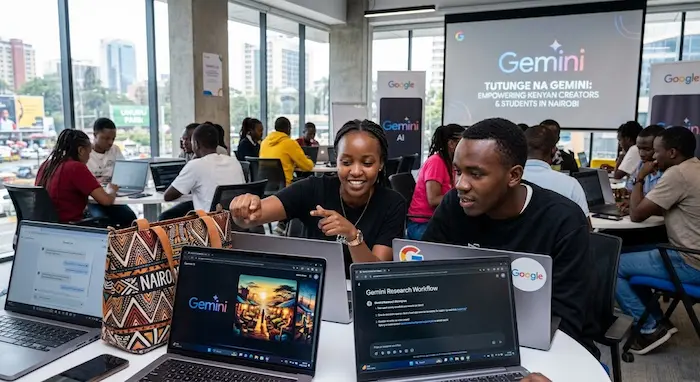

Google is giving Kenyan creators and university students hands-on exposure to Gemini AI as the technology moves deeper into content creation, research and everyday work.
Google has brought its Gemini artificial intelligence tools closer to Kenyan creators, media professionals and university students through a hands-on workshop held in Nairobi.
The workshop, known as “Tutunge na Gemini,” focused on practical ways people can use AI for brainstorming, research, writing, editing, visual creation and content planning.
Rather than presenting Gemini simply as a chatbot, the Nairobi session demonstrated how AI can become part of a wider workflow — from developing an idea to researching it, creating content and refining the final product.
For Kenyan students and creators, that shift is important because the value of generative AI is increasingly moving beyond asking a chatbot to write something.
What Google Demonstrated at the Nairobi Gemini Workshop
The Nairobi workshop gave participants an opportunity to explore several Gemini capabilities through demonstrations and practical exercises.
Google highlighted tools including Gemini Omni, Nano Banana 2, Gemini Live and Gems.
The demonstrations covered areas such as:
- Brainstorming new ideas
- Research and information synthesis
- Writing and editing
- Content planning
- Visual creation
- Product photography
- Promotional content
- Rapid prototyping
- Conversational idea development
- Creating customized AI workflows
Gemini Live was demonstrated as a way of discussing ideas conversationally, while Gems can be customized for particular tasks and workflows.
Nano Banana 2 and Gemini Omni were also highlighted for visual and creative applications.
The bigger message from the workshop was that AI can potentially support several stages of the creative process rather than being used only at the writing stage.
Google Is Targeting a Growing Kenyan AI Audience
The Nairobi event brought together digital creators, media professionals and university students.
That audience is significant because these groups are already among the people experimenting with generative AI for content, research, education and productivity.
A student, for example, may use AI to organize lecture notes or create revision questions.
A content creator may use it to brainstorm video concepts, develop scripts or generate visual ideas.
A journalist or publisher may use AI to organize research or speed up repetitive parts of the editorial workflow.
However, these applications also require users to understand the limitations of AI-generated information.
AI can help with research and drafting, but important facts still need to be checked against reliable sources before publication or academic submission.
Google AI Plus Student Offer Comes to Kenya
The workshop also highlighted Google’s Google AI Plus Student Offer for eligible university and college students.
Google announced in August that eligible students across 27 African countries could receive 12 months of Google AI Plus at no cost. The offer includes access to Gemini Omni, higher Gemini usage limits and 400GB of storage across Google Drive, Gmail and Google Photos.
Google has also introduced student-focused learning features within Gemini.
These include a student hub, study notebooks, flashcards, practice quizzes and interactive visualizations.
Study notebooks can use a student’s own learning materials to help organize topics into revision plans, while Gemini can also assist with interactive explanations and research.
For Kenyan students, this could make AI more relevant to everyday academic work — particularly when used alongside lecture notes, course materials and independent research.
What This Means for a Kenyan University Student
Consider a student studying information technology at a Kenyan university.
Instead of simply asking Gemini to “write my assignment,” the student could use AI more responsibly throughout the learning process.
For example:
Step 1: Upload or provide their own approved course material.
Step 2: Ask Gemini to identify difficult concepts.
Step 3: Create practice questions based on those concepts.
Step 4: Use the questions to test their understanding.
Step 5: Ask for explanations of areas they got wrong.
Step 6: Conduct additional research using credible sources.
The student remains responsible for understanding and producing the final academic work.
That distinction matters because AI should ideally support learning rather than simply replace it.
What This Means for Kenyan Content Creators
The same idea applies to creators.
Imagine a Kenyan YouTuber preparing a video about the rising cost of smartphones.
AI could help the creator brainstorm potential angles, organize research questions, develop a video structure and suggest visual ideas.
The creator could then independently verify prices, specifications and market information before recording.
This creates a workflow where AI assists with repetitive or time-consuming stages while the creator remains responsible for accuracy, originality and editorial judgment.
For media professionals, the same approach can apply to research, transcription, content planning and editing.
AI Is Moving From Chatbots to Workflows
Google’s Nairobi workshop also connects with a larger shift happening across the AI industry.
The first generation of consumer AI adoption was largely about asking questions.
People opened a chatbot and asked it to write an email, explain a concept, summarize a document or generate ideas.
The next stage is increasingly about connecting AI to workflows.
That could mean an AI system helping a business organize customer enquiries, prepare reports, manage repetitive tasks or identify information that needs human attention.
TechDrivers recently examined this shift in “AI Will Not Become Your Employee. It Will Change How Work Is Managed.” The article looks at why the bigger transformation may involve redesigning workflows rather than simply replacing individual employees.
Read: AI Will Not Become Your Employee. It Will Change How Work Is Managed
Kenya’s AI Skills Ecosystem Is Expanding
Google’s Nairobi workshop is not happening in isolation.
Kenya’s AI ecosystem is seeing more initiatives aimed at developing practical skills, supporting developers and introducing AI to students and businesses.
Earlier in September, TechDrivers reported on Meta and This Is Digital’s AI Academy Kenya, a programme focused on developing AI skills and supporting local developers and startups.
Read: Meta and This Is Digital Launch AI Academy in Kenya
Together, these developments point to a broader question for Kenya:
Will the country have enough people who know how to use AI effectively, not just enough people who have access to AI tools?
Access is only the starting point.
People also need to understand prompting, verification, data privacy, workflow design and responsible AI use.
AI Could Help Kenyan SMEs Too
The benefits of AI are not limited to universities and content creators.
A small Kenyan business could use AI to assist with everyday activities such as:
- Drafting customer responses
- Creating social media content
- Organizing product descriptions
- Summarizing meeting notes
- Creating marketing ideas
- Preparing internal documents
- Analyzing customer feedback
- Planning campaigns
For a small business with limited staff, saving even a few hours each week on repetitive work can be useful.
But businesses should be careful about entering confidential customer, financial or personal information into AI tools without understanding the relevant privacy and security implications.
AI Can Assist Without Replacing Human Judgment
One of the most important lessons from the growing use of AI is that faster does not automatically mean better.
A Gemini-generated answer may sound convincing while still containing an incorrect statistic or unsupported claim.
A generated image may look realistic while containing visual errors.
A summary may leave out an important detail.
A student’s AI-generated explanation may also oversimplify a difficult concept.
That is why the human role remains important.
For a Kenyan journalist, that means checking sources.
For a student, it means understanding the material.
For a business owner, it means reviewing important decisions.
For a creator, it means maintaining responsibility for what is published.
A Practical AI Workflow for Kenyan Creators
A simple workflow could look like this:
Idea → Research → AI assistance → Human verification → Creation → Editing → Publication
For example, a Tech creator covering a new smartphone could ask AI to help generate possible story angles.
The creator would then independently confirm the phone’s specifications, price and availability.
AI could help organize the information into a structure, while the journalist or creator decides what is relevant to the Kenyan audience.
The final article or video would then be reviewed before publication.
This approach allows AI to improve productivity without turning the entire editorial process over to an automated system.
Google’s Student Offer Has Important Conditions
Students considering Google’s AI Plus offer should check the eligibility requirements and terms before signing up.
Google says eligibility verification is required, and the offer is subject to its terms. The free period does not mean the subscription necessarily remains free indefinitely.
Google’s published offer states that eligible students outside the United States receive one year of Google AI Plus at no cost, with the subscription subject to the applicable offer terms.
Students should therefore check the renewal information shown when claiming the offer and understand what happens after the promotional period.
What Kenyan Students Should Use AI For
AI can be particularly useful when it helps a student understand something rather than simply produce an answer.
Useful applications include:
Revision
Students can turn their own notes into practice questions, quizzes and revision plans.
Difficult concepts
A student can ask AI to explain a complicated concept using simpler examples.
Research planning
AI can help identify questions that need to be investigated further.
Brainstorming
Students can use AI to generate possible project ideas and then evaluate which ones are realistic.
Organization
AI tools can help students organize study schedules, project tasks and deadlines.
The final responsibility for academic work, however, remains with the student.
What Kenyan Creators Should Use AI For
Creators can similarly use AI as a productivity assistant.
It can help with:
- Content calendars
- Story ideas
- Video concepts
- Draft structures
- Headline ideas
- Editing
- Repurposing content
- Visual concepts
- Research organization
But creators should avoid treating AI output as automatically accurate.
That is especially important when creating content about Kenyan prices, government policies, companies, financial products or breaking news.
Google’s Nairobi Workshop Shows Where AI Adoption Is Heading
The significance of the Tutunge na Gemini workshop is not simply that Google demonstrated another set of AI features.
It shows that AI adoption in Kenya is increasingly being discussed in terms of practical skills.
Students want to know how AI can help them learn.
Creators want to know how it can improve production.
Businesses want to know how it can reduce repetitive work.
Media organizations want to know how it can improve workflows without compromising accuracy.
That makes AI literacy increasingly important.
Frequently Asked Questions
What was the Tutunge na Gemini workshop?
Tutunge na Gemini was a hands-on Google workshop in Nairobi that introduced Kenyan creators, media professionals and university students to practical applications of Gemini AI in research, storytelling, content creation and learning.
Which Gemini tools were demonstrated?
The workshop highlighted Gemini Omni, Nano Banana 2, Gemini Live and Gems, covering areas such as visual creation, brainstorming, conversational ideation and customized workflows.
Is Google offering Gemini free to Kenyan students?
Google announced a 12-month Google AI Plus offer at no cost for eligible college and university students across 27 African countries. Eligibility and offer terms apply.
How much Google storage is included?
Google says the student offer includes 400GB of storage across Google Drive, Gmail and Google Photos.
Can Kenyan students use Gemini for assignments?
Students can use AI as a learning and research aid, but they should follow their institution’s academic-integrity rules and verify information rather than submitting unreviewed AI-generated work as their own.
Can Kenyan businesses use Gemini?
AI tools can assist businesses with tasks such as brainstorming, customer communication, content planning and document work. Businesses should consider privacy, security, accuracy and human oversight when introducing AI into important workflows.
Does AI replace the need for human editors and creators?
No. AI can assist with parts of the creative process, but humans remain important for judgment, fact-checking, originality, context and accountability.
Conclusion
Google’s Nairobi Tutunge na Gemini workshop highlights a growing shift in Kenya’s AI landscape: the conversation is moving from simply having access to AI tools toward learning how to use them effectively.
For students, Gemini can support research, revision and learning.
For creators, it can assist with brainstorming, production and editing.
For businesses, AI can become part of broader workflows that reduce repetitive work.
But the technology works best when people remain responsible for the final decisions.
As AI becomes more accessible in Kenya, the advantage may not belong simply to those who use AI the most.
It may belong to those who understand where AI is useful, where it needs human oversight and how to turn it into a practical tool rather than a shortcut.
