
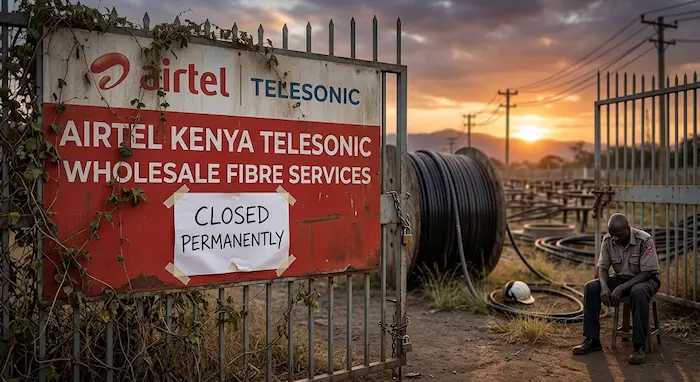

Airtel Africa is winding up its Kenyan wholesale fibre and internet subsidiary, Airtel Kenya Telesonic Limited, after about two years of operation in a market where demand for fixed internet continued to grow.
The company reported zero revenue in both 2024 and 2025, while its net loss increased to KSh16.1 million in 2025, from KSh2.9 million a year earlier.
Airtel says the decision to close the business followed a combination of strategic, operational and commercial considerations.
The development is notable because Kenya’s fibre market was expanding during the same period, raising questions about the challenges involved in building a profitable wholesale connectivity business in an increasingly competitive market.
What Is Airtel Kenya Telesonic?
Airtel Kenya Telesonic was established as Airtel Africa’s wholesale connectivity business in Kenya.
Unlike a consumer-facing broadband service that sells internet connections directly to households, a wholesale fibre business provides connectivity infrastructure and services to larger customers such as enterprises, governments, internet service providers and cloud companies.
Across Airtel Africa’s operations, Telesonic is part of the group’s broader wholesale connectivity strategy, which includes terrestrial fibre infrastructure and international connectivity.
In Kenya, the company operated under a Network Facilities Provider Tier 2 (NFPT2) licence issued by the Communications Authority of Kenya.
The business was therefore positioned to participate in Kenya’s growing demand for high-capacity connectivity.
Telesonic Reported Zero Revenue
The most striking part of the company’s financial performance is that Airtel Kenya Telesonic did not report revenue during either of the two years covered by its financial statements.
According to financial information reported from the company’s accounts, Telesonic recorded:
| Financial year | Revenue | Net loss |
|---|---|---|
| 2024 | KSh0 | KSh2.9 million |
| 2025 | KSh0 | KSh16.1 million |
The company’s accumulated losses reached approximately KSh19.08 million by the end of 2025.
The 2025 financial statements were prepared on a liquidation basis after the decision was made to wind up the company.
The figures show that Telesonic incurred costs without establishing a revenue-generating operation during its short period in Kenya.
Why Is Airtel Closing Telesonic?
Airtel’s parent company, Bharti Airtel, has not identified one specific reason for the shutdown.
Instead, the company said the decision resulted from a combination of strategic, operational and commercial considerations.
Bharti Airtel also concluded that the Kenyan subsidiary could not continue as a going concern.
That distinction is important. The available financial information shows the business recorded no revenue, but it does not establish that one particular factor alone caused the failure.
Competition, operating costs, regulatory requirements and the challenge of acquiring wholesale customers can all affect the economics of a fibre infrastructure business, but Airtel has publicly attributed the decision to the broader combination of strategic, operational and commercial factors.
Airtel Surrendered Its Fibre License
The shutdown process involved the surrender of Telesonic’s Network Facilities Provider Tier 2 license.
The company notified the Communications Authority of Kenya of its intention to surrender the license toward the end of 2025.
Telesonic subsequently submitted the original license booklet to the regulator on February 6, 2026, according to reports based on the company’s filings.
The Communications Authority approved the shutdown, while the company is undergoing the remaining regulatory and corporate procedures required to complete the winding-up process.
The Registrar of Companies is expected to remove the company from the register by December 2026.
The NFPT2 license had a 15-year term and cost KSh15 million. Telesonic also incurred about KSh1.2 million in license and regulatory fees during 2025.
Kenya’s Fibre Market Was Growing
Telesonic’s closure comes at an interesting time for Kenya’s internet market.
Communications Authority of Kenya data shows that fibre-optic subscriptions increased from approximately 1.1 million in December 2024 to about 1.4 million in December 2025.
Other reporting based on CA data puts the December 2025 figure at nearly 1.38 million, reflecting continued growth in fixed broadband connections.
The growth has been supported by increasing demand for reliable internet for activities such as remote work, education, entertainment, e-commerce and business operations.
This means Telesonic’s closure should not be interpreted as evidence that demand for fibre in Kenya is disappearing.
Instead, its experience highlights the difference between market growth and the ability of an individual operator to turn that demand into revenue.
Who Dominates Kenya’s Fibre Market?
Kenya’s fixed broadband market already has several established operators.
According to Communications Authority data reported by Business Daily, Safaricom accounted for 35.4% of fibre-optic subscriptions as of December 2025, followed by Jamii Telecommunications with 19.5% and Wananchi Group with 10.4%.
The broader connectivity market also includes operators such as Liquid Intelligent Technologies, SEACOM and Bayobab.
For a new wholesale operator, competing in such a market requires more than access to fibre infrastructure.
It also requires customers, network utilisation, competitive pricing, reliable service and sufficient scale to cover operating and regulatory costs.
Telesonic’s Challenge Was Different From Consumer Fibre
It is easy to look at the growth in household fibre connections and assume that every fibre-related business should benefit from that growth.
Wholesale connectivity works differently.
A company such as Telesonic is primarily targeting organisations that require high-capacity connectivity rather than selling individual home broadband subscriptions.
A wholesale operator therefore needs to build relationships with large customers and generate enough traffic and contracts to justify its infrastructure and operating costs.
A growing number of internet users does not automatically translate into revenue for every wholesale provider.
Telesonic’s two years without reported revenue illustrate that distinction.
The Shutdown Does Not Mean Airtel Is Leaving Kenya
One important point for Airtel customers is that the closure of Airtel Kenya Telesonic is not the same as Airtel Africa leaving Kenya.
Telesonic was a separate legal entity focused on wholesale connectivity.
Airtel Networks Kenya continues to operate Airtel’s wider telecommunications business in the country, including its consumer and enterprise services.
The shutdown therefore relates specifically to the Telesonic wholesale business rather than Airtel’s entire Kenyan operation.
This distinction is particularly important because news of a fibre subsidiary being wound up could otherwise be interpreted as a wider withdrawal from Kenya.
What the Telesonic Shutdown Means for Kenya’s Fibre Industry
The closure provides an important case study for Kenya’s rapidly developing connectivity market.
First, fibre demand is still growing. The increase in subscriptions shows that households and businesses continue to adopt fixed broadband.
Second, market growth does not guarantee profitability for every operator. Telesonic recorded no revenue during its reported period of operation despite operating in a growing sector.
Third, competition matters. Established operators already have networks, customers, distribution channels and existing relationships with businesses and institutions.
Finally, the episode shows why telecom infrastructure investments can take time to translate into commercial returns.
For companies entering Kenya’s fibre market, having infrastructure or a regulatory licence is only part of the equation. The ability to secure customers and generate sustainable revenue is equally important.
What Happens to Airtel Kenya Telesonic Next?
The company is now progressing through the remaining steps required to complete its winding up.
The licence surrender has already been initiated, and the Communications Authority has approved the shutdown. The Registrar of Companies is expected to complete the company’s removal from the register by December 2026.
The closure will mark the end of Airtel Africa’s dedicated wholesale fibre subsidiary in Kenya after only about two years.
For the wider market, however, Kenya’s demand for fixed connectivity continues.
The key question is therefore not whether Kenya needs fibre, but which operators can convert that growing demand into sustainable businesses.
Frequently Asked Questions
Is Airtel shutting down in Kenya?
No. Airtel Kenya Telesonic is being wound up, but this is a separate wholesale fibre subsidiary. Airtel Networks Kenya continues operating its wider telecommunications business in the country.
What happened to Airtel Kenya Telesonic?
Airtel Kenya Telesonic is being wound up after reporting zero revenue in 2024 and 2025 and a net loss of KSh16.1 million in 2025.
How much did Airtel Telesonic lose in Kenya?
Telesonic reported a net loss of approximately KSh16.1 million in 2025, compared with KSh2.9 million in 2024.
Did Airtel Telesonic generate revenue?
According to financial information reported from the company’s accounts, Telesonic recorded zero revenue in both 2024 and 2025.
Does the shutdown affect Airtel Xstream Fibre customers?
The Telesonic shutdown concerns Airtel’s wholesale business and does not mean Airtel is shutting down its broader consumer telecommunications operations in Kenya.
How many fibre subscriptions does Kenya have?
Communications Authority data showed approximately 1.4 million fibre-optic subscriptions in Kenya by December 2025, up from about 1.1 million a year earlier.
Why did Airtel close Telesonic?
Airtel’s parent company said the decision followed a combination of strategic, operational and commercial considerations and concluded that the company could not continue as a going concern.
Conclusion
Airtel Kenya Telesonic’s shutdown is an unusual development in a Kenyan fibre market that continues to expand.
The company entered the wholesale connectivity market but reported no revenue during its two years of operation. Its losses increased to KSh16.1 million in 2025 before Airtel began the process of winding up the subsidiary.
At the same time, Kenya’s fibre subscriptions continued to grow.
The contrast highlights an important reality in the technology and telecommunications industry: a growing market does not automatically make every participant profitable.
For Kenya’s broadband sector, the Telesonic case will be worth watching as operators continue investing in networks while competing for customers across an increasingly connected economy.
