
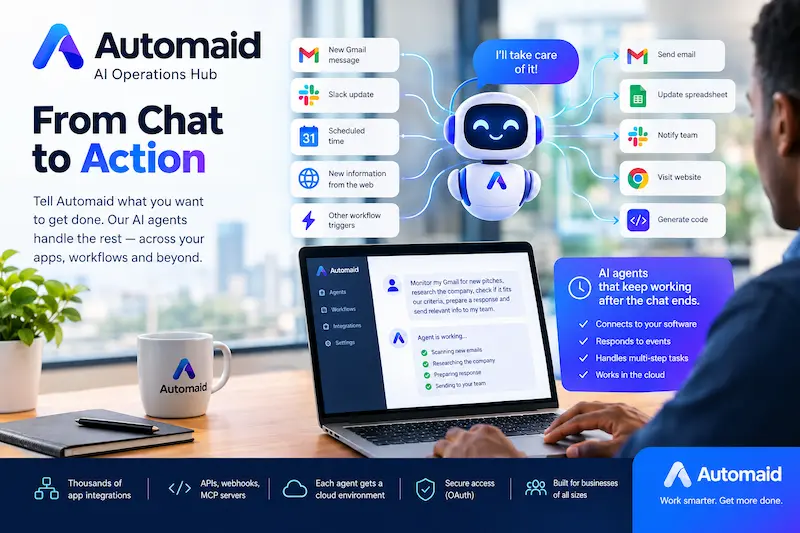

Singapore-based startup Automaid has launched an AI operations hub designed to let AI agents continue working after a user finishes a chat, with the platform able to connect to software, respond to events and carry out multi-step tasks.
Most AI assistants are good at producing an answer. The problem begins after the answer.
A user may still need to copy information into another application, send an email, update a spreadsheet, check a website, follow up with someone or repeat the same task later.
Automaid is taking a different approach.
The company has launched an AI operations platform where users can describe an intended outcome in plain English, with AI agents then determining which tools and actions are needed to complete the task.
According to Automaid, the agents can work across connected applications, generate code when necessary and continue cloud-based tasks even after the user closes their laptop.
What is Automaid?
Automaid describes itself as an AI operations hub rather than simply another chatbot.
Instead of asking an AI assistant a question and receiving an answer, users can give an agent an objective and allow it to carry out the associated work.
For example, a user could instruct an agent to monitor incoming Gmail messages, research a company mentioned in a new pitch, assess whether it fits specific criteria, prepare a response and send relevant information to another team member.
The idea is to move from AI-assisted work to AI-executed work.
Daniel Tan, founder of Automaid, says the company’s focus is what happens after an AI produces a response.
“Most AI products focus on giving a better response. We are focused on what happens after the response.”
How Automaid differs from traditional AI chatbots
A conventional chatbot generally waits for the user to start a conversation.
You ask a question, it responds. You ask another question, it responds again.
Automaid is designed around a more persistent model.
Its agents can reportedly be triggered by events such as a new Gmail message or Slack update. Once triggered, the agent can take actions across connected applications rather than simply returning text to the user.
That distinction could be important for businesses that want to automate repetitive operational tasks.
For example:
Traditional approach:
New email → employee reads it → researches the sender → writes a response → updates another system → follows up later.
Agent-based approach:
New email → AI agent detects the event → researches the sender → prepares the relevant information → performs the configured actions → continues the process when another event occurs.
The exact actions available depend on the applications, permissions and workflows connected to the platform.
Automaid aims to simplify workflow automation
Businesses have traditionally used automation platforms such as Zapier, IFTTT and n8n to connect applications and create workflows.
These platforms can be powerful, but building a complex workflow can require users to understand triggers, actions, conditions, integrations and data flows.
Automaid’s approach is to let users describe what they want in natural language.
Instead of manually defining every step, the company says its agents can determine the tools required to achieve the requested outcome.
This does not necessarily eliminate the need for configuration or oversight. Businesses still need to decide what an AI agent is allowed to access and what actions it can take.
That is particularly important when an agent is given access to email, customer information, internal systems or other sensitive business data.
Agents can respond to events
One of the more significant features highlighted by Automaid is event-driven execution.
Agents can reportedly start working when something happens rather than waiting for a user to open a chat.
Examples include:
- A new Gmail message arrives
- A Slack update is posted
- A scheduled time is reached
- Information becomes available through a connected service
- Another workflow triggers an action
This could allow businesses to automate processes that need to happen repeatedly or in response to incoming information.
For a media organisation, for example, an agent could monitor incoming pitches and help organise them for editorial review.
For a business, an agent could process incoming enquiries, gather relevant information and prepare the next action.
The important distinction is that the AI agent can potentially remain part of the workflow rather than disappearing after generating its initial response.
Automaid supports integrations and APIs
According to the company, Automaid can work with thousands of built-in application integrations.
It also supports technologies including:
- HTTP APIs
- Webhooks
- MCP servers
- Private internal tools
This gives businesses the option of connecting existing software rather than replacing their current systems.
Automaid says each agent also receives its own cloud environment for processing files and running code.
The platform uses Browser Use for website interaction where necessary.
The company says OAuth is used where supported, allowing users to authorise access through the connected service rather than handing their passwords directly to Automaid.
However, businesses should still evaluate permissions, data handling, security controls and the applications an AI agent can access before deploying it for sensitive operations.
What can Automaid be used for?
The potential applications extend beyond simple chatbot interactions.
Editorial workflows
A publication could use an agent to process incoming story pitches, research companies, summarise information and route relevant opportunities to editors.
Weekly research
An agent could be scheduled to collect developments in a particular industry and produce a summary for a team to review.
Customer operations
Businesses could potentially use agents to process incoming messages, collect information and initiate follow-up tasks.
Internal administration
Repetitive activities involving email, documents, software systems and scheduled tasks could potentially be automated.
WhatsApp workflows
Automaid says it is also developing a WhatsApp GPT and scheduler that will allow users to schedule messages, ask questions across their WhatsApp history and use WhatsApp as an action within broader workflows.
The company said this capability is expected to be available by the end of the following week.
Automaid’s founder has a background in fintech
Automaid was founded by Daniel Tan, who previously founded FindTheLoan.com, a Singapore-based digital loan marketplace.
FindTheLoan was designed to allow borrowers to submit an application and receive offers from multiple lenders through a single digital interface.
According to information supplied by the company, FindTheLoan raised an undisclosed seed round in 2025.
Tan’s previous startup experience was also focused on reducing manual processes through software. Automaid takes a similar principle into a broader range of business operations.
Instead of building software automation for one specific industry, the company is attempting to give users AI agents that can operate across the applications they already use.
Why the move toward AI agents matters
The development of AI agents reflects a broader change in how artificial intelligence is being used in business.
The first major wave of generative AI focused heavily on producing content.
Users could ask AI to write an email, summarise a document, generate code or answer a question.
The next stage is increasingly about taking action.
An AI system that can read an email is useful.
An AI system that can read the email, understand what needs to happen, use the appropriate software, complete the task and return only when human input is required could be significantly more useful.
But that also creates new challenges.
The more autonomy an AI agent has, the more important permissions, monitoring, reliability and human oversight become.
A poorly configured agent could potentially make mistakes at a much larger scale than a chatbot simply producing an incorrect answer.
What businesses should consider before using AI agents
AI automation can save time, but businesses should not hand over important processes without appropriate safeguards.
Before deploying an autonomous agent, organisations should consider:
Permissions
What systems can the agent access?
Data
What customer, financial or internal information can it process?
Human approval
Which actions require a person to review them before they are completed?
Reliability
What happens when an application is unavailable or the AI misunderstands an instruction?
Security
How are connected accounts, API credentials and business information protected?
Auditability
Can the business see what the agent did and why it took a particular action?
These questions become increasingly important as AI moves from generating information to acting on behalf of people and organisations.
What Automaid means for small businesses
The concept could be particularly interesting for small businesses that cannot afford large operations teams.
A small company may have only a few employees handling sales, customer support, research, administration and marketing.
Automating repetitive processes could allow those employees to spend more time on tasks that require human judgement.
For businesses in markets such as Kenya, where many small and growing companies operate with lean teams, AI agents could eventually become another way of reducing repetitive administrative work.
However, the value will depend on whether the technology can perform reliably in real-world workflows and whether the cost of automation is lower than the time and labour it replaces.
Automaid is not simply another chatbot
The company’s central proposition is relatively straightforward.
Instead of asking:
“What can AI tell me?”
Automaid wants users to ask:
“What can AI get done for me?”
That distinction is becoming increasingly important as the AI industry moves beyond chat interfaces.
Whether AI agents become a standard part of everyday business operations will depend on their reliability, security, integrations and ability to operate with appropriate human oversight.
For now, Automaid is betting that the next generation of AI tools will not just provide answers — they will keep working after the conversation ends.
TechDrivers reader offer
Readers interested in trying Automaid can use the TechDrivers promotion code provided with this launch.
Maximum 50 redemptions.
Offer expires 9 October 2026.
Visit Automaid to learn more and check the current terms of the offer.
Frequently asked questions
What is Automaid?
Automaid is an AI operations platform that uses AI agents to perform tasks across connected software and respond to events, according to the company.
How is Automaid different from ChatGPT?
ChatGPT is primarily designed around conversational interaction, while Automaid focuses on AI agents that can be triggered by events and perform actions across connected software.
Can Automaid work with other applications?
Automaid says it supports thousands of built-in app integrations as well as APIs, webhooks, MCP servers and private internal tools.
Can Automaid continue working after I close my laptop?
According to the company, cloud-based tasks can continue after the user’s laptop is closed.
Is Automaid useful for businesses?
The platform is designed for business processes involving repetitive tasks, software integrations, research, communication and scheduled workflows. Businesses should evaluate security, permissions and reliability before deploying autonomous agents.
Does Automaid work with WhatsApp?
The company says it is developing a WhatsApp GPT and scheduler that will allow users to schedule messages, query WhatsApp history and use WhatsApp as an action in broader workflows.
Who founded Automaid?
Automaid was founded by Daniel Tan, who previously founded Singapore-based digital loan marketplace FindTheLoan.com.
Final thoughts
The AI industry is gradually moving beyond the chatbot.
The next important question may not be whether an AI system can produce a better answer, but whether it can reliably complete the work that follows that answer.
Automaid is one of the startups pursuing that direction by combining AI agents, software integrations, event triggers and cloud-based execution.
For businesses, the opportunity is potentially significant — but so is the need for appropriate oversight.
AI agents may eventually become a normal layer between people and the software they use every day.
The challenge will be making sure they are not only autonomous, but also reliable, secure and accountable.
Editorial note: Automaid provided TechDrivers with information about its product and a promotional offer for readers. The promotional offer does not determine TechDrivers’ editorial conclusions.
