


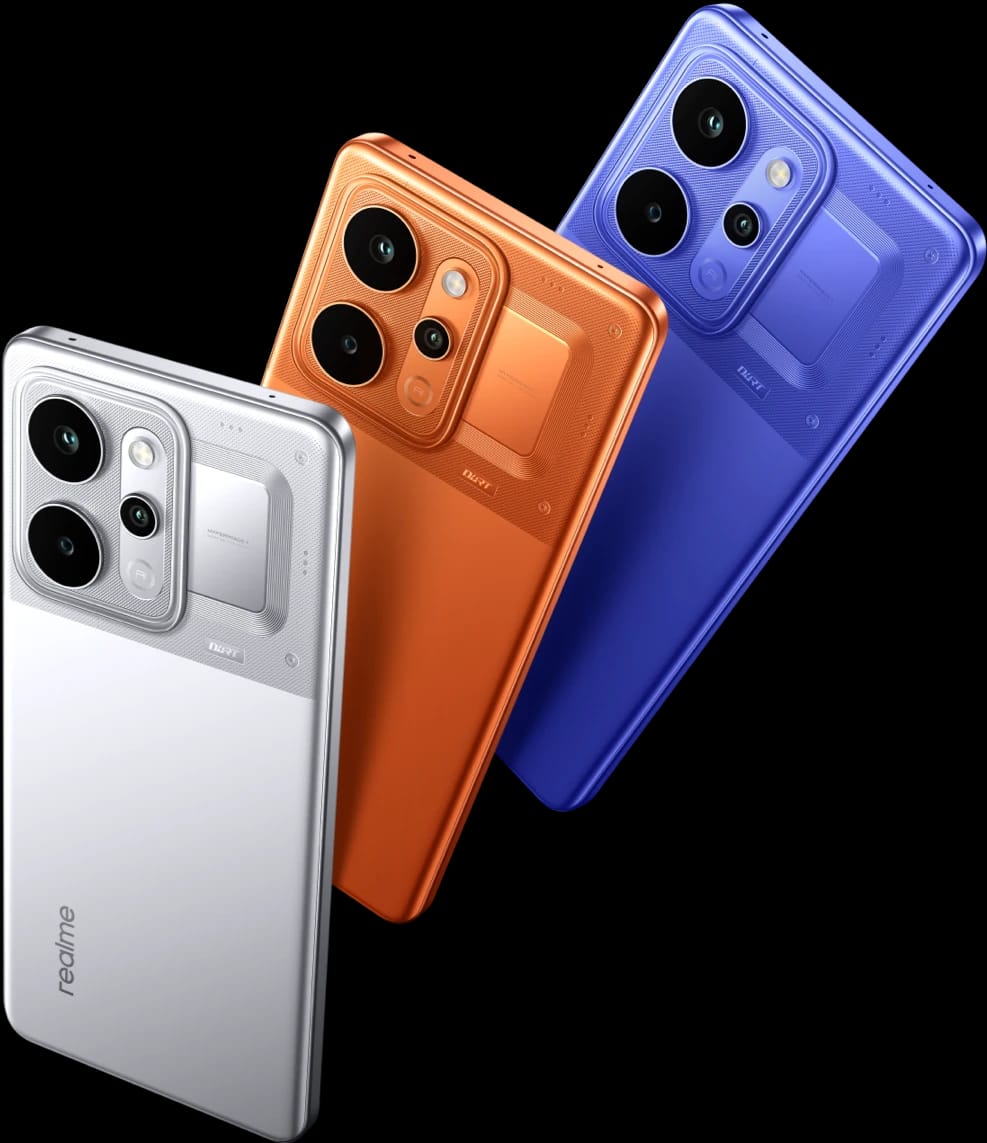
Smartphones with 7,000mAh batteries (silicon-carbon or otherwise) are now the norm in mid-range and premium segments, Realme has pulled off the unthinkable and launched a production device with a power bank-like 10,001mAh battery.
Given that smartphone chipsets today are much more power-efficient than those in older big-battery (or Max-branded) smartphones, most of them easily last beyond a day or deliver up to 1.5 days of battery life for the casual user. And so, we arrive at the question: Do you need a 10,001mAh capacity battery in a smartphone in 2026? Is it overkill? Or are you better off with something else that delivers better hardware at the same price?
Design
- Dimensions – 162.26 x 76.15 x 9.08mm
- Weight – 219g
- Durability – IP69 (dust and water)
For a phone that is designed to deliver excellent battery life, the Realme P4 Pro is shockingly slim. Silicon-carbon battery tech has helped smartphone manufacturers design slimmer smartphones with impressive standing power, but we aren’t talking about 7,000mAh batteries, but one with a 10,001mAh capacity.
Despite using silicon-carbon technology for its high-capacity battery, it’s hard to bend the laws of physics, especially since this is a mid-range device and not a high-end premium smartphone. Keeping this in mind, it’s commendable that Realme managed to package such a battery into a device that only feels slightly chunky. At 219 grams, it feels noticeably heavy but is still lighter than the iPhone 17 Pro Max, which weighs 233 grams.
5G First Impressions
As far as big-battery smartphones go, this one is surprisingly easy to handle and comfortable to hold, thanks to its curved edges and rounded corners. Its matte plastic rear panel does a decent job of rejecting fingerprints and dust, but the smooth back, combined with the matte-finished frame, makes this phone very slippery to hold without a case. So, I wouldn’t recommend holding it up above your face during late-night scrolling sessions, as it’s bound to cause injury if it slips. Also, the matte-plastic rear gets scratched quite easily.
Since most smartphones these days have moved past curved-edge displays, Realme may have adopted it (just for this model) to better package its large battery. The brand claims it has a 4D-curved screen, but from the looks of it, the underlying display is curved only on the left and right edges. The curved edges, which are also present on the rear, give the phone a slim profile even though the curved edges meet flat sides.
The rear camera module is quite flat, even though it houses three camera sensors and an LED flash. And to make it a bit special, Realme gave the upper third of its rear panel an embossed circuit board-like appearance. This weirdly looks like a wireless charging coil (obviously not functional) with ‘Dart’ branding. For those not in the know, the ‘Dart’ branding is used for Realme’s power banks and chargers. Whether it qualifies for doing that is something we explore in the battery section.
Display
- Display size – 6.79-inch, 1,280 x 2,800 pixels (full-HD+)
- Display type – AMOLED, LTPS, 144Hz (60-90-120-144Hz)
- Display protection – Corning Gorilla Glass
For a mid-range device, I was surprised to see skinny display borders on the Realme P4 Power. The 4D-curved display, as Realme calls it, is aggressively curved only on two sides. This makes the content appear immersive, but it also shows some unnecessary reflections when viewed outdoors.
The 144Hz high-refresh rate claim is gimmicky at best. Even if you set the display to run at ‘High’ refresh rate (instead of Auto), the maximum 144Hz screen refresh rate is only enabled or accessible when using the Compass and Calculator apps. Meanwhile, most software interactions will see the display stick to 120Hz, while movies stick to 90Hz (unless MEMC is enabled) and games are by default capped at 90Hz. Although you can go into App Specific settings and force the game to run at 120Hz. Regardless, no other app or software interface, apart from the two mentioned above, can access the 144Hz limit.
Refresh rate aside, the panel does get very bright, with a high-brightness mode reaching a claimed 1,800 nits and a peak brightness of 6,500 nits. The display is perfectly legible outdoors and works well when viewing HDR content, bumping up the brightness levels to display crisp and vibrant visuals where supported. The bottom-firing speaker is sufficiently loud but not very clear, and it sounds one-sided. And since there’s only one, it’s very easy to accidentally block out the sound when gripping the phone. Indeed, the audio experience should have been richer, given that such a big-battery device would have made for a long-lasting media player.
The Hyper Vision+ AI chip also offers an MEMC-based upscaling of regular 30 fps video to 120 fps, which also creates the soap opera effect. However, I noticed the chip was always struggling to keep up with most OTT videos (streaming content) I played on the device.
Software
- Android version – 16
- Software – Realme UI 7.0
- Software commitment – 3 years OS + 4 years SMR
Like most other phones launched towards the end of 2025, the Realme P4 Power thankfully runs Android 16 out of the box. Realme UI 7.0 runs smoothly and comes with all the bells and whistles found in premium devices, including AI features.
The latest version of Realme UI is very customizable. There are themes, shiny-new Liquid Glass-inspired icons, new fonts, plenty of springy animations and transitions for those who like to customize their devices.
I tried out the AI image editing features, and they work decently. As you can tell from the collage above, AI image editing isn’t perfect, as it leaves traces or outlines behind, but it’s not bad either. There is also an AI translator tool; the language options for India are limited to Hindi for now.
You do get a bunch of preinstalled apps out of the box, like Snapchat, PhonePe, Spotify, Netflix, LinkedIn, FinShell Pay and Amazon Music. If you have no use for them, you can uninstall them.
Performance
- Processor – MediaTek Dimensity 7400 Ultra, 2.6GHz, 4nm
- RAM – 8/12GB (LPDDR4X)
- Storage – 128/256GB (UFS 3.1)
Call of Duty: Mobile (CODM) defaults to Very High graphics and Max frame rate, during which it hits 55-60 fps with mostly smooth gameplay. Switching to Low graphics and Ultra frame rate gets you smoother 90 fps with a few drops. Turning on the Hyper Vision+ AI chip for MEMC-based upscaling, there is a noticeable difference between playing the game at the highest settings (Very High + Max) at around 60 fps versus the motion-enhanced 118-120 fps. It does feel smoother, but not quite as fluid as on top-end flagships. Even when playing the game with the AI Hyper Motion feature, the display’s refresh rate never touched 144Hz, as indicated by the developer tool.
The display’s touch sampling rate felt a bit slow for first-person shooter (FPS) titles, even after boosting it to ‘Ultra’ in the Game Assistant slide-out console.
| Benchmarks | Realme P4 Power | OnePlus Nord CE 5 | Motorola Edge 60 Pro |
|---|---|---|---|
| Display resolution | FHD+ | FHD+ | 1.5K |
| Chipset | Dimensity 7400 Ultra (4nm) | Dimensity 8350 Ultimate (4nm) | Dimensity 8350 Extreme (4 nm) |
| AnTuTu v10 | 10,36,008 | 14,12,373 | 14,13,220 |
| PCMark Work 3.0 | 13,707 | 13,435 | 19,111 |
| Geekbench 6 Single | 1,053 | 1,317 | 1,368 |
| Geekbench 6 Multi | 2,971 | 3,989 | 4,466 |
| Geekbench AI CPU (Quantized) | 2,077 | NA | NA |
| Geekbench AI GPU (Quantized) | 662 | NA | NA |
| 3DM Wild Life | 3,689 | Maxed Out | Maxed Out |
| 3DM Wild Life Unlimited | 3,650 | 11,038 | 11,148 |
| 3DM Steel Nomad Light | 410 | NA | NA |
While playing games, the phone did not noticeably heat up, even with the AI Hyper Motion feature enabled for enhanced frame rates. The camera app does warm up the phone even when recording basic 1080p video, but it does not get uncomfortably hot. I also noticed the video preview in the viewfinder lagging or stuttering heavily, particularly when recording 1080p 60 fps video. The phone does not offer 4K 60 fps video recording.
Cameras
- Primary camera – 50-megapixel, f/1.8, AF, OIS
- Ultra-wide camera – 8-megapixel, f/2.2
- Selfie camera – 16-megapixel f/2.4
As with most recent Realme smartphones, the brand offers two colour processing modes— Vibrant and Natural. As their tags aptly describe, one offers vibrant, punchy colours, while the other offers more toned-down, natural colours that may appear a bit faded. I stuck with the default Vibrant for this review, as there is no option to opt out of either mode.
The primary camera captures quality photos with good dynamic range and sufficient detail for a budget to mid-range device. There is a bit of detail loss due to the aggressive sharpening, which is visible once you zoom into the photos. Colors are a bit saturated, and there is a noticeable warmer tone to all the images.
In low-light scenarios or street-lit environments, the overall level of detail drops. Noise is under control and suppressed, but this reduces the sharpness, making photos appear a bit soft and textures appear like paintings when zoomed in. Given that this camera has optical image stabilisation, I expected better results. The phone cannot tackle dimly lit scenes well, and you will end up with soft images which lack detail.
The ultra-wide camera is clearly present to fill up the spec sheet. It’s low resolution sensor and shabby processing deliver images that appear soft and lack sufficient detail even in daylight.
Portrait photos from the primary camera look alright, with good detail and average edge detection. However, the selfie camera samples come out a bit soft and have fuzzy edge detection.
Video recordings come out fine in daylight, offering decent detail at 1080p and better detail at 4K resolution when shooting at 30 fps. Autofocus is sufficiently quick as well. Stabilization is decent, and the dynamic range is average, as some objects in the distance are not visible under bright conditions. In low-light or street-lit conditions, the colors remain intact, but the aggressive noise reduction results in soft videos that lack detail because of blotchy textures.
1080p 60 fps video recordings offer a higher frame rate, but I noticed some focus hopping both when shooting in daylight and low light. The phone also gets noticeably hot when doing so, and the viewfinder struggles to display the recorded video, lagging and stuttering. Thankfully, recorded footage did not show the same output. One detail to note across recording resolutions is that the view is quite cropped (by 1.5X-2X), perhaps to improve stabilisation.
Battery
- Battery capacity – 10,001mAh,
- Wired charging – 80W Ultra Charge/SuperVOOC, 55W PPS
- Reverse wired charging – 27W
- Charger in the box – Yes
As battery pack capacity increases, every percent starts to matter. In the case of the Realme P4 Power, if you have 5 percent left, you can still expect your phone to work as usual for about 1.5 hours without getting into Power Saver mode. For those concerned about longevity, Realme also claims to have used a different charging algorithm to control battery degradation, given that users won’t charge such a device as often as a regular smartphone. And this is needed as the brand claims that its massive battery should last 8 years before showing any signs of struggle (maintain at least 80 percent of its original capacity).
PCMark’s Work Battery Life test showed impressive results of 28 hours 41minutes. I noticed some abnormally generous battery times when using the phone. For casual users who don’t play games, the phone will easily last over two days of use on a single charge. For heavy users who are constantly on calls, constantly messaging and even playing games, along with camera usage, the phone will still last over 1.5 days without plugging in.
Charging speeds are pretty impressive given that the bundled 80W charger is charging an abnormally large battery. The charger fully charged the 10,001mAh battery from 0 to 31 per cent in 30 minutes and to 71 per cent in an hour, which is applause-worthy because it has charged up to 7,000mAh in this time. The phone reached a fully-charged state in 1 hour and 55 minutes.
Realme claims that its P4 Power can deliver 27W of reverse charge power and charge an iPhone 16 Pro to 50 percent in 27 minutes. I could not test this claim out since I did not have the device with me. But I did have an iPhone 15 Pro Max with a 4,441 mAh battery. The Realme P4 Power managed to charge the iPhone 15 Pro Max from 42 percent to 76 percent in 30 minutes and to 92 percent in an hour, meaning that the speed drops or alters drastically after the first 30 minutes.
Basically, the P4 Power delivered 49 percent charge (for the iPhone’s smaller battery) in the first 1 hour, while the P4 Power only lost 28 percent battery power during the same process, which isn’t bad when you really need it. Still, it is slow compared to regular power banks, which usually charge at a steady 30W or higher.
Regardless, Realme’s claim of charging an iPhone 16 Pro to 50 percent in 27 minutes is quite genuine. But do keep in mind that the iPhone 16 Pro has a rather low battery capacity of 3,582mAh. And even basic budget Android devices have 5,000mAh batteries, with most mid-range and premium devices packing 6,000 to 7,000mAh batteries. In short, you can fully charge iPhones and Android devices with batteries with up to 5,000mAh, but you will have to wait a really long time till it’s fully charged.
Conclusion
Indeed, the 10,001mAh battery inside the Realme P4 Power will feel a bit excessive in today’s day and age, given that most smartphones can deliver about 1.5 days of battery life if used smartly. However, road warriors who are always away from a charging port will be interested in buying this smartphone as it delivers what it claims to without the bulk. For a big-battery smartphone, the Realme P4 Power sure sets some new standards. It delivers the battery backup of two phones packed into one, minus the bulk of carrying a power bank with you (to charge the same phone). But battery life isn’t everything. Powerbank-like features aside, the Realme P4 Power cuts a few corners with its camera hardware and overall raw performance. And as always, the market has plenty of choices.
