


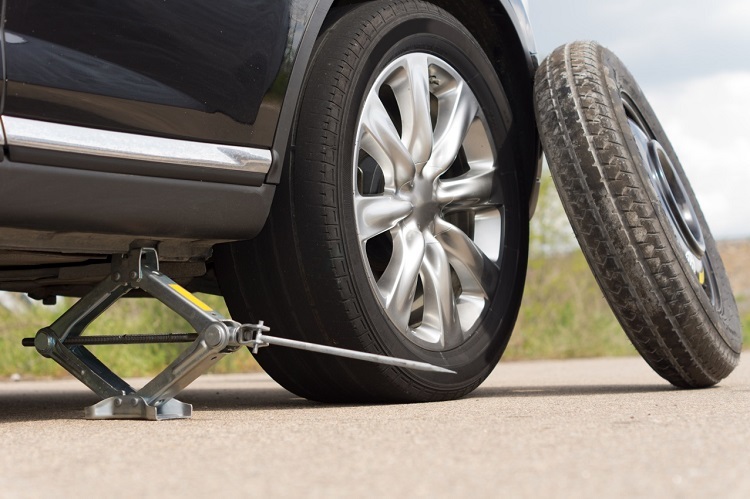
Here’s a clear, step-by-step guide on how to change a flat tire (flat tire) on a car safely. This applies to most passenger vehicles with a spare tire. Important safety notes first
- If you’re on a busy road/highway and feel unsafe, call roadside assistance instead (AA, RAC, your insurance provider, etc.).
- Never change a tire on a steep slope, soft ground (mud/grass), or very close to fast traffic.
- Always wear high-visibility clothing if possible and turn on hazard lights.
Tools you normally need (check your boot/trunk)
- Spare tire (full-size or space-saver/donut)
- Jack (scissor jack or bottle jack)
- Lug wrench / wheel brace (cross or L-shaped)
- Wheel chocks / wedges (or bricks/large stones in emergency)
- Owner’s manual (shows exact jack points)
Step-by-step instructions
- Find a safe place to stop
Pull over to a flat, solid, level surface (pavement or hard shoulder) far from traffic if possible. Avoid slopes, gravel, or soft ground. Turn on hazard lights. Put the car in Park (automatic) or 1st gear (manual) + apply handbrake / parking brake firmly. - Place wheel chocks / stabilizers
Put chocks (or bricks/rocks) behind and in front of the tire diagonally opposite the flat one (e.g. if front left is flat → chock rear right tire both sides). This prevents rolling. - Remove the spare tire and tools
Open the boot, lift the floor cover, and take out the spare tire + jack + wheel brace.
(Some cars store the spare underneath — check your manual for the release cable/bolt.) - Loosen the lug nuts (wheel nuts) while the car is still on the ground
- Remove hubcap / wheel cover if present (pry gently with the flat end of the wheel brace).
- Fit the wheel brace onto each lug nut.
- Push down firmly (or stand on the brace) to loosen them about ½–1 turn each. Do not remove them completely yet.
(Most are righty-tightly / lefty-loosely — turn anti-clockwise to loosen.)
- Locate the correct jacking point
Look in your owner’s manual or on the sill/underbody for the reinforced jacking points (usually marked with a notch or plastic cap near each wheel).
Never jack under the floor pan, suspension, or bumper — only on the designated strong points. - Jack up the car
- Place the jack under the correct jacking point.
- Wind / pump the jack until the flat tire is just off the ground (about 5–10 cm clearance).
- The car should feel stable — give it a gentle shake to test.
- Remove the lug nuts and flat tire
- Finish unscrewing the loosened lug nuts by hand (keep them safe in the hubcap or pocket).
- Pull the flat tire straight off toward you (it can be heavy — mind your back).
- Lay it flat under the car (extra safety if the jack fails).
- Mount the spare tire
- Line up the holes in the spare with the wheel studs.
- Push it on firmly until it sits flat against the hub.
- Hand-tighten the lug nuts as much as possible (in a star / crisscross pattern — not round and round).
- Lower the car and fully tighten the lug nuts
- Slowly lower the jack until the tire touches the ground.
- Remove the jack completely.
- Use the wheel brace to fully tighten the lug nuts in a star pattern (opposite nuts in sequence). Go round 2–3 times applying strong force.
- Very important: do not use foot-standing power on a space-saver spare — hand tight + reasonable force only.
- Final checks and pack up
- Stow the flat tire, jack, and tools securely.
- Check the spare tire pressure (many space-savers need 60 psi / 4.1 bar — use your gauge or filling station).
- Turn off hazards if safe.
- Drive cautiously — most space-saver spares have a max speed of 80 km/h (50 mph) and should only be used short distance.
- Get the flat tire repaired or replaced ASAP
Space-saver spares are temporary only. Head to a tire shop within 50–100 km max.
Quick star pattern for tightening (example for 5-lug wheel):
Tighten nut 1 → opposite nut 3 → nut 5 → nut 2 → nut 4 → repeat once more. Stay safe out there, Wafula! Practice once in your driveway when you’re not stressed — it makes a huge difference when it’s dark/raining. If your car has run-flat tires or no spare (just tire repair kit), the process is different.

4 Comments
I like this website.
Thank you
I like this website.
Thank you